In Emotional Perception the UK Supreme Court delivered its verdict on how the patent eligibility of computer-implemented inventions should be assessed in the UK. The decision was a tour de force, rejecting the much-maligned Aerotel approach favoured by the UK Intellectual Property Office (UKIPO), instead putting the European COMVIK (sometimes referred to as the “any hardware”) approach at the heart of UK patent practice.
However, the UK Supreme Court decision in Emotional Perception left behind a loose thread: how the COMVIK approach should be implemented in the UK as part of the assessment of inventive step. In this article I pull on this loose thread, to see where challenges might lie ahead for the UKIPO in seeking to implement the assessment of inventive step following Emotional Perception.
Emotional Perception and the assessment of inventive step
In Emotional Perception, the UK Supreme Court essentially set out that the UK should take the following approach to assessing patent eligibility:
1. Determine whether an invention is excluded from patentability as being a program for a computer by applying an "any hardware" test. If the invention is implemented on any hardware, it passes this low threshold and is not excluded simply for being a computer program.
1a. An “intermediate step” of determining whether each claimed feature contributes to, or interacts with, the technical character of the invention viewed “as a whole”. That is, to filter out features that do not contribute to the technical character, so they are excluded from the inventive step analysis.
2. Only consider the features that contribute to the technical character when assessing whether the invention involves an inventive step.
Much of the UK Supreme Court’s decision in Emotional Perception focused on steps (1) and (1a), and there has been plenty of excellent coverage of these steps in published commentary.
However, the UK Supreme Court said relatively little about the all-important step (2), which pertains to the question of how inventive step should be assessed in view of Emotional Perception.
The UKIPO, in its submissions ahead of the Emotional Perception decision, argued that combining the COMVIK approach with the UK’s existing Pozzoli test for the assessment of inventive step would create a “Frankenstein monster”. The UK Supreme Court rejected this, and said it saw “no reason to doubt” the legitimacy of the UK’s existing Pozzoli test for the assessment of inventive step as a means for implementing the COMVIK approach.
The UK’s Pozzoli test involves the following steps:
1. (a) Identify the notional “person skilled in the art”
1. (b) Identify the relevant common general knowledge of that person;
2. Identify the inventive concept of the claim in question or if that cannot readily be done, construe it;
3. Identify what, if any, differences exist between the matter cited as forming part of the “state of the art” and the inventive concept of the claim or the claim as construed;
4. Viewed without any knowledge of the alleged invention as claimed, do those differences constitute steps which would have been obvious to the person skilled in the art or do they require any degree of invention?
Under the reasoning set out in Emotional Perception, it is clear that non-technical features cannot contribute to inventive step under the UK’s Pozzoli test, but there seems to be an open question about how this is to be implemented in practice.
Here, it is important to note that there is a subtlety contained within the EPO’s application of COMVIK, which relates to so-called “mixed” inventions, i.e. inventions which combine technical and non-technical features. For such inventions, the EPO provides guidance in the context of its “problem-and-solution” approach as follows (see EPO Guidelines G-VII 5.4.1):
“the formulation of the objective technical problem may refer to features which do not make a technical contribution, or to any non-technical effect achieved by the invention, as a given framework within which the technical problem is posed, e.g. in the form of a requirements specification provided to the skilled person in a technical field. The aim of formulating the technical problem according to these principles is to ensure that inventive step can be established only on the basis of features which contribute to the technical character of the invention.”
Here, the EPO is obliquely stating something rather profound, which is that for the assessment of inventive step at the EPO, the non-technical features of a claim should effectively be taken to be part of the prior art, regardless of whether these non-technical features actually appear in a prior art document.
Accordingly, the EPO’s approach to assessing inventive step of “mixed” inventions might be summarised as follows:
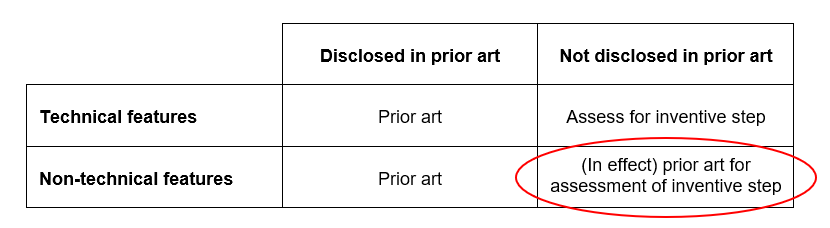
The circled item in the table above becomes highly relevant when assessing inventive step of “mixed” inventions in practice, because it allows the EPO to consider the obviousness of the non-disclosed technical features to a skilled person armed with prior knowledge of any non-technical features in the claim.
Take, for example, a hypothetical claim directed to a novel business method which has been implemented using various well-known items of computer hardware in some novel arrangement designed to support the novel business method. Under the EPO approach, the underlying business method is, in effect, taken as part of the prior art (regardless of whether that business method has actually been identified in the prior art), and the question of obviousness becomes would it have been obvious for a skilled person armed with prior knowledge of the novel business method to use the various well-known items of computer hardware in the arrangement designed to support the novel business method? Often, the answer to this question is yes, since the skilled person would usually find it obvious to use the well-known items of hardware in a manner that supports the novel business method, unless there is something clever about the particular arrangement that has been claimed. Hence, an invention along these lines is usually found by the EPO to lack inventive step.
This aspect of the EPO approach (that non-technical features can be viewed as prior art for the assessment of inventive step) makes a brief appearance in Emotional Perception as principle G of the Duns principles listed in item 39 of the decision (emphasis added):
“(G) For the purpose of the problem-and-solution approach, the problem must be a technical problem which the skilled person in the particular technical field might be asked to solve at the relevant priority date. The technical problem may be formulated using an aim to be achieved in a non-technical field, and which is thus not part of the technical contribution provided by the invention to the prior art. This may be done in particular to define a constraint that has to be met (even if the aim stems from an a posteriori knowledge of the invention).”
However, the UK Supreme Court then goes on in item 66 of their decision to expressly reject this principle from UK practice (emphasis added):
“In our view, the approach which should be adopted by courts in the UK is that contained in the Duns principles other than principle G”
In excluding principle G, it may have been the intention of the UK Supreme Court simply to rule out use of the EPO’s “problem-and-solution” approach in the UK (i.e. maintenance of the Pozzoli test). Nonetheless, in excluding principle G from UK practice, the UK position regarding step (2) of the Emotional Perception approach for assessing patent eligibility would seem to be as follows:
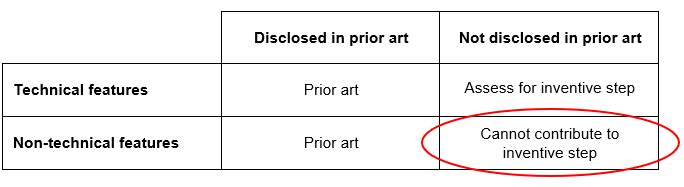
Turning again to the hypothetical example described above, this would seem to leave the UKIPO looking at the question of whether the novel arrangement of well-known hardware for supporting the novel business method is inventive without arming the skilled person with prior knowledge of the novel business method. This is different from the question the EPO would be considering, when faced with the same fact pattern. On the face of it, it seems possible that the UKIPO might more easily find the novel arrangement of well-known hardware as being non-obvious under Pozzoli (compared with the EPO), since for the UKIPO the notional skilled person considering the question of obviousness would have no apparent reason to arrange the well-known hardware in that novel arrangement (since they have no knowledge of the novel business method).
Memories of Aerotel
This brings back memories of Aerotel, in which patentability was successfully argued by the patentee at the UK Court of Appeal on the basis of a “special exchange” that, it was acknowledged, “could be implemented using conventional computers”:
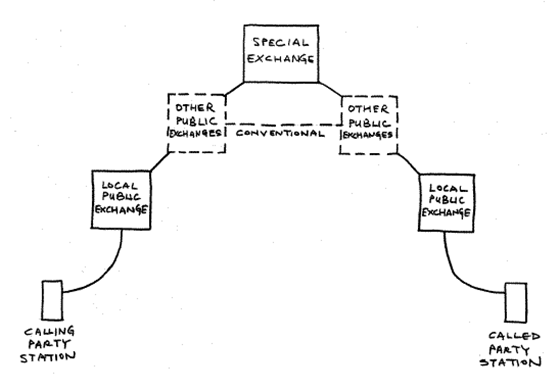
Under the EPO approach, this “special exchange” would likely have been found to be obvious, because it was conventional hardware arranged in a way that seems obvious if the skilled person is given prior knowledge of the novel business method it is designed to support. Whereas in the absence of taking this novel business method as prior art, the question of obviousness potentially becomes trickier (and led, in the case of Aerotel, to a finding by the UK Court of Appeal of the claimed invention being viewed as patent eligible).
Latest UKIPO Examination Report on GB1904713.3
As of the date of this article (5th May 2026), the UKIPO have not issued formal guidance as to how it plans to implement Emotional Perception in practice.
However, the UKIPO recently (on 27 March 2026) issued an examination report on GB1904713.3, the UK patent application which led to the Emotional Perception decision.
In this examination report, the UKIPO examiner acknowledged that there are various ways in which Emotional Perception might be implemented in practice, and worked through two of them.
In the first implementation, the UKIPO examiner filtered out the non-technical aspects of the claimed invention, leaving a conventional hardware arrangement which the UKIPO examiner concluded was disclosed in the prior art. Since the only differences remaining from the cited prior art were non-technical, the UKIPO examiner concluded that the claimed invention was obvious. Notably, in this implementation, the UKIPO examiner avoided analysing the claims under Pozzoli.
In the second implementation, the UKIPO examiner sought to apply the Pozzoli test more directly, by identifying the “differences” from the cited prior art. Per Emotional Perception, the UKIPO examiner then assessed whether these differences possessed technical character, concluding that they did not. The claimed invention was then considered obvious on this basis.
Under both implementations, the UKIPO examiner reached a conclusion of obviousness in this case because, in their view, the differences between the claimed invention and the cited prior art were viewed as being entirely non-technical.
In some ways, this is not so very different from the patent eligibility objections raised by the UKIPO earlier in the same case, where it was concluded that the “contribution” made by the claimed invention was excluded subject matter “as such” (see UKIPO exam report dated 13 October 2020), albeit that the objection is now a lack of inventive step objection rather than an excluded subject matter objection.
Where next?
I am interested to know how inventive step will be assessed by the UKIPO in those cases where a “mixed” claim includes clearly novel technical features that are not disclosed/suggested by the cited prior art, but are suggested by the non-technical features in the claim.
For me, the cleanest way of aligning UKIPO and EPO approaches for “mixed” claims would have been for the UKIPO to examine inventive step of such cases by assessing inventive step of the technical features of the claim, whilst treating the non-technical features of the claim as (in effect) prior art for this assessment (as at the EPO). However, as noted above, Emotional Perception seems to explicitly rule out the UKIPO taking this approach.
Accordingly, it seems that the UKIPO must instead assess obviousness of the novel technical features in a “mixed” claim in view of the cited prior art, without recourse to any non-technical features which are absent from the cited prior art.
Will this open the door to lots more UK patents being granted for “mixed” inventions involving novel hardware arrangements? I doubt it, because Emotional Perception still gives the UKIPO a wide scope for identifying claimed features as being “non-technical” if, in the view of the UKIPO, those features do not contribute to the technical character of the invention viewed “as a whole”.
We can, I think, see the seeds of this in the latest UKIPO Examination Report on GB1904713.3 (discussed above), whereby the UKIPO essentially dismisses much of the claimed invention as being non-technical, including some features which give the appearance of being technical in nature (e.g. “using output vectors generated at the output of the ANN from processing of said multiplicity of pairs to adjust weighting factors in the ANN”). Such features may well have been viewed by the EPO as technical features, albeit those technical features would have then been assessed for obviousness by the EPO from the perspective of a skilled person armed with knowledge of the non-technical aspects of the claimed invention.
Accordingly, it seems possible that in order to maintain the Pozzoli test under Emotional Perception, the UKIPO may take a harsher line than the EPO in categorising claimed features as “non-technical”, since there is less scope for the UKIPO to reject such features as “obvious” under Pozzoli when compared with the EPO’s ability to do so under its “problem-and-solution” approach. If this is the route taken by the UKIPO, then it strikes me that outcomes for “mixed” inventions at the UKIPO might remain relatively unchanged under Emotional Perception, albeit with the arguments about patent eligibility shifting from identifying the “contribution” of the claimed invention (under Aerotel) to identifying what claimed features of the invention contribute to its “technical character … as a whole” (under Emotional Perception).
For now, this is of course just speculation on my part.
UKIPO guidance
In the coming months, we look forward to seeing the UKIPO issue guidance explaining how it intends to assess inventive step under Emotional Perception. In issuing such guidance, I would really like to see the UKIPO setting out
- How the UKIPO intends to perform the “intermediate step” of determining whether each claimed feature contributes to, or interacts with, the technical character of the invention viewed “as a whole”.
In doing this, I would encourage the UKIPO to ask its examiners to perform a feature-by-feature analysis of the full claim language (e.g. striking out those features viewed as “non-technical”) rather than paraphrasing the invention, so as to make it clear precisely which features of a claimed invention are considered by the UKIPO to have “technical character”. - How the UKIPO intends to implement the Pozzoli test under Emotional Perception.
It is clear from the latest examination report on GB1904713.3 that there are at least two ways of implementing this test, so clarity as to the steps to be followed by UKIPO examiners when implementing the Pozzoli test would be very helpful to UK patent attorneys and patent applicants alike.
We will continue to watch the output of the UKIPO with interest over the coming months, as they look to implement Emotional Perception in practice.

.png)
.png)