Professors Serena Best and Ruth Cameron revealed the inner workings of this remarkable research group, Cambridge Centre for Medical Materials.
Forward: features are independent pieces written for Mewburn Ellis discussing and celebrating the best of innovation and exploration from the scientific and entrepreneurial worlds.
Professors Serena Best and Ruth Cameron run the Cambridge Centre for Medical Materials. They revealed the inner workings of this remarkable research group to Mewburn Ellis.
The Cambridge Centre for Medical Materials (CCMM) is an extraordinary hotspot of scientific innovation undertaking world-leading research. The focus is on bioactive structures – advanced medical materials that are designed to work in harmony with the body. These can be anything from skeletal implants and medical prostheses to tissue models and bioreactor substrates, based on materials ranging from bioceramics to resorbable polymers.
It’s a place of fascination for anyone interested in cutting-edge materials science and bioscience. The laboratories are located in the University of Cambridge’s Department of Materials Science and Metallurgy on the western fringe of Cambridge city and are not open to the general public. Fortunately, Mewburn Ellis asked Professor Serena Best and Professor Ruth Cameron, who jointly lead the centre, for an interview – and they generously agreed to reveal what happens there.
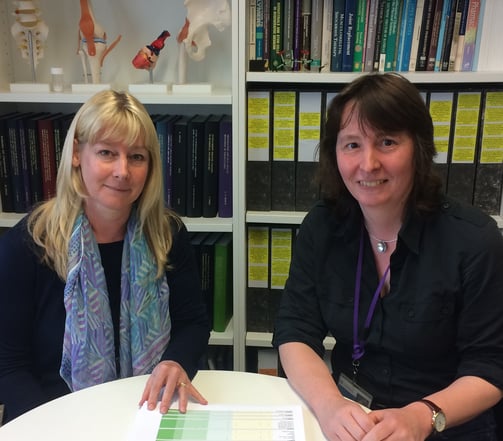
Professor Ruth Cameron and Professor Serena Best (Co-directors of CCMM)
How the team works
Professors Best and Cameron are more than mere custodians of the CCMM. They’re the dual figureheads who’ve run it for almost two decades.
Job sharing is unusual at this level. So what happened? ‘The CCMM was established by Professor Bill Bonfield in 1999,’ explains Best. ‘When he retired around 2007, we agreed that we should take on shared leadership. This was unusual at the time, but it has proved to be very successful.’
Together they run the labs. ‘We have around 20 people, including PhD students, postdocs and visitors,’ explains Cameron. ‘We also have our roles as professors at the university, involving teaching and administration. So we wear a number of different hats.’
Cameron also ran the Department of Materials Science for five years as joint head with two other academics. ‘We took over in the throes of Covid rather suddenly. We’ve taken lessons from the way we’ve run the group together – again, it worked really well,’ she explains.
Best reflects: ‘We also have our college roles. Ruth is at Lucy Cavendish and I’m at St John’s, so there are many different aspects to the overall role that need to be balanced.’
The centre is famous for producing diverse work in the field of biomaterials. And this, argues Cameron, is down to the dazzling array of talents it attracts from all fields. ‘Research is a collaborative thing,’ she says. ‘In the field of medical materials you need expertise and a range of perspectives. In our team, over the years, we’ve had materials scientists, medics and vets, cell biologists, mathematicians and electrical engineers. The important thing is that they can all talk to each other in the group. They bring their own perspectives to solving problems. Our research brings together all of these disciplines, which is why it’s such an interesting place to be.’
The group also interacts closely with other scientific departments and institutions: ‘We view ourselves as a hub,’ says Best. ‘It’s important for us to be outward-facing, and to collaborate with clinicians and biologists, with chemists, physicists, and people around the university and beyond, to develop new materials.’
Today at the cutting edge
So what is the team working on right now? The core philosophy for Best and Cameron is to find materials that allow the body to heal in a natural way. ‘A hip joint is currently made from plastic and titanium,’ says Cameron. ‘While this is a highly successful approach in this context, these materials are not found naturally in the body. We’re looking for materials that allow the body to heal, but disappear over time.’
Best started her career in the ceramics field, looking at bone-graft materials. Bones are calcium-based materials, so she researched calcium phosphates as material with high compatibility with the human body. Cameron’s original focus was on polymer materials. Over time their paths have converged.
One of their main areas of focus today is on three-dimensional, porous structures that cells can grow through and colonise. ‘We use collagen,’ says Cameron. ‘It occurs naturally in the body. We use a technique called ice templating. We take water with about 0.5% of collagen mixed in, then freeze it. The ice makes lots of little ice crystals, but excludes the collagen to the edges of it. We then use sublimation, where the ice goes from solid to a gas without going through a liquid state, and we’re left with collagen with lots of space where the ice was. It is possible to grow different shapes and sizes with different connections between the crystals, and we refer to these sponge-like structures as “scaffolds”.’
Because the structure is collagen, shaped by a water-based crystal, it’s extremely clean. ‘We grow cells in the collagen structure,’ says Cameron. ‘We can control the structure’s stiffness and how the cells experience it. And we can functionalise the structures with things that the cells are going to look for, to bind to. So we can control how the cells respond.’
It’s a platform technology, with applications in cardiac, lung, dermal and kidney treatments. ‘We’re looking at developing the scaffolds so that they can be used to host endometrial organoids,’ says Best. ‘By creating appropriate scaffold environments, we can work with people who are looking at the causes of early miscarriage and endometriosis.’
Another key area is regenerative membranes. ‘These are flat structures rather than sponges,’ says Cameron. ‘We’re using a technique called electrophoretic deposition. It takes the water-based collagen slurry and, instead of freezing it, puts it between two electrodes. Then, because the collagen in that system is charged when you turn on the voltage, the collagen is attracted to an electrode.’ It’s a highly controllable effect and well suited to creating structures for live cells to be inserted into. ‘We can start to build up tissues and different molecules,’ explains Cameron. ‘It’s a platform technology and we keep coming up with new ways we can apply it.’
The CCMM team is researching how to grow cell cultures in specific shapes. Cameron says: ‘Collections of cells cultured together can start to self-assemble into more complex structures resembling those in the human body. In a gel structure there’s no directionality to the gel, but we’re able to use three-dimensional scaffolds to direct the way the self-assembly is going in a way that’s more physiologically correct.’ Ultimately, these cell structures could be implantable, but are currently used for studying disease states in the lungs, kidney and endometrium.
It’s worth looking at the research published by Cameron and Best to get a feel for the scope of their work. The pair were co-authors on a paper this year outlining the effect of native myocardial strain on regenerative cardiac patches applied to the heart to reduce wall stress and encourage ventricular functioning and repair – an approach based on their collagen scaffolding technique. Another paper shows how it’s possible to mimic ex vivo the bone marrow structures that produce platelets (thrombocytes). The depth and variety is extraordinary. And prolific. According to Google Scholar, they’ve authored several hundred publications. The volume and variety of their investigations is impressive, to put it mildly.
Source of spin-outs
Investors may be wondering what investment opportunities lie in the CCMM, and, yes, there’s a strong record of registering commercially valuable breakthroughs. ‘Clinical translation can take an awfully long time,’ says Best, who has good experience of the spin-out world, as she was involved in the successful spin-out ApaTech, founded by Bill Bonfield, which later sold at a $300m valuation. Best and Cameron hold a number of patents with others in the pipeline – and are always keen to explore translation and licensing opportunities.
However, the ethos of the CCMM is to put the science first – and, where appropriate, translation will follow naturally. Cameron says: ‘For me, the primary motivation for all this work is to benefit patients. We want to take the research as far as it can go. That may be in the form of publishing it and letting other people take it forward, which is absolutely valid. I am keen to see the advances we are making being true to the original intention of the research.’
This means the pair are equally content to pursue the answers to fundamental questions that may not always be convertible into commercial products. ‘Things that don’t go all the way are still contributing to the wider understanding,’ says Cameron. ‘Then other people can run with it.’
Best agrees: ‘I like being an academic and I enjoy the freedom to pursue what I’m interested in.’
When registering intellectual property, Cameron and Best often work with Mewburn Ellis. ‘We’ve worked with Mewburn Ellis a number of times,’ says Cameron. ‘The Mewburn partner we work with understands our approach and we’re always impressed with the expertise they bring.’
The University of Cambridge also boasts a formidable technology transfer unit called Cambridge Enterprise, which is also able to provide support when members of the department produce ideas with commercial potential.
Where ideas come from
As co-heads, Cameron and Best have shaped a unit known for creativity in research. Are there any insights they can offer into how this culture is achieved?
‘Ideas come in different ways,’ says Cameron. ‘Sometimes an idea sparks from a conversation with somebody in another aligned area. We’ve had cases where it’s been a conversation over lunch. The Cambridge system really helps with that, because the colleges offer a mixture of disciplines within the Fellowship, and you meet people with a wide range of knowledge and expertise.’
There are echoes here of Apple founder Steve Jobs, who designed the new headquarters for Pixar, the cartoon company he also created. Jobs spent hours thinking about the structure of the atrium and even the bathrooms to ensure serendipitous encounters, which he felt were crucial to creativity.
Cameron says ideas are also spontaneously generated during projects. ‘Once you’ve got interesting research, there are always questions bubbling up from it. They start new areas. Whenever you do a piece of work, if it’s gone well, there are always more interesting questions and more ideas to follow up.’
At times it’s a simple request. ‘Clinicians come and say: “We’re interested in your research”,’ says Best. ‘They bring clinical challenges for discussion, knowing that we have these amazing people working here.’ The team loves a challenge. ‘This method works better than us telling people what to do. If we tried that, it would stale pretty quickly.’
The academic year end also offers a moment to generate and pursue new ideas. ‘Thinking is luxury time,’ says Best. ‘So, particularly over the summer, Ruth and I take the chance to plan where we’re going, look at the group structure, and then begin to shape what’s going to happen.’
The future of the lab
Cameron and Best are guarded as to some aspects of the next direction of their work. ‘We have some patent ideas under discussion,’ says Best, apologetically.
They do, however, offer an insight into the impact AI might have on materials science research. Sir Demis Hassabis, founder of AI company DeepMind, recently said he believed all diseases would be cured within 10 years with the help of AI. Best acknowledges that AI is useful in areas such as computational modelling and data-rich analysis. It is not, however, the core of day-to-day experimental work at the CCMM – sorry Demis. ‘The problem with AI is that it’s partly data mining, data scraping,’ says Best. ‘So it's bringing lots of stuff that’s out there together. But fundamentally our work is to innovate and produce new things.’
This supports a view expressed by other cutting-edge researchers in biology and materials science. AI can accelerate discovery by proposing structures, revealing patterns and guiding decision-making, while laboratory science provides the synthesis, characterisation and validation that turn ideas into clinically relevant materials. The two are complementary. This is why lab-based research done at the CCMM is so vital: it generates high-quality raw data and new materials that AI tools can learn from and build on. There is no substitute for this kind of experimental foundation.
The pair confirm they are as energised as ever to continue their work at the CCMM into a third decade.
In fact, at the time of our interview, Cameron was on the brink of taking a year’s sabbatical. ‘It means I can devote myself entirely to a year of research,’ she says. ‘I will still be coming in every day.’
Isobel Stone, Patent Attorney and Partner, at Mewburn Ellis comments:
“Having been taught by Ruth and Serena, and having worked closely with Ruth during my Master’s research many years ago, it has been hugely rewarding to witness the continued growth of materials research at the Cambridge Centre for Medical Materials, and to support that work by helping to protect innovations emerging from the CCMM and the University of Cambridge’s Department of Materials Science and Metallurgy. I look forward to seeing how these advances continue to develop and translate into future impact.”
Written by Charles Orton-Jones.

.png)