The global battery sector is entering a new phase. As electric vehicle and energy‑storage deployment accelerates, attention is rapidly shifting from how batteries are made to what happens when they reach end-of-life. According to the latest analysis from the European Patent Office and the International Energy Agency, inventions relating to battery reuse and recycling have increased more than seven‑fold over the last decade – making battery circularity one of the most dynamic areas of battery innovation today. This is not only a sustainability story, but one of materials security, industrial competitiveness and intellectual property strategy.
From linear to circular: why recycling economics are changing
Historically, battery recycling economics have been challenging. High collection costs, complex chemistries, safety risks and volatile metal prices often made recycling marginal compared with primary mining. That equation is now shifting for several structural reasons.
First, scale is rapidly increasing. The EPO-IEA analysis highlights a sharp rise anticipated in end‑of‑life EV batteries – from around 1.2 million units in 2030 to around 14 million by 2040 – creating a more predictable and investable feedstock for recycling infrastructure.
Second, as discussed previously in our analysis of chemical recycling, access to lithium, nickel, cobalt and graphite is becoming more geopolitically sensitive. Circularity technologies covering collection, sorting, recycling, refining and second‑life reuse are therefore attracting investment as a strategic supplement to primary supply, with the potential to reduce import dependencies and environmental impact.
Recycling is also being reframed as a pathway decision at end-of-life: reuse, second‑life deployment or recycling (depending on state‑of‑health, residual capacity and safety considerations). Batteries suitable for reuse may deliver value in lower-demand applications such as stationary energy storage, delaying recycling and influencing when (and in what condition) recyclers ultimately receive feedstock. At the same time, recycling technologies themselves are diversifying, with industrial approaches spanning pyrometallurgical, hydrometallurgical, biological, and direct recycling routes, each with different cost, efficiency and regulatory profiles. This technological plurality is reflected in patenting trends, with innovation concentrated not just in recovery processes, but also in sorting, disassembly and chemical transformation steps.
Innovation trends – what the patent data tells us
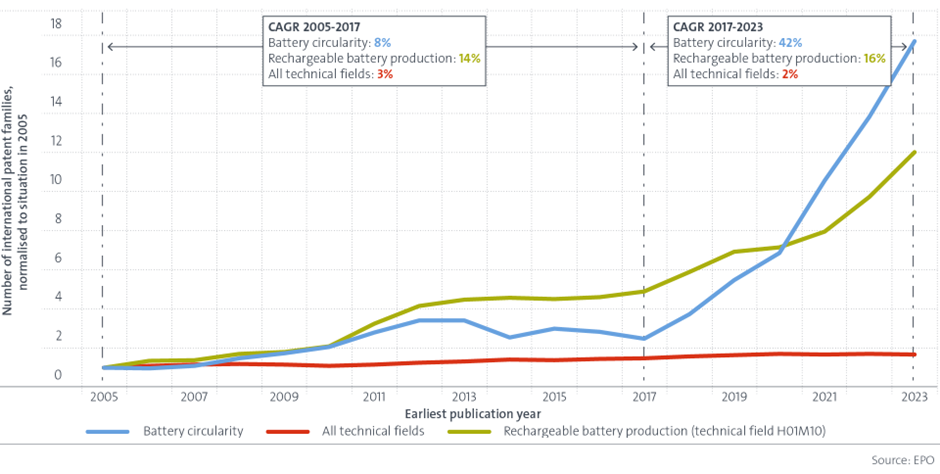
One of the most striking findings is the pace of innovation. Since 2017, patenting in battery circularity has grown at around 42% per year, significantly outpacing rechargeable battery manufacturing (see Figure 1 below). This growth coincides with the first wave of mass‑market EV deployment and reflects recognition that recycling capacity and enabling technologies must be developed years ahead of volume and regulatory pressures. The field is maturing, with early filings giving way to broader portfolio building and more strategic competitive positioning.
Figure 1: Patenting activity in battery circularity, rechargeable battery production, and all technical fields combined
(Source EPO)
Asian companies currently dominate the global patent landscape for battery circularity, accounting for nearly two‑thirds of international patent families. Chinese and Korean applicants are particularly active across the recycling value chain, from collection through to metal recovery and reintegration. Europe, however, has developed a distinct innovation profile, with strong activity in upstream circularity, including collection and safe handling of used batteries, chemical transformation and hydrometallurgical recovery, and technologies aligned with safety, high recovery efficiency and traceability requirements. For companies operating in this space, freedom‑to‑operate and portfolio strategy must now account not only for cell chemistry and pack design, but also for end‑of‑life handling, recovery processes and data infrastructure.
Regulation as an innovation catalyst
The EPO-IEA study notes that jurisdictions combining supportive policy frameworks with access to recycling feedstock are well positioned to lead in circular battery value chains. Europe exemplifies this approach. The EU Battery Regulation (discussed in our earlier article) is the backbone of a vertically integrated framework linking recycling efficiency, recovery targets and recycled‑content requirements directly to market access. As a result, recycling is no longer a peripheral compliance exercise, but a design and manufacturing consideration that must be addressed well in advance of legal deadlines. Figure 2 summarises how these obligations translate into specific requirements across the battery lifecycle.
Figure 2: The EU’s Integrated Battery Governance Framework
(Source: Volta Foundation 2025 Battery Report p725)
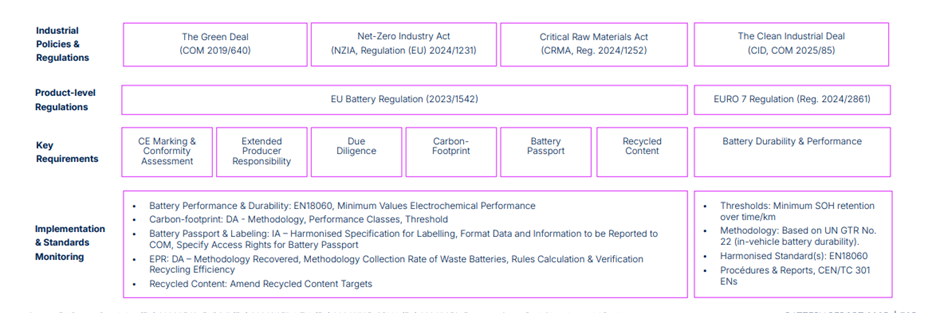
European policy initiatives increasingly extend responsibility across the battery value chain, from design and placing on the market through to end‑of‑life handling, recycling efficiency and reporting. Key focus areas include:
- lifecycle traceability and battery passports
- mandatory reporting of end‑of‑life and recycling data
- qualification and oversight of recycling operators
- standards for recycled materials and second‑life use
This regulatory certainty has helped to sustain European innovation in battery circularity, even as global competition intensifies.
Risks and constraints: why battery recycling remains technically and commercially challenging
Despite rapid growth in innovation, battery recycling remains technically and commercially challenging. One of the most significant operational risks is safety. End‑of‑life lithium‑ion batteries often retain residual charge and may be damaged or degraded, creating a recognised risk of thermal runaway and fire during collection, storage and processing. These risks have attracted increasing regulatory and insurer attention and are actively shaping innovation priorities, with growing patent activity in remote handling, isolation and immobilisation technologies aimed at reducing human exposure and mitigating fire risk within recycling facilities.
A further structural challenge lies in the heterogeneity of battery waste streams. Recycling plants rarely receive uniform feedstock: battery chemistries, formats and design generations vary widely, complicating sorting, dismantling and downstream processing, and directly affecting recovery yields and cost. Fragmented collection systems and geographically dispersed waste streams make it harder to secure the consistent volumes needed for economies of scale, while limited automation increases both cost and safety risk. Encouragingly, these constraints are driving innovation, with patent filings increasingly focused on flexible, chemistry‑agnostic systems and integrated recycling‑to‑materials solutions capable of handling mixed inputs while still delivering battery‑grade outputs.
What this means for IP and business strategy
Battery recycling is no longer only about waste management. It is becoming a core pillar of battery economics, shaped by regulation, technology choices and supply chain resilience. Battery quality, traceability and lifecycle accountability have become central to product liability and recall risk. As circularity requirements increase, failures in recycling processes, data accuracy or chain of custody could have consequences well beyond environmental compliance.
At the same time, strong IP positions in recycling and reuse technologies represent strategic assets. As the EPO-IEA report notes, regions and companies that align innovation with policy and industrial scaling are likely to capture disproportionate value as the battery economy matures. For innovators, investors and policymakers, the practical challenge is alignment: connecting reuse decisions, recycling operations, compliance and IP strategy into a coherent operating model. The acceleration in patenting highlighted by the EPO suggests that many organisations are already moving in this direction.

.png)
.png)