Aubert Demaray, director of operations at SpectraPower, talks to Mewburn Ellis about what he is seeing across the battery sector - from supply chains and manufacturing economics to emerging cell chemistries.
Forward: features are independent pieces written for Mewburn Ellis discussing and celebrating the best of innovation and exploration from the scientific and entrepreneurial worlds.
SpectraPower is a relatively small company in the battery industry, but its work gives it a unique perspective across a wide range of battery technologies and businesses.

Aubert Demaray, Director of Operations at SpectraPower
“We have about 350 past clients,” says Aubert Demaray, director of operations at SpectraPower. “This means we've worked with all of the key players in the battery industry, with the possible exception of BYD.”
The company supports battery-related projects ranging from evaluating new materials and testing prototypes to advising on technical development and failure analysis. That gives Demaray a practical view of where companies are investing effort, and where they are encountering problems.
“We cover a broad range of battery tasks,” explains Demaray. “People send us new materials to analyse and evaluate. We do mixing and coating of electrodes with novel active materials. We work on new anodes, new cathodes, silicon, solid state materials, current collectors, electrolytes, binders, coatings, cell design, and we do R&D work for companies which don't have their own lab. We do larger electrode coating runs for companies that want to ship pilot-line quality stuff to their customers. We do battery pack and cell tear-downs to evaluate different vendors or products. And we support the legal profession with testing and expert witness services.”
Much of that work is handled by a relatively small core team, supported by a wider network of external experts. Demaray attributes that breadth partly to the team’s decades of experience and enthusiasm for the technical challenges involved.
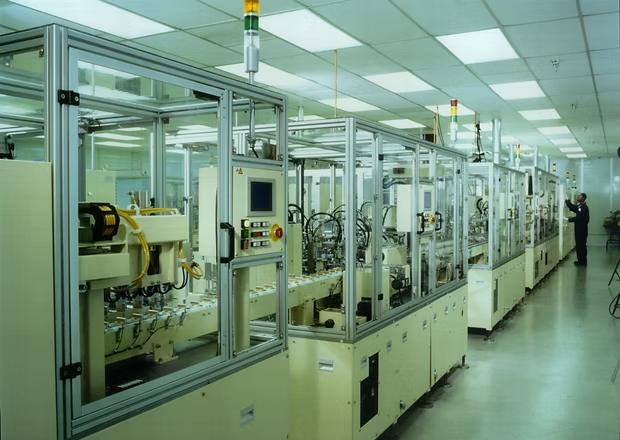
SpectraPower workshop
For Demaray, the appeal of the work lies in the technical complexity of batteries themselves: “The battery industry is fascinating to me,” he says. “I came out of the semiconductor industry, and quite frankly I think batteries are more complex and more difficult. There's a quote that batteries have the complexity of semiconductors, the margins of solar - which means zero - and the throughput requirements of paper. It's hard.”
He is motivated by both the intellectual challenge of the work, and its potential impact: “Batteries are a commodity product that enable literally everything – data-centres, grid storage, solar, satellites, CubeSats, airplanes, buses, trucks, cars, mopeds, bikes, and cell phones. Every device is a unique use case, needing different technologies, designs, and supply chains.”
SpectraPower’s leadership also reflects the long history of battery development in the US.
“What is unique about SpectraPower is our two primaries, CEO Jim Kaschmitter and CTO Steve Pierce,” says Demaray. “Jim and Steve together have over 60 years of experience in batteries and energy technologies, including R&D, scaling, manufacturing, commercialising, and exiting successfully, which is the hard part.”
Those in the industry will be familiar with their biographies. In 1993 Kaschmitter founded PolyStor, the first US company to commercially manufacture prismatic, pouch, and cylindrical lithium-ion batteries. PolyStor became an important early training ground for people who later moved into other parts of the US battery industry. “A lot of the big players in the US battery industry got their start at PolyStor,” says Demaray. “The co-founders of Farasis Energy were at PolyStor. Menahem Anderman, who founded Advanced Automotive Batteries. Robert Spotnitz, founder of Battery Design Studio which was sold to Siemens. A co-founder of Enovix. There's Dick Mank, who went on to help lead Apple's battery programme for the last 20 years.” With such a roster of talent it's hard to believe the company could struggle. But Demaray explains: “Unfortunately, PolyStor was caught in the 'valley of death' with a high burn rate during early market entry when both market and investment crashed after the World Trade Center disaster on 9/11. Subsequently, the company’s highly skilled talent dispersed and founded or brought key skills to a whole load of companies.” This even extended to South Korea, where employees at PolyStor’s Korean assembly facility moved on to work at LGC, SK and others.
SpectraPower was one of the enterprises to emerge after PolyStor, and today remains connected to that wider network of battery expertise. Demaray is vocal about the benefits he gains from being part of this remarkable team: “I've gotten to work with senior inventors, industry titans, people with many decades of experience, and learn from them.”
Emerging trends
Through that range of project work, Demaray has a view of several trends currently shaping the sector.
So what are the big shifts in the battery world right now?
“The biggest thing I've seen in the last couple of years is the split in the industry,” he explains. “Lithium Iron Phosphate chemistry, or LFP, won low-cost, long life-cycle. If you can, you use it. Cheap electric vehicles, grid storage, and anything where weight isn't a significant factor all use it. And where cost is the number one concern.”
Lithium Nickel Manganese Cobalt Oxide, or NMC, has a higher energy density than LFP, so can provide higher range in EVs for the same battery size, but LFP is winning market share on cost and life-cycle in the mass-market.
An issue is the ability to transport batteries. Sodium Ion is emerging as a competitor for LFP for low cost/high life-cycle applications. “Sodium Ion has the advantage of cold temperature operations, and 0V state for shipping, compared to 15% to 30% for lithium ion batteries. This matters. If you are sending thousands of cars on a cargo ship you need to get the risk of fires down.”
Another major trend he identifies is the restructuring of supply chains.
“At the macro level, there's what I call the graphite woes,” says Demaray. “China announced graphite restrictions in 2023, which were significant as they control about 90% of the battery-grade global market. China requires licenses to export graphite. Without those, you aren't making batteries, so the push has been to build new supply chains in the US or Europe. To do this they need graphite or other anode materials.” This is creating new market opportunities for suppliers able to meet this new demand.
Naturally, SpectraPower is witnessing a constant change in the design of batteries: “What's really interesting is silicon as an additive or replacement for graphite anodes. It's higher energy, higher cost, lower life cycle. But, there remains a bunch of problems to figure out.”
Silicon is arriving in diverse forms. “There is cheap processed silicon as well as processed refined silicon. A lot of companies use CVD silane coating or carbon coating around silicon anode particles to control swelling and add conductivity. There is an enormous amount of work being done in silicon for higher end markets such as EVs, drones and consumer electronics.”
Manufacturing of silicon battery tech is very challenging, says Demaray. “There will be success stories, because the market demands it. And there are more low-hanging fruit opportunities, compared to solid state or lithium metal, which have much further to go.” He points to a long list of companies in the US focused on silicon R&D, including Sila, Group14, Amprius, and Enovix. “And there's another 20 or 30 others, which go from tens of millions to billions in terms of funding raised.”
Economics of battery making
Although SpectraPower’s work is technical, Demaray says the company also sees the commercial pressures affecting battery developers.
“There's a slide that Michael Liu at the Volta Foundation presents at battery shows, which is a list of who is profitable and who is not in the battery industry. Basically nobody is profitable, except CATL and a couple of others. Everyone else loses money.”
The fallout is visible.
“We are seeing a lot of auctions for large company battery pilot lines in the US,” observes Demaray. “Many have gone belly up. Or they laid off people and are selling off assets. It's a great time to buy used equipment!” The cause? It's a convergence of several factors. “In 2024 and 2025 the US Department of Energy ramped down funding from the last administration. The EV market experienced a downturn and investment moved elsewhere.”
Competition from China is tough: “Chinese oversupply and historical Chinese subsidies are hard to compete with. Their goal is not profit, it's to build the entire supply chain.”
Tariffs are designed to change the equation, making domestic US production more competitive on cost, but the impact is underwhelming. “US automakers need a 100% to 200% tariff to compete with Chinese brands like BYD, which has a $26,000 car nicer than some US models at $120,000. Even with tariffs it's hard to compete. A company here may think they can mine or refine synthetic or natural graphite for $15 to $20 and sell at a profit, but when companies in China can do it for $6, even a 200% tariff isn't enough.”
The battery bubble led to inflated salaries. Now the industry is correcting: “Everyone in the EV industry was hiring. An enormous amount of people came from adjacent industries, who didn't really know what they were doing.” And the amount of time it takes to develop a new battery technology is not speculator friendly. “You need five to ten years of runway to develop and manufacture a new battery technology,” says Demaray. “In the best case it's hundreds of millions or billions of dollars. When reality finally sank in, investors stopped putting in the money.”
In response, some companies are outsourcing critical aspects of development rather than investing immediately in their own pilot-line capability.
What's next?
As battery technologies become more commercially valuable, disputes around them are also becoming more significant. Another line of work keeping the SpectraPower team busy is legal work. “We do a lot of expert witness work in the US,” reveals Demaray. “Here some of the cases can be huge, with millions of dollars expended on both sides and very large settlements, with billions in battery revenue and tens to hundreds of billions of OEM products at risk.”
Technical expert evidence can be important in high-value battery disputes, particularly where the issues turn on cell design, materials, testing or manufacturing processes. “In some cases contractual or product-liability claims may not be subject to a predetermined cap,” says Demaray. “The consequences can also extend beyond damages. A court may restrict or halt the manufacture, sale, or shipment of a disputed OEM product.”
He is also involved in the Volta Report, an industry report that brings together contributions from specialists across different areas of battery technology. “I cannot recommend the Report enough,” says Demaray. “Last year I helped manage 160 pages in the cell chemistry section. I actually keep the report near me and I read it just for fun. I get through a couple of pages most days at lunch.”
The pace of technical change remains a central theme in Demaray’s comments, particularly in relation to silicon anodes.
“Just in silicon, there are so many things people are working on. Silicon is going to be the next big thing. Five years ago we saw 3% to 9% silicon in anodes for high-end consumer electronics. This year Samsung might have commercial cells at 35%. This could rise to 50% soon as the technology continues to mature.”
Demaray expects demand for specialist technical support to continue, particularly where companies need access to equipment or expertise before committing to their own full pilot-line capability.
“We expect a lot of work handling overflow. Companies want to build their own pilot lines and hire teams, but need help with coatings, or tear-downs, or need a multi-layer cell build, so we get the call,” says Demaray.
The picture Demaray paints is of an industry moving from ambition to execution. The need for better batteries remains clear, but battery innovation is no longer just about promising chemistries or impressive lab results. Increasingly, it is about supply chains, manufacturability, cost, reliability and scale. Those are difficult problems, but they are also the problems that will determine which technologies make the transition from interesting ideas to commercial products.
Chloe Flower, Partner and Patent Attorney at Mewburn Ellis comments:
'Aubert's insights highlight both the immense opportunities and the realities facing battery innovators today. From emerging silicon technologies to evolving supply chains, success depends not only on breakthrough science but also on the ability to develop, scale and protect innovation effectively. It was fascinating to hear how SpectraPower is helping companies across the sector bridge that gap and accelerate the development of next-generation energy technologies.'
Written by Charles Orten-Jones.

.png)
-1.png)