So-called “position marks” are increasingly valuable for brand owners whose distinctive identity lies not in a name or logo alone, but in where a visual element appears on a product. This is especially true in industries like fashion, footwear, and luxury goods, where consistently placed stripes, tabs, badges, or stitching can serve as a powerful indicator of commercial origin.
This article sets out the key practical lessons for brand owners considering position mark protection in the UK, drawing on the Court of Appeal’s recent decision in Thom Browne Ltd & Anor v adidas AG & Ors [2024] EWHC 2990 (Ch) (22 November 2024); [2025] EWCA Civ 1340 (October 2025) (Thom Browne v adidas) as the leading UK authority on how such marks are assessed. Although the dispute centred on adidas’ well-known three-stripe position marks and Thom Browne’s four-bar design, the principles articulated by both the High Court at first instance and the Court of Appeal offer wider guidance for non‑traditional trade marks generally, particularly those defined by both a graphic representation and a written description.
The UK “gap”: no formal category for position marks
The UKIPO does not formally recognise position marks as a distinct category of trade marks. In practice, marks that are substantively position marks are typically registered as figurative or three‑dimensional marks (see examples of adidas’ registrations here and here for example).
This lack of formal recognition means there is limited guidance from the UKIPO. Consequently, case law provides the most authoritative framework. The significance of Thom Browne v adidas lies in the fact that it is the first case in which the courts of England and Wales thoroughly examined the registrability and validity of marks that were, in substance, position marks.
At first instance, Mrs Justice Joanna Smith expressly acknowledged the difficulty of making a decision “given the absence of any English case law expressly considering the approach to be taken to position marks” (Thom Browne Inc & Anor v adidas AC & Ors [2024] EWHC 2990, paragraph 187).
Defining a position mark: UK versus EU
By contrast, the EUIPO explicitly recognises position marks, and a wide range are registered across various classes and, in turn, industries. Several examples of EU-registered position marks are provided below:
|
|
|
|
|
|
|
|




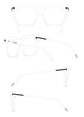
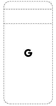
Article 3(3)(d) of Commission Implementing Regulation (EU) 2018/626 defines a position mark as “a trade mark consisting of the specific way in which the trade mark is placed on or affixed to the product,” a definition reflected in the EUIPO Guidelines.
However, in the UK Court of Appeal decision in Thom Browne v adidas, Arnold LJ found this EU definition unsatisfactory. He regarded it as circular, since it refers to “the mark” itself, and overly broad, as it could apply irrespective of the sign’s nature. Instead, the Court agreed that a position mark is more accurately defined as “a combination of a visual element […] and its position on the goods.
Requirements for registering position marks
Both the High Court and Court of Appeal in Thom Browne v adidas confirmed that position marks are subject to the same fundamental requirements as any other trade mark. Specifically, a position mark must be:
1. A sign;
2. capable of being represented graphically in a way which clearly outlines the clear and precise subject matter of the protection under the registration; and
3. capable of distinguishing the goods or services of one undertaking from those of another.
Although the UKIPO abolished the strict requirement for graphic representation for applications filed from January 2019, the adidas registrations pre‑dated this change. Their validity therefore fell to be assessed under the former legal framework.
Representation: clarity and precision
The central issue before the High Court was whether the adidas position marks were represented with sufficient clarity and precision.
Thom Browne challenged sixteen adidas registrations, arguing that they were invalid because they covered an excessively broad range of forms, contained inconsistencies between the written descriptions and the graphic representations, lacked clarity and precision, and in many cases treated the graphics as merely illustrative rather than as part of a single, defined sign.
In addressing these arguments, Justice Smith relied on established case law, namely Société des Produits Nestlé SA v Cadbury UK Ltd [2017] EWCA Civ 358 (Nestlé), in which the Court of Appeal rejected the use of the word “predominant” in a colour mark description because it permitted too great a range of visual permutations. From this body of authority, the High Court distilled several key principles applicable to position marks:
1. the graphic representation must allow the sign to be identified clearly and precisely;
2. the representation and any verbal description must be considered together, with neither prevailing over the other;
3. the verbal description must be consistent with the graphic representation; and
4. these requirements are underpinned by the need to ensure the proper functioning of the trade mark registration system, both for competent authorities examining the mark and for competitors.
Applying these principles, the High Court held that eight of the sixteen adidas marks were invalid due to lack of clarity and precision.
Comparing representations
The judgment is particularly instructive when comparing how relatively subtle differences in representation led to varying validity outcomes.
1. Tracksuit top mark 808 (UK00001240808)
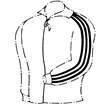 |
“The mark consists of three equally spaced stripes, all of the same colour, applied to the exterior of the goods covered by the specification, the stripes running down substantially the whole length of the outer lateral surface of the sleeves, legs and/or trunks of the goods, the stripes contrasting with the colour of that part of the goods to which the stripes are applied, as illustrated on the form of application”. |
This registration was invalidated because it was not sufficiently clear, precise, and objectively ascertainable. A central difficulty lay in the phrase “substantially the whole length,” which introduced unacceptable ambiguity.
The expression could encompass anything from just over half of a sleeve or trouser leg to 80–90% of its length. The uncertainty was compounded by references to garment parts, such as “legs and/or trunks,” which were not depicted in the graphic representation at all.
The Court observed that adidas could have avoided these issues by adopting more specific language or by filing separate applications for different garment types but had chosen not to do so.
2. Tracksuit top mark 588 (UK00903517588)
 |
“The mark consists of three parallel equally spaced stripes applied to an upper garment, the stripes running along one third or more of the length of the sleeve of the garment.” |
The EU Cancellation Division (decision of 26 April 2024, C 50 357, upheld on appeal in May 2025) found that this mark met the representational requirements. Although the description allowed for some variation - notably that the stripes must extend for “one third or more” of the length of the sleeve of the garment, with no fixed starting point - the Division considered that the scope for variation was sufficiently limited. The stripes were required to be parallel, equally spaced and positioned on the sleeve. The Division concluded that minor differences in stripe length would not prevent consumers from recognising the mark or making repeat purchases; the relevant public, being reasonably observant and informed, would understand what the mark comprised of, making a degree of interpretative flexibility acceptable. Furthermore, since no inconsistencies were identified during the Office’s initial examination of the mark at the time of filing, a certain amount of interpretational leeway was deemed permissible.
The High Court, however, took a distinctly different view. Justice Smith rejected the EU Cancellation Division’s conclusions for several reasons:
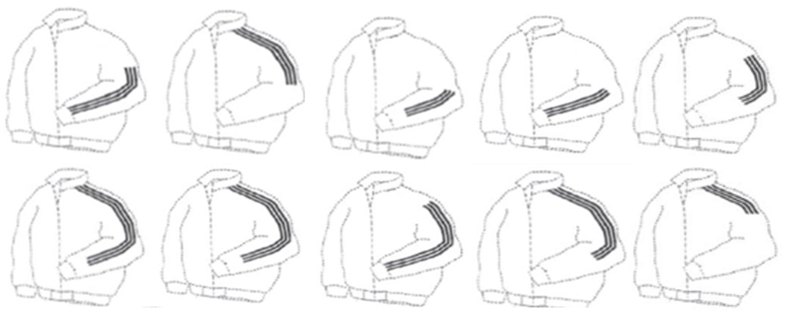
1. Firstly, she was not persuaded that the scope for variation was truly limited. While the stripes had to be parallel and evenly spaced, their length, starting point and finishing point were left undefined, giving rise to a wide range of visually distinct outcomes (as illustrated by the graphic below). The description also failed to confine the stripes to the outer side of the sleeve, leaving open the possibility of placement on the underside.
2. Secondly, Justice Smith held that registrability cannot depend on the fact that inconsistencies may not have been identified by the Registry at the time of filing. Assessment must be based on objectively ascertainable criteria, not on hindsight reliance on administrative practice.
3. Shoe mark 646 (UK00903517646)
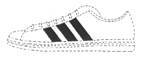 |
“The mark consists of three parallel equally spaced stripes applied to footwear, the stripes positioned on the footwear upper in the area between the laces and the sole.” |
In contrast, Justice Smith found this shoe mark to be valid. When assessed as a whole, the written description and graphic worked together to define a single, clearly identifiable sign. The graphic precisely depicted the placement of the three stripes on the upper of the footwear, and the description admitted no variation in their length or positioning. There was no basis for treating the graphic as illustrative rather than definitional.
Thom Browne’s argument that there was ambiguity in the phrase “in the area between the laces and the sole” was also rejected. When read alongside the graphic, the meaning was entirely clear, and the absence of express measurements did not create uncertainty, since the size of that area was objectively determined by the structure of the shoe.
Taken together, these rulings underline the need for position marks in the UK to be tightly and carefully defined. Any flexibility must be strictly limited. Vague language or undefined placement risks invalidity, whereas precise drafting materially improves prospects for enforceability.
Distinctiveness
Thom Browne further argued that adidas was impermissibly asserting that decoration alone could function as a badge of origin, and that the marks lacked distinctive character, rendering them invalid. adidas rejected this and relied on acquired distinctiveness.
The judge accepted adidas’ position. Each of the adidas marks was found to have acquired distinctive character by the relevant date of 20 July 2021. adidas had adduced extensive, unchallenged evidence of longstanding and intensive use, including sales figures, marketing materials, sponsorship of major sporting events and celebrity endorsements. Most of the registrations dated back to the 1990s or early 2000s and had originally been registered on the basis of acquired distinctiveness.
Infringement and similarity
adidas counterclaimed for trade mark infringement under sections 10(2) and 10(3) of the Trade Marks Act 1994, as well as passing off. Although over a thousand Thom Browne products were initially in issue, the case ultimately focused on twenty‑four specimens. The judge held that the counterclaim would have failed even if all adidas marks had been valid.
This part of the judgment is notable because it addresses infringement of position marks under section 10(2) for the first time in the UK. The judge emphasised that placement and orientation are critical to the assessment of similarity and may be determinative. In several instances, differences in stripe placement alone were sufficient to avoid similarity.
Overall, the judge found only faint or low levels of similarity between the majority of the parties’ respective marks, with moderate similarity limited to a few items, such as certain shoes and bags (see below), due to the vertical orientation of stripes on Thom Browne’s four-stripe designs. Conversely, no similarity was found for items like bobble hats (see below), where the stripes varied in length, orientation, and placement.
|
adidas |
Thom Browne |
|
|
|
|
|
|
|
|
|
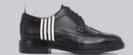
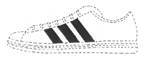

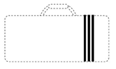


While some similarity existed between the marks and goods, the judge ultimately found no likelihood of confusion. The average consumer of clothing, footwear, and accessories - who pays a moderate level of attention - would readily recognise the distinction between three stripes and four stripes.
Notably, adidas did not allege point-of-sale confusion at trial, relying exclusively on post-sale confusion. The judge clarified that post‑sale confusion involves the same reasonably well informed and observant consumer, who can clearly see the sign in its correct position when worn by someone else. She dismissed adidas’ suggestion that fleeting, partial, or obscured views - such as catching sight of someone during sport - should be taken into account.
The lack of evidence of actual confusion provided by adidas was also significant. Despite years of concurrent use - sometimes in the same retail outlets - and extensive media coverage, adidas could only point to 11 comments on Thom Browne’s Instagram referencing adidas. The judge observed that, had genuine confusion existed, far more social media posts would be expected. Moreover, adidas did not call any of these commenters as witnesses. Claims of indirect confusion, such as consumers assuming a collaboration between the brands, were also rejected. The judge noted that adidas’ collaborations always feature the three-stripe mark, and there was no evidence of consumer belief in a partnership, nor any sign that adidas itself was concerned about such confusion.
After considering all these factors, the judge found no likelihood of direct or indirect confusion. Consequently, adidas’ claims of infringement under Sections 10(2), 10(3), and passing off failed.
Honest concurrent use: the impact of delayed action
Justice Smith went on to observe that, had infringement been established, Thom Browne could likely have been able to rely on honest concurrent use.
adidas had been aware of Thom Browne’s four-stripe design since 2009. Aside from raising an informal objection in 2007 concerning Thom Browne’s original three-stripe design, adidas took no significant steps until 2021. adidas explained its lack of earlier action in the UK by stating the “tipping point” came in 2020, when Thom Browne launched its “compression range” of sportswear targeting the activewear sector (see below).
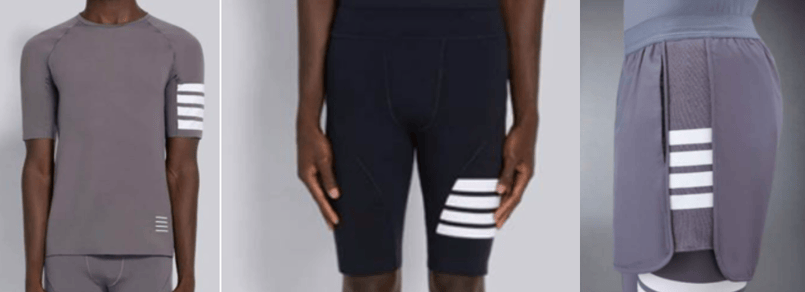
Nonetheless, the judge considered that adidas’s lengthy period of inaction was a strong indication that the company did not regard Thom Browne’s four-stripe design as an infringement and was prepared to coexist alongside its designs.
The judge went further, suggesting that adidas may have actually drawn inspiration from Thom Browne’s designs. Evidence showed Thom Browne garments featured in adidas’s internal slide deck during the development of its 2022 Neuclassics range (see below), indicating that Thom Browne’s designs had influenced adidas’ own products.
|
adidas' Neuclassics range |
Thom Browne Designs |
|
|
|


The Court of Appeal decision
adidas appealed the invalidation of six out of eight of its position mark registrations. Their appeal ultimately consisted of four grounds, namely that the judge had:
1. wrongly found that the written description of a mark allowing for unrepresented signs (i.e. signs not shown in the registration) is fatal to (or, at least a factor against) registrability;
2. wrongly interpreted the marks which led her to overstate the degree of variation encompassed by each mark;
3. confused the requirement of clarity and precision with a requirement that any variations are depicted in the pictorial depiction of the mark; and
4. focused on visual differences and did not properly consider the original message’s impact.
On 23 October 2025, the Court of Appeal dismissed all four grounds and upheld the invalidation of all six disputed marks. Specifically, the Court:
1. confirmed that the High Court judge had not erred in law, by treating written descriptions that encompassed variations not shown in the graphic representations as a relevant but non‑conclusive factor;
2. held that the judge did not wrongly interpret the marks or overstate their variability; any possible over‑reading of the scope was immaterial and did not affect her core reasoning;
3. concluded that “there [was] nothing inconsistent or illogical or wrong” in the judge’s reasoning; and
4. held that the judge did consider whether visual differences affected the origin message, and was right to disregard adidas’ evidence of use, as it did not show that all variations were perceived by consumers as conveying the same trade origin.
In summary, Lord Justice Arnold observed that, although the graphic representations may appear relatively clear in isolation, the written descriptions included language indicating that each mark was not limited to its graphic form. Therefore, a description that covers multiple signs fails the key requirement that a trade mark must be a single, clearly identifiable sign.
Practical lessons and advice for brand owners
Four clear lessons emerge from Thom Browne v adidas:
(1) Precision is essential: Position marks must define a single, clearly identifiable sign. Written descriptions must tightly align with the graphic representation and should not introduce flexibility that leads to multiple possible visual outcomes.
(2) Placement and orientation: Similarity and thus enforceability may only exist when the registered position mark has an equivalent placement and orientation to the complained-of sign.
(3) Expect reliance on acquired distinctiveness: Position marks involving basic or decorative features are unlikely to be inherently distinctive. Success will often depend on strong evidence showing that consumers recognise the sign in its specific position as a badge of origin.
(4) UK and EU trade mark law diverge: The differing decisions in the UK and EU courts show that UK judges may take a differing (and somewhat stricter) approach to European judges, even when applying similar legal principles.
Find out more
If you are interested in learning more about effectively protecting your position mark or your brand more generally in the UK and EU, our trade mark team would be glad to assist you.


.png)