2026 Week 22
After a brush with the doctrine of equivalents (DoE) over the last couple of weeks, we’re back with a new first instance decision where everything turned on equivalence. The technology is wheel arrangements for strollers. Although it’s a cliché, a fair few patent attorneys do tend to get fascinated by baby and toddler hardware. Here, we’re going to dive into the mechanics of stroller wheels of the type that can be allowed to swivel in any direction like a shopping trolley wheel, and then can be locked so that they just point forwards.
The decision is Wonderland v. Cybex (UPC LD Düsseldorf, 27 May 2026). There were loads of issues in play, including allegations of late filing of arguments and validity. But we’re going to focus on the way in which the court decided on non-infringement.
The technology
The patent is EP 1905615 B1. Having thought about this a fair bit, it’s pointless to try to understand the decision without understanding the key points of the claim. And to do that we need to look at the claim and drawings. It’s worth it.
Fig. 1 shows a set of stroller wheels that would be at the bottom of one corner of the frame of the stroller. Fig. 2 shows the claimed “swivel locking device (14)” without the stroller frame 10 and without the wheels 18.
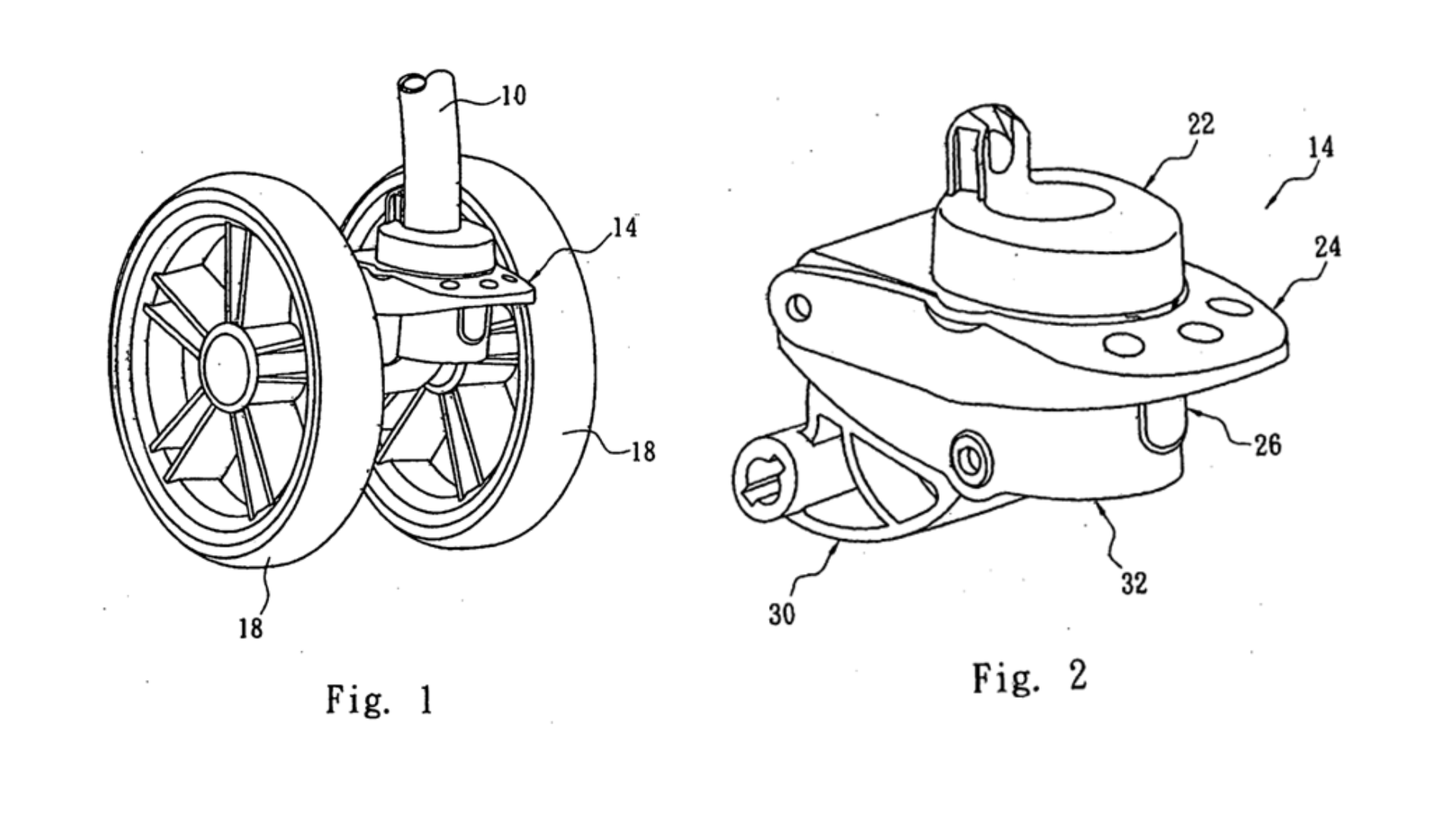
The idea of the invention is that you can press down on the “operating member (24)” which will move the “locking pin (26)” down and out of engagement with the “seat (22)” to allow the “base (32)” of the “wheel bearing assembly (20)” to rotate around the vertical axis, so that the wheels can point in any direction. To lock the wheel in the forward direction, you first get them pointing in the forward direction and then pull up the operating member 24 to move the locking pin 26 into engagement with the seat 22.
In the main claim, the wheel bearing assembly 20 holds the various moving parts including the operating member 24 and the locking pin 26. But in fact these features were acknowledged to be prior art and the claim was characterized by the way in which the seat 22 and the base 32 fitted together. Here’s claim 1, with the feature numbering added by the court:
1.1 A swivel locking device (14) for stroller wheel, comprising:
1.2 a seat (22);
1.3 a wheel bearing assembly (20) coupled to the seat, capable of rotating with respect to the seat and comprising a wheel bearing (30) and a base (32) coupled to the wheel bearing;
1.4 a locking pin (26) disposed on the wheel bearing assembly (20) so as to move between a first position where the locking pin (26) is coupled to the seat (22) and the wheel bearing assembly (20) is unable to rotate around the seat (22) and a second position where the locking pin (26) is decoupled to the seat (22) to allow the rotation between the seat and the wheel bearing assembly (20);
1.5 a biasing member (28), which normally biases the locking pin to the first position; and
1.6 an operating member (24) coupled to the wheel bearing assembly (20) so as to move between a locked position and an unlocked position,
1.7 wherein the operating member (24) is operatively coupled to the locking pin (26) such that movement of the operating member (24) toward the locked position causes the locking pin (26) to move toward the first position, and
1.8 the movement of the operating member (24) toward the unlocked position causes the locking pin (26) to move toward the second position;
1.9 characterized in that a cavity (51) is formed on the base of the wheel bearing assembly (20) for receiving the seat (22) and
1.10 comprises a clasping mechanism (53) therein for restricting the movement of the seat (22) along an axis of the cavity (51).
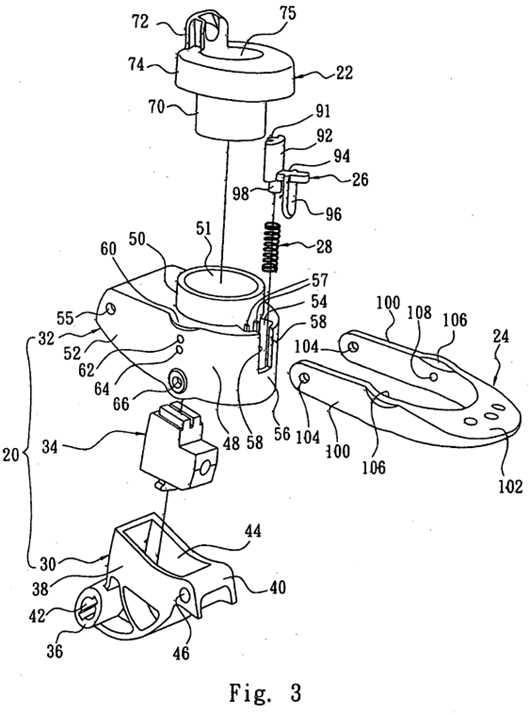
To understand the relationship between the seat 22 and the base 32, Fig. 3 shows a complicated-looking exploded view:
And then Figs. 7 and 8 shows a cross-sectional view through the assembled device when it is locked, as in Fig. 2:
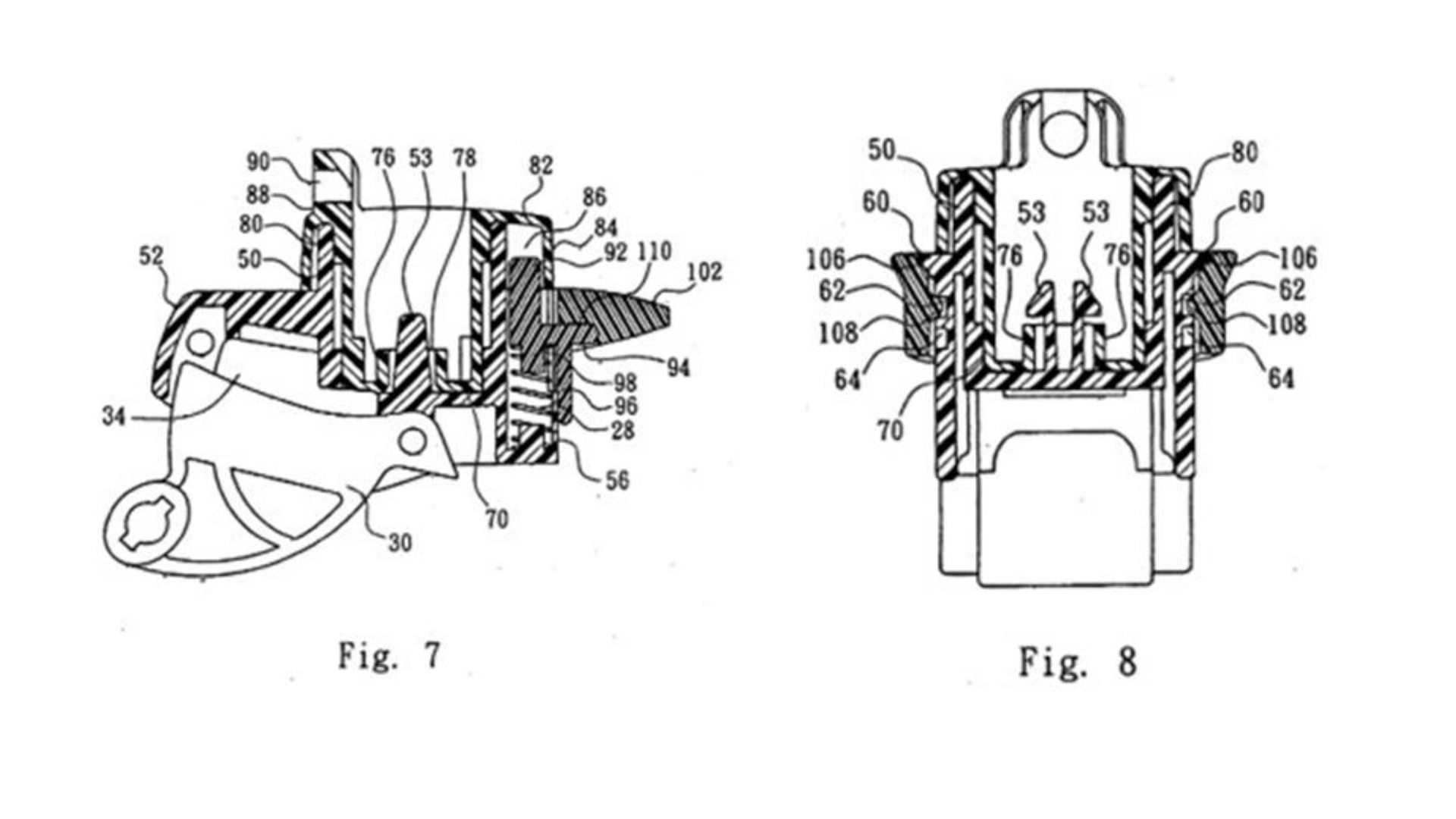
You can see that the downward projection 70 from the seat 22 fits into a cavity 51 formed by slightly wider upwards projection 50 from the base 32. And in the embodiment, these two parts fit together by a pair of hooks 53 in the cavity 51 of the base 32 snap fitting into a corresponding shape in the downward projection 70 from the seat 22.
Patentee’s main argument
The patentee argued infringement by equivalence as their main request, but only in respect of feature 1.4 and 1.6. We’re not going to spend time on this. The court said that this did not work because there were other features of the claim (features 1.9 and 1.10) that were not literally infringed.
The alleged infringement
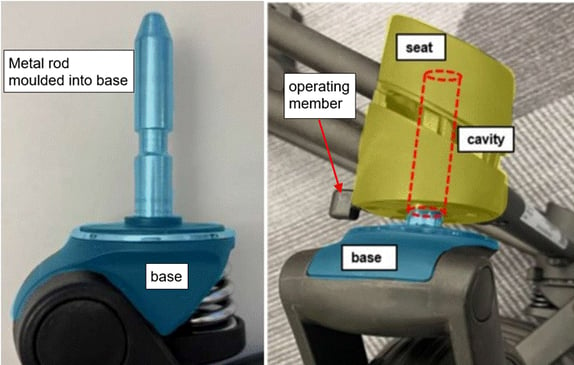
The alleged infringement was a range of strollers with wheels that were releasably lockable in the forward position as in the claim. However, the construction was different. Specifically, the locking pin and the operating member were located on the seat (the part fixed to the frame of the stroller), and the wheel bearing assembly fitted upwardly into a cavity formed in the seat. These images of the alleged infringement give a flavour. The locking pin (not shown) moves downwards from the yellow seat as the operating member is pushed circumferentially around the seat, to push the locking pin into a corresponding recess in the blue base.
Patentee’s auxiliary argument
The court noted that there was no literal infringement because the claim requires:
1.4 a locking pin (26) disposed on the wheel bearing assembly (20) so as to move between a first position where the locking pin (26) is coupled to the seat (22) and the wheel bearing assembly (20) is unable to rotate around the seat (22) and a second position where the locking pin (26) is decoupled to the seat (22) to allow the rotation between the seat and the wheel bearing assembly (20);
…
1.6 an operating member (24) coupled to the wheel bearing assembly (20) so as to move between a locked position and an unlocked position,
…
1.9 characterized in that a cavity (51) is formed on the base of the wheel bearing assembly (20) for receiving the seat (22) and
1.10 comprises a clasping mechanism (53) therein for restricting the movement of the seat (22) along an axis of the cavity (51).
The features shown in purple text are different to the alleged infringement.
Just to help with the analysis, here is a hypothetical different claim that presumably would have been literally infringed. Deletions are shown in orange between square brackets and additions are shown in green with underlining:
1.1 A swivel locking device (14) for stroller wheel, comprising:
1.2 a seat (22);
1.3 a wheel bearing assembly (20) coupled to the seat, capable of rotating with respect to the seat and comprising a wheel bearing (30) and a base (32) coupled to the wheel bearing;
1.4 a locking pin (26) disposed on the [[wheel bearing assembly (20)]] seat (22) so as to move between a first position where the locking pin (26) is coupled to the [[seat (22)]] wheel bearing assembly (20) and the wheel bearing assembly (20) is unable to rotate around the seat (22) and a second position where the locking pin (26) is decoupled to the [[seat (22)]] wheel bearing assembly (20) to allow the rotation between the seat and the wheel bearing assembly (20);
1.5 a biasing member (28), which normally biases the locking pin to the first position; and
1.6 an operating member (24) coupled to the [[wheel bearing assembly (20)]] seat (22) so as to move between a locked position and an unlocked position,
1.7 wherein the operating member (24) is operatively coupled to the locking pin (26) such that movement of the operating member (24) toward the locked position causes the locking pin (26) to move toward the first position, and
1.8 the movement of the operating member (24) toward the unlocked position causes the locking pin (26) to move toward the second position;
1.9 characterized in that a cavity (51) is formed on the [[base of the wheel bearing assembly (20)]] seat (22) for receiving the [[seat (22)]] base of the wheel bearing assembly (20) and
1.10 comprises a clasping mechanism (53) therein for restricting the movement of the [[seat (22)]] base of the wheel bearing assembly (20) along an axis of the cavity (51).
As you can see, lots of changes are needed to bring the alleged infringement inside the literal scope of the claim. But the patentee’s basic argument was that the alleged infringement simply inverts the functions of the wheel bearing assembly and the seat for their connection and for their locking in position.
The court’s approach to DoE
The Düsseldorf LD noted that the UPC Court of Appeal has not yet given guidance on infringement by equivalence. As we have commented on in detail before (see UPC Weekly 2025 w24), various Local Divisions have stopped short of setting out their own test for a DoE, noting instead that there must at least be a lowest common denominator of “technical equivalence”. The notable exception is The Hague LD, who set out their four step approach in Plant-e v. Arkyne, which we reviewed in UPC Weekly 2024 w27. The same LD used the same test in a PI case in Washtower v. BEGA (see UPC Weekly 2025 w37).
Some other divisions have followed the same approach, but typically because the parties have jointly agreed to it – see for example AIM Sport v. TGI Sport (UPC LD Helsinki, 29 April 2026) reviewed in UPC Weekly 2026 w19.
Until now, no other LD has really got behind the test applied by The Hague LD. Here, the Düsseldorf LD gives it a ringing endorsement, describing the criteria as a “coherent whole”. The test is that: A variation is equivalent to an element specified in the claim if the following four questions are answered in the affirmative:
1) Technical equivalence: Does the variation solve (essentially) the same problem that the patented invention solves and performs (essentially) the same function in this context?
2) Is extending the protection of the claim to the equivalent proportionate to a fair protection for the patentee? This needs to be assessed in view of the patentee’s contribution to the art and taking into account the question whether it is obvious to the skilled person from the patent publication how to apply the equivalent element (at the time of infringement).
3) Reasonable legal certainty for third parties: Does the skilled person understand from the patent that the scope of the invention is broader than what is claimed literally?
4) Is the allegedly infringing product novel and inventive over the prior art?
Step 2 includes further guidance than in the original concise version of the test, but the point about the implementation of the variation being obvious to the skilled person was also clearly stated and applied by The Hague LD.
The Düsseldorf LD decided that the answer to each of the first three questions was “no” in this case, and so did not answer the fourth question.
Holistic, or feature-by-feature?
The claimant’s argument was simple – all you need to do is to reverse the location of some features of the seat and the wheel bearing assembly, and the skilled person would understand that this would be mechanically equivalent to the claim. Therefore the claimant wanted the court to assess equivalence for the claimed invention as a whole, rather than carrying out an assessment of the individual functions of the specific features. The court did not agree, saying:
While it is true that the claim must always be considered as a whole, it is nevertheless necessary to determine the function of each substituted feature in relation to the claim. Only in this way can a comparison be made between the technical functions of the claimed and substitute means. … Therefore, it is not sufficient to focus solely on the objective task of the patent in suit. Rather, what matters is the function of each exchanged features in achieving this task. This includes the function of the arrangement and location of the respective components, as set out specifically in the claim.
Stepping through the first three questions of the DoE test:
1) Technical equivalence?
Court: no. The function of each varied feature must be considered and then a determination made of whether the same technical function is achieved by each variation. At that level, each variation achieved a different technical function.
2) Fair protection for the patentee?
Court: no. Concentrating on the point about whether it would be obvious to the skilled person how to implement the equivalent arrangement, the court said that this would require a fundamental redesign. Several parts would need to be rearranged simultaneously. The court noted that the claimant had not made any particular submissions on the “contribution to the art” point and so the court did not make any finding in favour of the claimant on this issue.
3) Reasonable legal certainty for third parties?
Court: no. It is the precise arrangement of components as claimed that leads to the desired secured connection between rotatable and non-rotatable elements.
The claimant’s best hope had been that the court would assess equivalence holistically, and see that the skilled person could relatively easily decide to invert the claimed structure and still achieve the same overall effect of a secure connection between the seat and the wheel bearing assembly, while allowing selective locking of the direction of the wheels. However, the court instead took the differences on a feature-by-feature basis, meaning that there were simply too many changes needed between the literal scope of the claim and the alleged infringement.
The court therefore decided that there was no infringement. They also decided that the patent as granted was valid. So both the infringement action and the cc for revocation were dismissed.
Where next?
The next LD to decide on infringement by equivalence faces a choice of setting out their own test, using The Hague LD test, or reverting to the common denominator approach. That could be a tricky choice. We really need a case to reach to Court of Appeal for some definitive guidance, but possibly this case is not ideal due to the number of differences between the claim and the alleged infringement.



.png)