Forward speaks to Entrepreneur Sara Alão about how she is shaking up the space industry with Very Low Earth Orbit satellites.
Forward: features are independent pieces written for Mewburn Ellis discussing and celebrating the best of innovation and exploration from the scientific and entrepreneurial worlds.
Entrepreneur Sara Alão is shaking up the space industry with Very Low Earth Orbit satellites. She tells Mewburn Ellis about plasma ramjets, why she thinks low orbits are important, and what shooting stars are really made of.
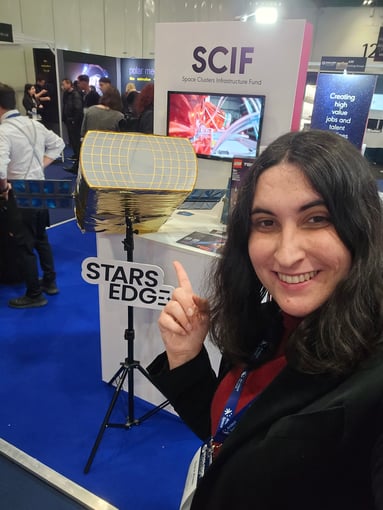
Sara Alão - CEO and Co-founder of Stars Edge
The satellite industry is booming. Retail giant Amazon is midway through a launch programme of more than three thousand satellites to provide broadband connectivity worldwide. There is Elon Musk’s Starlink, which has 9,400 satellites in orbit with a hope to reach 42,000. The European Union is plotting its own global network called IRIS². And then there’s a recent Chinese bid to secure 200,000 slots in space.
Into this mix enters Stars Edge, founded by Sara Alão.
This bold British startup is looking to shake up the satellite scene with a list of innovations, including a plasma ramjet engine, a low-cost modular design, and a focus on Very Low Earth Orbit or VLEO.
The ramjet immediately stands out. In theory, a plasma ramjet is a futuristic engine, blasting ionised gases for hypersonic flight, a concept popularised by Poul Anderson in his novel Tau Zero, published in 1970 and usually found only in science fiction novels.
Surely a plasma ramjet doesn’t really exist?
‘It’s a fun way to describe our Aeris engine, but it’s not truly a ramjet,’ says Alão. ‘It’s a space ion engine, the first of its kind. And does, in fact, use plasma to accelerate whatever goes through it with a lot of thrust.’
The design is a twist on an existing type of ion jet engine. Alão explains: ‘Typically, space engines shoot neon, argon, xenon – the noble gases – one particle at a time to keep the satellite in the right position. Our engine is different because it’s hollow. As our satellite flies through the air, it takes in the particles and adds extra energy to the flow. It’s like when you hit a speed gate and go faster in Super Mario Kart. So Aeris is akin to a ramjet, but we aren’t injecting fuel.’
VLEO
Just by itself, the Aeris engine would be fascinating. But it’s a single part of Alão’s bigger vision to create something new in the satellite industry.
Stars Edge is seeking to be the dominant force in a space niche – Low Earth Orbit.
‘VLEO means orbital altitudes below 400km above the Earth’s surface,’ she explains. ‘Our sweet spot is 100km to 150km.’ This compares to 550km for Starlink satellites at LEO and 23,000km for the Galileo GPS at medium orbit.
‘There are lots of advantages to VLEO over the more traditional orbits,’ says Alão.
Exposure to harmful space radiation is reduced with VLEO. ‘The air cloaks us,’ she says. ‘At higher orbits the radiation destroys electronics pretty quickly, so they need to be shielded. Our lower orbit means we can host electronics such as higher-resolution cameras and antennas that aren’t space rated. We are able to host the new FPGA [field-programmable gate array] and GPU chips that are used in AI, which enables us to do some of the AI data-processing on board. This reduces the amount of raw data we need to send to the ground.’
The Stars Edge satellite platform can host all sorts of kit. These include cameras for observing the Earth, with applications for agriculture, military and environmental monitoring. Telecoms transmitters can handle 5G and other signals. Broadband can be provided. VLEO offers advantages to them all.
VLEO offers a clearer line of sight and lower latency than higher-orbit satellites. The latency for a one-way journey from the ground to a VLEO satellite is 0.5 milliseconds, a third of that offered by an LEO satellite. This means a real-world round-trip responsivity of 5 to 10 milliseconds, a benefit for time-sensitive applications such as handling telephone or video calls.
Being closer to the ground also means the equipment can perform better. ‘For cameras there’s less visual distortion,’ says Alão. ‘This is important, because there’s so much demand for optical services.’
Cost of provision is slashed. Whereas higher-orbit satellites require specialist equipment built for the lower pressure and exposure to radiation, VLEO is more tolerant to off-the-shelf kit. A standard 5G antenna works perfectly well at VLEO.
And VLEO is less polluting. The Aeris engine sucks in air from the atmosphere to shoot out its funnel. This means there’s no need for chemical or noble gas propellants. As the number of satellites hits the hundreds of thousands, space pollution is becoming a hot topic, so this is another selling point.
The satellite platform
As a startup, Stars Edge needs to keep costs down, so Alão and her team of 11 are building a satellite platform on a tight budget. She explains that traditional satellites use layers of aluminium sheets or honeycomb, which are stable across extreme temperatures. However, she explains: ‘These are intricate, take time to make and only a couple of companies supply them, so it’s a limiting approach.’ Stars Edge takes advantage of VLEO to be more cost effective. ‘We can get away with cheaper and better materials, because the temperatures at lower orbits aren’t that high,’ says Alão. ‘We use ceramics, composite materials such as carbon fibre and glass fibre, and even plastics. We can use low-cost production methods such as 3D printing and mould casting.’
Being closer to Earth reduces shielding demands: ‘We don’t require the same levels of thermal protection as generic satellites.’
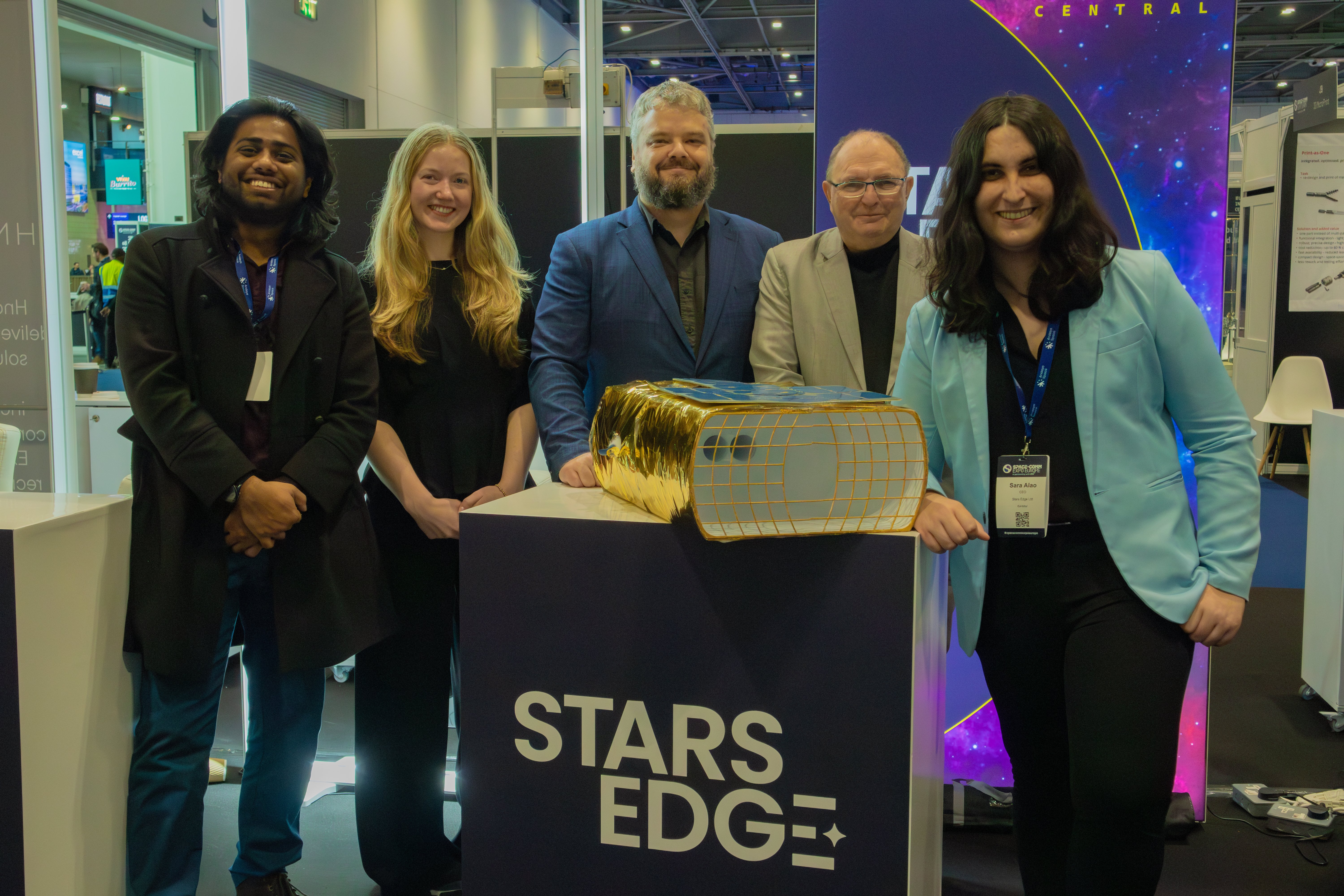
The result is a low-cost, easily modified satellite platform that can host devices of almost any specification. ‘In terms of size, our smallest satellite is 32 inches across, and about 10 centimetres tall,’ says Alão. ‘The solar panels that supply the energy are from two metre wingspan. The components – such as the batteries, solar panels, computers and so on – we’ll outsource. There’s no point in making these ourselves when we can use standardised components.’
Launch, test then sell
The next phase of development for Stars Edge is to put the hardware into space. ‘We’ve reached the limit of what we can do on the ground,’ says Alão. ‘What we’re doing is very difficult to validate. It’s easier to test in space than on Earth with mimicked conditions.’
The physics of satellite performance in VLEO, where air resistance is significant, is ‘messy’ she says. ‘The only facilities that can mimic this are large ones for space shuttles and their re-entry. They cost hundreds of thousands of dollars a day to hire. Computational fluid dynamics can simulate air flows, but it’s just cheaper to go into space and test there.’
The growth of the UK space industry may offer a route to orbit. Spaceport Cornwall opened in 2022, with a 2.7km runway for horizontal take-off spacecraft. More than 500 space and data companies are in the regional cluster. There’s SaxaVord Spaceport in Shetland, still under construction. ‘The spaceports are ready,’ says Alão. ‘It’s the rocket launcher companies that everyone’s waiting for.’
The small size of the Stars Edge satellite is a big help. ‘We can get quite a few on board a smaller launcher, and even if we pay for a dedicated launch we can inject our satellites into the high atmosphere. Our low orbit means we don’t need to pay as much for fuel as traditional satellites. We can also go with a big launcher, get dropped with all the others at 500km and then drop our altitude over time to 150km.’ The Aeris plasma ramjet would steer the satellite into space in this scenario.
VLEO also means radical new methods may work: ‘There are companies trying to use high-altitude balloons. And one of my personal favourites is to fly a fighter jet high and then launch using a missile with a satellite on it instead of a warhead.’
The fighter jet method is built on a Cold War military method. ‘The Russians had spy satellites, in Molniya orbit, which is highly elliptical and gets very close to Earth at its lowest point,’ says Alão. ‘A fighter jet could fly to 40km high and fire a missile carrying the satellite.’ Alão admits there may be regulatory concerns about fighter jets firing satellite missiles into orbit, but the science is sound.
When orbital testing begins, more funding may be needed. So far, Alão has been a master of improvisation. ‘We’ve been able to bootstrap for two years without any money injections,’ she reveals. ‘The most raw cash I’ve ever got is £100,000. Everything else has been in kind. We’ve accumulated over a million in benefits, from testing facilities and prototyping, manufacturing, legal, marketing, branding and everything else.’ A current funding round is underway. ‘This will allow us to scale production capability, fund an orbit demo, and start bringing more seniority and expertise within the team as well. We’ve done incredibly well with partnerships, research and technology so far, but in the end every space company needs funding.’
The space industry
Alão is confident Stars Edge has a bright commercial future. ‘There’s a lot of unserviced demand,’ she says.
Telecoms could be huge. ‘We can cover the whole of the UK with just 50 satellites to provide 5G coverage. There’s the potential to transfer data straight down the phone without needing a massive ground antenna. We need fewer satellites because we’re VLEO, we’re closer.’
The cost is low for the telecoms world. ‘A 5G network by Stars Edge would cost under £500m a year. This would give the mobile phone company a monopoly on reach. The coverage here in Britain is so patchy.’ Anyone trying to get a signal in central London or on a commuter train can attest to this. For context, the newly merged VodafoneThree is spending £11bn on 5G infrastructure over the next decade.
The lower cost means nations currently excluded from the space industry can enter the sector. The geopolitical angle is also important for potential clients. ‘Nations in the Middle East and Eastern Europe want to develop their own space capabilities. There’s a sense that they don’t want to always rely on the United States. Resilience, security and sovereignty are something we can offer.’
There’s a chance to licence some of the technology. The Aeris engine is bound to be of interest to other satellite companies that are currently wedded to legacy technology. ‘This is an industry slightly stuck with existing technology because of production lines. You see this in the airline industry, where delta wings are superior but won’t happen because of the cost of switching.’
Stars Edge is an agile organisation, based in the Surrey Research Park in Guildford, home to more than 140 entrepreneurial companies. It’s a great place to be, says Alão: ‘We are part of the Surrey Space ecosystem, which goes to Portsmouth, Southampton and London. It’s really active. It’s where we met Mewburn Ellis, at a space event. We talked about the work we’re doing.’
Alão is fast becoming a spokesperson for the UK space industry. Her natural eloquence on space topics, grounded in her PhD in aerospace from Cranfield University, means she’s in demand by the media. She also gave a great TED Talk on how shooting stars are often merely man-made debris. ‘It’s true,’ she says. ‘A lot of what you see are satellites crashing down to Earth. If the colour is blue and white, that’s aluminium burning.’
Her mission is to build Stars Edge into a leading name in the space industry: ‘The goal is to make better-quality space data more accessible and cheaper, and really upping the sovereignty angle too. Emerging markets deserve access to space.’
The space industry is dominated by national agencies, tech entrepreneurs and the military. But with the ramjet, focus on VLEO and embracing of new design principles for the satellite hardware, there may well be room for a passionate and creative company such as Stars Edge.
Toby Hill, Associate and Patent Attorney, at Mewburn Ellis comments:
“Stars Edge represents the very best of the UK’s rapidly growing space sector - ambition, creativity and a willingness to rethink established design principles. Sara’s work on VLEO satellites and the Aeris engine is opening up new technological and commercial opportunities that simply haven’t been possible before. It’s inspiring to see a company driving this level of innovation, and we look forward to watching Stars Edge continue to accelerate."
Written by Charles Orton-Jones.
.png?width=100&height=100&name=My%20project-1%20(9).png)
.png)
-1.png)