Forward speaks to Asel Sartbaeva, the co-inventor of a method to make temperature sensitive medicines withstand heat, with the potential to transform the way they are stored, transported and delivered.
Forward: features are independent pieces written for Mewburn Ellis discussing and celebrating the best of innovation and exploration from the scientific and entrepreneurial worlds.
Keeping life-saving medicines chilled is a major global challenge. Dr Asel Sartbaeva is the co-inventor of a method to make temperature sensitive medicines withstand heat, with the potential to transform the way they are stored, transported and delivered. Her work has won more than 30 awards.
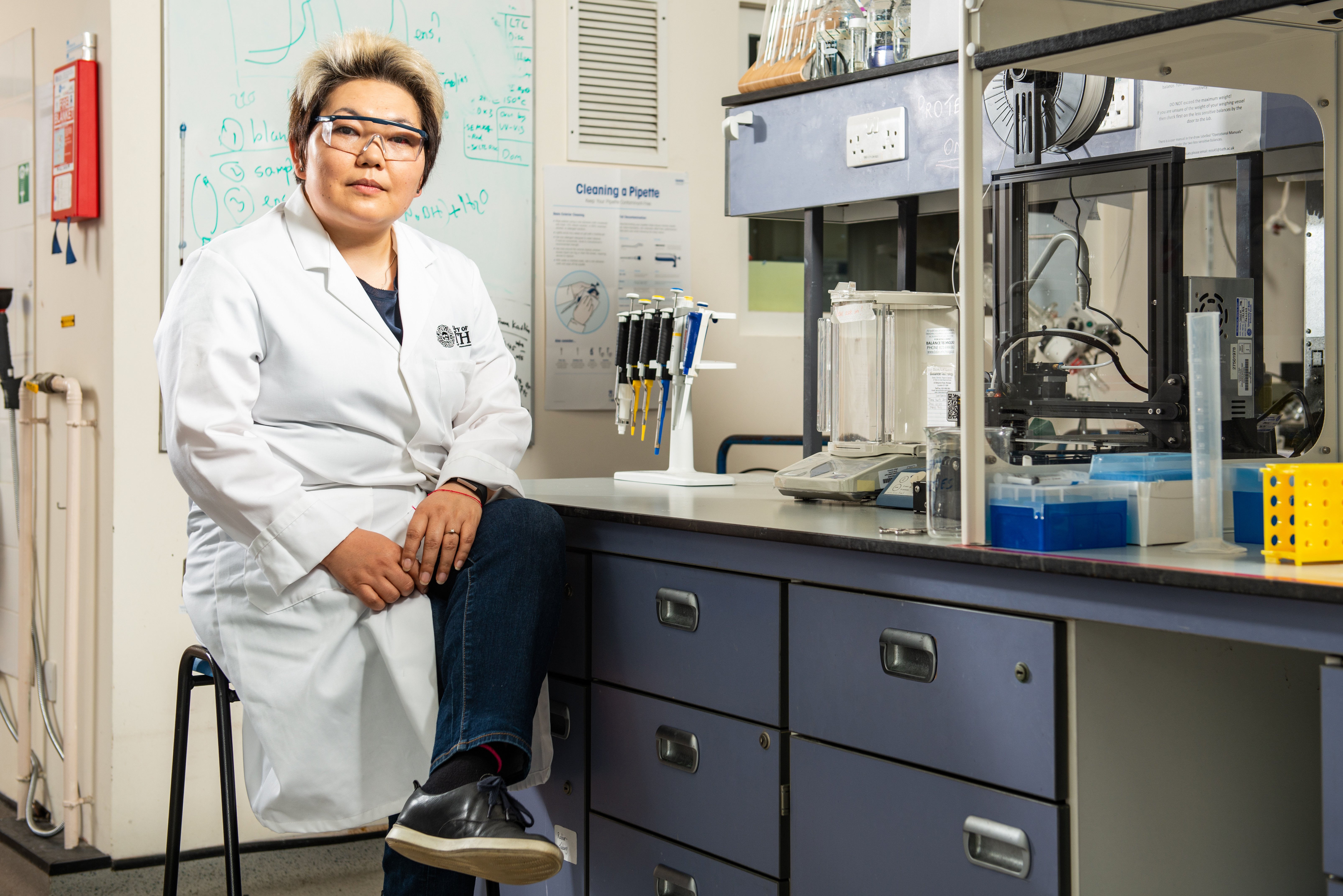
Dr Asel Sartbaeva
Co-founder and CEO at EnsiliTech
Vaccines save millions of lives each year – but only if they are kept cold. From factory to clinic, most must travel through a fragile global cold chain of refrigerators, freezers and ice packs. When that chain breaks, vaccines spoil, programmes falter and lives are lost.
It was a brief encounter with that system that set Asel Sartbaeva on a path to change it.
When Sartbaeva took her baby daughter to be immunised, she was surprised to see the doctor take the vaccine out of the fridge. She asked if it could be warmed up before it was given to Melinda, who was just a few weeks old, only to be told it would spoil in the heat.
That chance conversation changed the course of her research – and could ultimately save millions of lives.
Sartbaeva, a researcher in chemistry at the University of Bath, went on to develop a coating that allows the vaccines to withstand temperatures of up to 50°C, without the need for refrigeration.
The need and, therefore the potential, is huge.
Most vaccines rely on a global network of refrigerators and freezers during transit and storage. This cold chain is expensive, costing an estimated $200 to $300 million a year – up to 80% of the total cost of vaccination programmes. It is also energy intensive, generating more than 1.5 billion tonnes of carbon dioxide annually, and prone to failure.
The World Health Organisation estimates that up to 50% of vaccines are wasted, in large part due to breaks in the cold chain. The challenges vary country by country. In sub-Saharan Africa, for example, only half of hospitals have a reliable electricity supply.
By contrast, in Kyrgyzstan, Sartbaeva’s home country, the infrastructure is typically ‘quite good’ but some pockets of the population remain hard to reach. Vaccines may be taken on horseback to nomadic communities in the mountains, for example.
Eliminating the cold chain would make it easier to transport vaccines to those who need them. It would save on emissions, and with 1.5 million children under five dying from vaccine-preventable diseases each year, it could also save lives.
Why sand may hold the secret
Sartbaeva’s curiosity was piqued by the doctor’s throwaway remark. Her background is in mineral physics and she wondered if she could use her knowledge of inorganic materials to make vaccines thermally stable.
Most traditional vaccines are protein-based. These proteins are folded into complex 3D shapes, which determine their function. Without refrigeration, these chains can unfold and the vaccine can lose its potency.
‘You can liken it to boiling an egg,’ explains Sartbaeva. ‘The proteins inside an egg unravel when you boil it – and there’s no way back. You can’t unboil it.’
Her solution to preventing this unfolding was to encase the proteins in silica.
Silica, the main constituent of sand, is inexpensive, abundant, non-toxic and biocompatible, and she had been studying it for many years.
First, the silica is broken down into small particulates – tetrahedra comprised of one silicon atom connected to four oxygens.
These ‘standalone’ silica molecules are then placed on the protein’s surface, where they clump together, forming a tight, protective coating.
Whole viruses and bacteria can also be encased like this, and the technique can also be used to stablilise mRNA vaccines.
The process, which is known as ensilication, is being perfected by EnsiliTech, the biotech Sartbaeva went on to co-found with three others.
EnsiliTech, which spun out from the University of Bath in 2022, aims to license the technology to vaccine manufacturers. They would add ensilication to their existing manufacturing process, likely at the stage at which they add adjuvants. The vaccines would then leave the factory without the need for refrigeration.
Towards clinical trials
The company has shown that the process can keep wide range of vaccines stable, carried out safety studies on animals and is close to going into the clinic.
The first trials will be of animal vaccines (Sartbaeva can’t say which ones) and these could be on the market by 2028.
The first human trials, meanwhile, will likely be of a product that EnsiliTech is developing with biotechs in South Africa and the US. The trio are working on the world’s first thermally stable mRNA vaccine.
mRNA vaccines are particularly unstable and the ensilication-free version of the new jab needs to be kept at minus 80°C.
By contrast, the ensilicated version can be kept in a refrigerator and, with further work, it may be possible to keep it a room temperature.
This vaccine, against Hantaan virus, a rodent-borne infection that can cause life-threatening respiratory and kidney problems, could be on the market in five to eight years, says Sartbaeva.
There have been challenges, too. These include how to release the active ingredient from its protective coating when required.
EnsiliTech spent several years working on an injectable device that would crack open the silica shell but is now pursuing a simpler solution.
It turns out that the silica coating is biodegradable: it dissolves in the slightly alkali pH that is found in many body fluids, including those in the muscles. In other words, there may be no need to remove the shell at all.
Stopping antibodies from bumping into one another
EnsiliTech is also working on improving the delivery of antibody therapies. Like many vaccines, most therapeutic antibodies need to be kept cold, but temperature is not the only challenge.
Antibodies also tend to aggregate. When they are compressed into a small volume, the molecules clump together, which stops them from working properly.
To get round this, antibodies often are diluted in large quantities of liquid – sometimes up to two litres. As a result, they must be administered slowly via intravenous infusion, with treatment often taking several hours in a hospital setting.
Wrapping each antibody in silica prevents aggregation, says Sartbaeva, meaning that it should be possible to do away with the large amounts of fluid.
It may even be possible for some drugs to be given as subcutaneous injections, allowing cancer patients or those with cystic fibrosis or Crohn’s disease to treat themselves at home and removing the need for time-consuming hospital visits.
The hope is that the combination of easier transportation and administration will help widen access to treatment worldwide.
‘A recent Wellcome Trust report said that 80% of the antibody-based treatments are produced by in the EU, US and Canada; they are also being consumed by those territories,’ says Sartbaeva. ‘That means that the 85% of the population that live outsides those territories are not getting these therapies. We want to change that.’
Inspiring the next generation
Sartbaeva and EnsiliTech have won more than 30 awards for their work. Recent accolades include MedTech & HealthTech Startup of the Year at the UK Startup Awards 2025 and Technology Entrepreneur of the Year at the ‘Grammys for entrepreneurship’, the Allica Bank Great British Entrepreneur Awards.
Sartbaeva, who picked up a ‘woman of the year’ award in 2021, is particularly proud of her role as a goodwill ambassador for UNICEF.
As the first person from Central Asia to receive a PhD from Cambridge, she is something of a celebrity in Kyrgyzstan, where she helped develop and deliver a programme that encouraged girls to pursue careers in STEM subjects.
'Kyrgyzstan is a very patriarchal society with high rates of femicide and very high rates of domestic violence against women,’ she says. ‘I think partly stems from differences in the way the sexes are educated, with girls actively discouraged from getting an education but everything allowed for boys.’
‘This inevitably leads to an imbalance – and girls and young women becoming financially dependent on their husbands or families.’
‘The idea of the UNICEF programme was to encourage girls to think of going to university so that they get a higher education and financial independence. My goal is to encourage all girls to get an education so that they can fulfil their potential and get a career alongside the family life.’
Working with the girls’ parents, especially their fathers, was particularly fulfilling.
Sartbaeva says: ‘The fathers would say “If females go into science, they don’t marry and don’t have children” and “We don’t want to see our daughters not married because it’s a very patriarchal society and you have to be married to succeed in life”.’
‘By telling them my story and saying “look, I’m a prominent scientist, I’ve succeeded in science but I also have a family and children. It’s possible to have both”, a lot of them changed their opinion.’
The programme provided mentorship and masterclasses to more than 4,000 girls – eight times more than originally planned. Most of those who were about to leave school went on to university, where almost two-thirds studied STEM subjects.
Room for everyone
Of course, EnsiliTech isn’t the only start-up working on making vaccines more heat stable. Some are using sugar glass or the polymer PLGA to encapsulate vaccines; others are trying to create more efficient refrigerators.
‘I’m quite pragmatic about it because it is a big, big problem,’ says Sartbaeva. ‘There will probably be some vaccines for which one technology is better than another and so there is probably space for everyone.’
‘Our big mission at EnsiliTech, and why we created the company, is for people to have access to life-saving vaccines and antibodies for hard-to-treat diseases no matter where they are born.’
‘Our ultimate goal is to save as many lives as possible.’
Anja Koller, Senior Associate and Patent Attorney, at Mewburn Ellis comments:
“What makes Asel Sartbaeva’s work particularly compelling is that it originated from a real world problem. Her approach shows how deep scientific curiosity, when directed at genuine unmet needs, can lead to innovations with lasting future impact."
Written by Fiona MacRae.

.png)
.png)