Alina Klarner explains her firm’s philosophy of impact investing, the difference between a unicorn and a zebra and how her fund supports founders from diverse backgrounds.
Forward: features are independent pieces written for Mewburn Ellis discussing and celebrating the best of innovation and exploration from the scientific and entrepreneurial worlds.
We asked Alina Klarner, Founding Partner at Impact Shakers Ventures, to explain her firm’s philosophy of impact investing, the difference between a unicorn and a zebra and how her fund supports founders from diverse backgrounds.
Hi Alina! What is Impact Shakers?
We are an ecosystem investor. Back in 2018, Impact Shakers was set up to help build the European impact ecosystem. We worked on bringing over 500 organisations in Europe and the UK together to collaborate on building the impact economy, and ran over 30 accelerators, incubators and investor readiness programmes for diverse founders. In 2022, we decided to add capital and launched our friends and family vehicle, the Impact Shakers Microfund, which has more than 100 members and made ten-plus investments. Then, in 2024, we launched our first €20m Impact VC fund. In fewer than 18 months, we have made 13 investments, with four more in the pipeline for this year, and backed 23 exceptionally diverse founders. We have deployed almost €4m in pre-seed funding and catalysed another €10m from others in this timeframe. And this is just the beginning! Our mission is to create impact at scale by changing who gets to build businesses, for which purpose and how we build them.
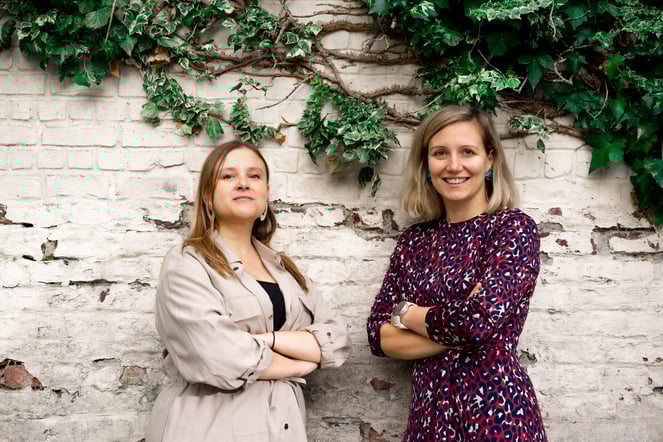
Yonca Braeckman and Alina Klarner (Founding Partners of Impact Shakers Ventures)
What do the terms diverse and minority encompass?
Impact Shakers was founded on the belief that in order to solve the world’s most pressing issues, we need humanity’s full problem-solving potential. We therefore invest in diverse teams led by women, people of colour, people with a migration background, LGBTQ+ and people with a disability. We chose an intersectional approach because we believe there is true power in diverse and inclusive innovators who can bring their unique perspective based on deep lived experience, both personal and professional.
But this is far from the norm. When you have 85% of founders in the US coming from two universities – Stanford and Harvard – and only 2% of venture capital going to female-led businesses, the definition of who can become a successful entrepreneur becomes very narrow. What’s worse, the amount of capital going to diverse teams hasn’t changed since we started collecting data over 13 years ago, but the opportunity is enormous. As an example, depending on stage and geography, somewhere between 20–50% of companies are women-founded. This represents a significant market inefficiency – overlooked founders with proven track records who can’t access capital. That’s the kind of arbitrage opportunity VCs dream about and it comes with the bonus of creating real-world impact. Plus, as a European investor, this approach to diverse and inclusive teams aligns well with the diversity we have on the continent.
How do you find investments?
We have custom-built a pipeline for diverse impact startups, with three main parts. First, a significant part of the pipeline comes through our partner network of over 500 universities, accelerators, ecosystem builders and other impact investors. They refer founders to us when they think it’s a good fit, but we also co-organise pitching competitions and other events. Second, there’s our own scouting: each week, we publish impact startups to watch, we have calls for applications that bring in hundreds of startups and we proactively look for specific solutions. Finally, there’s the inbound aspect. There are very few pre-seed funds in Europe investing €250k in diverse teams building impact businesses, so founders also find us. We see more than 2,000 startups each year and the quality of a great many of them is exceptional.
Wow! And how long do you usually take to familiarise yourself with founders?
Most of the founders we will have known for six to 12 months before we invest. We try to get to know the founders and what drives them before we even start the due diligence process. So much of the impact they’ll likely create will be based on their intentions and their North Star, so this is very important to us. Plus, we invest in humans, not companies, so the better we get to know each other, the better. After we invest, our founders go through a six-month accelerator programme focused on scale, impact and founder wellbeing, where we work very closely with them on everything from go-to-market to hiring. This gives us another chance to see them in action, work together and get real insights into how we can best help.
I know six to 12 months sounds long, but it’s crucial. We can move fast if we need to, but the ideal scenario is that we give ourselves the time to get to know each other before the founders actually need the money. So if you’re six to12 months out from fundraising, reach out now. Let’s build that relationship before you need the cheque.
Human relationships are everything, so we do everything we can to build a relationship founded in trust, transparency and support for the humans behind the business – and we expect the same from our founders!
A pet peeve in the investment world is BBC show Dragons’ Den, where investors are abrasive and the entrepreneurs are feisty and fight back. Is this image off-putting to entrepreneurs from underrepresented backgrounds?
Dragons’ Den is of course mostly entertainment, but even in the traditional VC world so much needs to be challenged – from the ‘winner takes all’ mentality to the power dynamics that favour investors to the pattern matching that means investment mostly goes to a very narrow slice of the entrepreneurial population.
We deeply believe that in order to build a sustainable and inclusive economy, we need to evolve who gets to build businesses, for which purpose and how we build them. This goes from supporting diverse entrepreneurs to building meaningful businesses with the potential to change entire systems to looking after founders’ mental health. This is the only way we can future-proof the economy and work towards thriving people on a thriving planet.
What sectors are you investing in?
We are across Europe and the UK in pre-seed and seed. The three sectors we focus on are climate tech, impact infrastructure and inclusion tech. Inclusion tech specifically focuses on startups working to create access to everything from health to education to financial services. As with diversity, we look for founding teams that take an intersectional approach to environmental and social issues and often have interdisciplinary backgrounds as well. We also look at how we can leverage AI for impact (e.g. AI models to make sense of complex datasets in renewable energy or medicine), as well as where we need to incorporate impact principles into AI progress (think untapped datasets improving outcomes in FemTech or for deskless workers). The common thread is the potential of the solution to positively contribute to systemic change.
So the businesses need a social or environmental impact, not just to make a profit?
Yes, very much so. As an impact VC, we need real-world, tangible impact that’s deeply interlinked with commercial success.
Is there a trade-off between profits and social value? Are you sacrificing something in the search for a social contribution?
This is the question that has been holding back the impact investment space for a long time. Take retail – there is a spectrum that goes from small corner shops or lifestyle businesses all the way to listed, international conglomerates. As an investor, you need to choose where on this spectrum you want to invest. As an impact VC, we choose startups that have the potential to grow fast, teams that are excited to scale, and business models that can deliver impact and returns at scale. What’s more, in times of economic and geopolitical uncertainty and rapidly changing environments, impact businesses have proven to be more resilient, better at attracting great people, and more authentic in terms of connecting with customers who are increasingly environmentally and socially conscious.
Let me give you some examples: Solence isn’t just helping women with polycystic ovary syndrome (PCOS) out of kindness – it’s tapping into a €24bn market that’s been completely underserved. Circular Library Network isn’t just reducing waste – it’s solving a real estate problem while creating recurring revenue streams. The impact isn’t separate from the business model; it’s what makes the business model work.
Can you give us some more examples of your investments?
An interesting one is BitaGreen. The team has built a climate risk analysis platform for cities and real estate. Climate disasters cost an estimated $200bn annually, yet most urban planning relies on outdated risk assessments. BitaGreen uses satellite data and AI to help cities and real estate developers model climate scenarios and plan nature-based solutions, providing cost and ROI analysis in the process. The founder, Nora Van Cauwenbergh, has assembled a team that combines environmental science with tech expertise and has already secured an impressive roster of corporate and infrastructure clients.
Another recent investment is Curiouz, a marketplace for vintage furniture tackling the fast furniture problem. One standard piece of furniture produces 53kg of CO2 and furniture accounts for 4% of municipal waste. The founder, Barbara Neto, previously built a profitable interiors business and invested a significant amount of her own capital into this venture. Her AI-powered platform curates vintage pieces and connects sellers, buyers and logistics in one place. In the six months between starting the business and us investing, the team onboarded 552 sellers and attracted 50,000 visitors – proving that conscious consumption can be both beautiful and profitable – and has been growing at speed ever since.
And one from the social sector?
There’s a fascinating company called Motics, an AI operating system for healthcare clinics that automates administrative work. Doctors spend over 20% of their time on paperwork, leading to burnout and medical errors. The founders, Harvinder Power (a doctor) and Salinna Abdullah (AI expert), reached over 150 paying clinics with just a team of two, hitting breakeven in under 12 months. They’re reducing administrative costs by up to 25% while improving patient safety – that’s systemic change potential in healthcare.
What advice do you have for entrepreneurs taking on early-stage funding? Especially around the issue of dilution – giving up large slices of equity.
Too many founders still don’t fully understand the implications of taking VC funding and the industry exploits this, leaving too many founders frustrated and burnt out. Before we invest, we explore with the founders what kind of business they want to build and over what timeframes, and what their ideal exit scenario might look like. While you can’t plan some of this, it gives us a good sense of the motivations and the kind of businesses founders want to build. We’ve had to turn down investments because we thought venture capital and the pressure to scale and exit within five to seven years wasn’t an ethical fit. We even run an investor readiness programme in Belgium where we dive into everything from how VC works to reading term sheets to building your very own fundraising plan that aligns with your values and your vision.
Here’s my concrete advice: before you take any investor meetings, answer three questions. What does success look like for you personally in five to ten years? What kind of company do you want to build – lifestyle business, steady growth, rocket ship? What are you absolutely unwilling to compromise on? Then ask potential investors the same questions about their expectations. If there’s misalignment, walk away. No amount of capital is worth building someone else’s vision.
And the issue isn’t purely dilution, right? It’s who has the right to make crucial decisions for the business, who can veto them and what hoops do you make founders jump through day to day. Even at the early stages, there are some outdated practices out there. If we truly believe in diverse founders’ ability to innovate and scale their solutions, we should be working on ways to keep decision-making consensual and in the interest of all parties. For example, we structure board seats to maintain founder control at early stages. These aren’t just nice-to-haves – they’re essential if you believe diverse founders know their businesses best.
Finally, the Silicon Valley Unicorn model is a US model. Over decades, we’ve been feeling bad about not living up to the US hype. Fewer IPOs, less risk capital, and so on. The fact of the matter is that we’re operating in the European market and most exits come from acquisitions, not IPOs. So if the data on the outcomes tells us that it’s not a great fit with the US model, maybe it’s time to be more proudly European and embrace a diversity of models to grow, run and maybe exit your business one day.
Impact Shakers talks about zebras. What’s a zebra?
While Silicon Valley chases unicorns, mythical creatures where winner takes all. Zebras are real. They’re black and white: profitable AND purposeful. They thrive through collaboration, not domination.
But here’s the thing: we need both. Some solutions require unicorn-scale growth and massive capital deployment. Others are zebras – sustainable, steady, delivering deep impact and solid returns. And, honestly, there are dozens of other models we haven’t even named yet.
The traditional VC model says: invest in ten companies, expect nine to fail, hope one returns 100x. That’s wasteful and fundamentally at odds with impact investing. We build portfolios where every company can succeed on its own terms. The point isn’t to force every startup into the same mold – it’s to match the right model to the right solution. One size doesn’t fit all – and that’s not just okay, it’s essential for solving complex problems.
What support should entrepreneurs expect from a VC? What’s the ideal relationship?
Choosing an investor is like choosing a life partner. You commit to potentially spending the next ten-plus years together on something that probably takes up most of your time, energy and intellectual capacity. Every founder gets to choose what this relationship should look like for them. At the most basic level, a VC’s job is to provide access to capital and networks. If we come from an operational background, like most of our team, we can provide more: we offer support across sales, marketing, operations, hiring, finance, impact and, maybe most importantly, founder wellbeing. I think we will see VC move more into this direction – as AI provides more leverage early on, VCs will need to evolve their business models to create more actual value for longer.
Impact Shakers as a company is also diverse. What’s the culture like?
You should probably ask the team… When I was working in private equity, I could spend an entire week without meeting another woman. Impact Shakers is the complete opposite. We strive to be as diverse and inclusive as possible in our team, our partners, our suppliers and everyone else we work with. We’re trying to build a culture where it’s normal to challenge the status quo, where everyone gets a chance to do what they’re good at and enjoy, but also where everyone is willing to give their all to get us closer to our goal of creating impact at scale.
You run an angel investing course. What does it cover?
When I started my angel investing journey, I learned many things from people I co-invested with, by making my own mistakes, by reading and researching. The most enjoyable parts were those where I got to invest together with others. This course accelerates this process by bringing together a cohort of ten to 15 people who want to learn and invest in line with their values, providing a basic introduction to everything I wish I had known and encouraging people to go out there and put some money on the table. We’re deliberately encouraging people who don’t look like traditional angels to deploy capital. Because if angels decide what gets to exist at the earliest stages, we need those angels to represent the diversity of solutions the world needs. Even a €5–10k ticket can be catalytic for a pre-seed founder.
And, finally, for entrepreneurs you have an accelerator. What support do you provide?
We’ve run over 30 programmes since 2018, but since launching our €20m VC fund, we have mostly been focusing on our flagship accelerator. This brings together the best of what we’ve created over the past years and is entirely tailored to each team. The three main pillars are scale, impact and founder wellbeing, and we have an exceptional in-house team to help founders, as well as a pool of trusted operators to help startups with everything from setting up an ABM strategy to finding the best hires. What’s truly unique about this is the personalised nature and the focus on making sure the founders AND the business do well. Our accelerator is all about the humans and helping them achieve what they want.
Thanks, Alina!
You’re welcome!
Eleanor Maciver, Sustainability Champion, Patent Attorney and Partner, at Mewburn Ellis comments:
“Impact Shakers’ model shows what the European startup ecosystem gains when capital, inclusion and mission align. By investing early in diverse teams solving complex social and environmental challenges, Alina is helping strengthen the region’s innovation infrastructure.”
Written by Charles Orton-Jones.


.png)