Cambridge University spin-out BioTryp is developing inhibitors that disrupt a signalling mechanism of bacteria to prevent the formation of biofilms, thereby reducing infection.
Forward: features are independent pieces written for Mewburn Ellis discussing and celebrating the best of innovation and exploration from the scientific and entrepreneurial worlds.
Antibiotic resistance is a profound threat to global health. A recent World Health Organisation report spelled out the danger. One in six laboratory-confirmed bacterial infections were resistant to antibiotic treatments in 2023, and more than 40% of antibiotics lost efficacy to treat common urinary tract, blood, gut and sexually transmitted infections between 2018 and 2023.
Dr Yvan Hutin, director of the WHO’s department of antimicrobial resistance, warned:
‘As antibiotic resistance continues to rise, we’re running out of treatment options and we’re putting lives at risk.’
BioTryp Therapeutics may have a solution. This Cambridge University spin-out is developing a new way to address bacterial infections. Its small molecules work by preventing the signalling between bacteria that enables them to form biofilms. It’s not an antibiotic, so it treats bacterial infection without contributing to antibiotic resistance.
‘I know people who have died of resistant infections,’ says Dr Ashraf Zarkan, CEO of BioTryp. ‘The O’Neill report, the seminal work on the topic, predicts 10 million deaths annually by 2050 if nothing is done. This is more than all cancers combined. The healthcare system relies on antibiotics. Whether you have stomach surgery, a hip replacement or receive immunotherapies to treat cancer, if you don’t have antibiotics, you probably won’t survive.’
Disrupting the biofilm
BioTryp’s alternative approach stems from the way bacteria interact. Four in five chronic bacterial infections are caused by biofilms – tight communities of bacteria that form a protective wall against the immune system and antibiotics. Biofilms are the defensive fortresses in which bacteria generate critical mass to threaten the health of their host.
Dr David Summers, the scientific director of BioTryp, made a discovery in his lab that would lead him to investigate biofilm formation.
‘There are accessory DNA circles called plasmids that live in bacteria,’ explains Dr Summers. ‘The relationship with the bacterial cell is interesting, as they behave very much like parasites. Don’t think of a plasmid as just a component of the bacterial cell – it’s more like a flea on a dog. The discovery we made was that a plasmid I’d studied for years, called ColE1, was manipulating the cell cycle of its host. It was regulating the ability of the cell to grow and divide to suit its own ends. We realised it did this by chemical signalling, in one case making the cell produce a molecule that inhibited its ability to divide.’
He began to focus on the underlying mechanics of how plasmids regulate the behaviour of the cells in which they live. ‘We started working on chemical signalling,’ says Dr Summers. ‘It just took over everything.’
He brought in Dr Zarkan, who has a background in pharmacy, to help him decipher cell signalling. The team mapped out how certain compounds could impede cell signalling, with implications for biofilm formation.
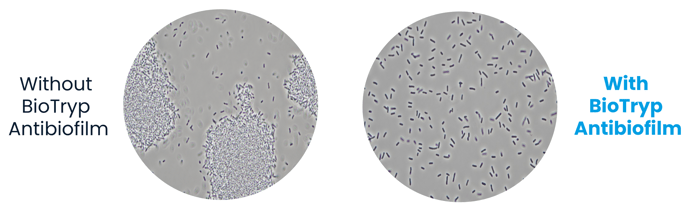
‘You get an effect where bacteria are not dead,’ says Dr Zarkan, ‘but they lose the ability to talk to each other. If they can’t communicate, they can’t coordinate to form biofilms. We very quickly saw how important this could be.’
They brought in external partner Cresset Biomolecular Discovery to accelerate the research. Computer simulations predicted which compounds might be relevant. Around 1,000 molecules were tested in the lab. ‘After six or seven years of research we had multiple classes of compounds that disrupt the signalling of bacteria,’ says Dr Zarkan. ‘They don’t kill the bacteria, merely stop them from forming biofilms.’
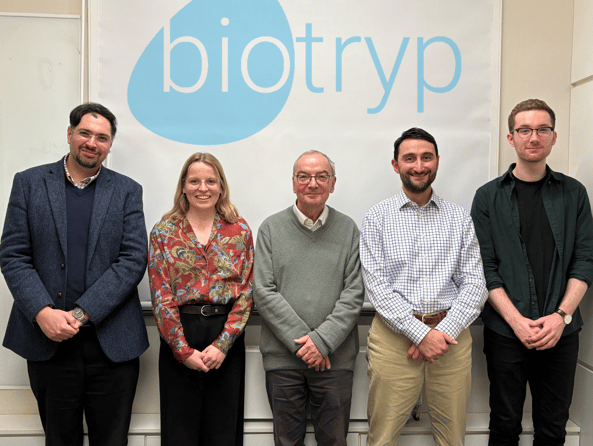
Dr Jehangir Cama (Commercial Director), Dr Juliette Nourry (Research Scientist), Dr David Summers (Scientific Director), Dr Ashraf Zarkan (CEO), and Mr Kieran Abbott (Research Scientist).
UTI treatment
The range of applications for biofilm inhibitors is far-reaching. BioTryp is focusing on one of the most important: urinary tract infections (UTIs).
‘Why UTIs?’ says Dr Zarkan. ‘They’re the most common bacterial infection on the planet, with 400 million cases a year. A major problem with UTIs is that you give an antibiotic, the clinical symptoms seem to clear up and then the infection returns. This is driven by the biofilms forming in the urinary tract. The current treatment is rather poor. After a dose of antibiotics, patients are put on low-dose prophylactic antibiotics for up to two years. This increases the chance of resistant pathogens developing.’
There is evidence that low-dose antibiotics may stimulate biofilm formation, making the problem even worse.
This new approach to bacterial infection means clinicians will be given a new tool to deploy. As an antibiotic-agnostic therapy, BioTryp’s compounds could be used in parallel with, or as a replacement for, any antibiotic at any stage, early or late, with potentially no impact on resistance.
Dr Zarkan: ‘We suggest a combination of antibiotics and our anti-biofilm drug. Our inhibitor prevents biofilms from forming, so the antibiotic can attack the isolated bacteria to clear up the infection faster. Then, afterwards, our drug would potentially work as a monotherapy to prevent the infection from coming back.’
Toxicity is a critical area where the company feels it has an advantage. ‘Drug discovery is not just about being effective, it must be safe too,’ says Dr Summers. ‘We are targeting a favourable effect whereby the kidneys would take our drug and naturally send it straight into the urine, giving us a high concentration precisely where needed to treat UTIs. It’s much easier to treat a UTI, therefore, than, say, an infection in the lungs.’
The research is still at an early stage. ‘We are testing mainly uropathogenic Escherichia coli bacteria in the lab, the most common type of bacteria in UTIs’ says Dr Zarkan. ‘By using our compounds, we can inhibit the formation of biofilms. But it’s in vitro work. The next step is to prove it in a mouse, then in a human.’
The road to market
The market is huge. One in two women and one in 10 men are afflicted by UTIs in their lifetime, and account for 17% of all hospital-acquired bloodstream infections. The current global UTI treatment spend is around $10bn a year.
BioTryp is building a roadmap to take its compounds to market. It is identifying a lead compound, which will be entered into pre-clinical trials, typically one rodent and one non-rodent study. The data will then be submitted to the regulator for approval to conduct a Phase 1 clinical trial. IntelliSyn Pharma, a Montreal-based preclinical drug discovery research company, is BioTryp’s partner for the current phase of development. Funding includes CA$200,000 from the National Research Council of Canada Industrial Research Assistance Program, alongside £300,000 from Innovate UK. Funding to date exceeds £1m.
‘We’ll hopefully have our lead candidate drug in a year, maybe a year and a half,’ says Dr Zarkan. ‘Then we’ll need more fundraising and two more years of pre-clinical work, with a Phase 1 clinical trial potentially in 2029.’
If UTIs are successfully treated, there are plenty of opportunities to expand. ‘Biofilms are a major problem in gastrointestinal and soft-tissue infections, wounds, implants, catheters and stents,’ says Dr Zarkan. ‘There are so many different aspects for us to explore.’
The team is currently raising a £2m seed round, led by Dr Zarkan together with co-founder and commercial director Dr Jehangir Cama.
Professor Susan Hopkins, chief executive of the UK Health Security Agency, recently declared: ‘Antibiotic resistance is one of the greatest health threats we face.’ BioTryp’s work points to a future in which bacterial infections can be controlled in way that’s sustainable in the long term.
Louise Atkins, Associate and Patent Attorney, at Mewburn Ellis comments:
“BioTryp offers a revolutionary approach for tackling antibiotic resistance – an antibiotic‑agnostic means of blocking the signals bacteria rely on for biofilm formation. This innovative strategy has the potential to transform how we manage persistent infections.”
Written by Charles Orton-Jones.


.jpeg)
.png)