The UPC Court of Appeal (CoA) has already said that the prosecution file history can have an effect on litigation in the UPC. But so far, this has been limited to providing evidence to confirm what the skilled person would have understood.
In Agathon v. Intercom (5 May 2026), on the face of it, the Milan Local Division held closely to this line of case law from the CoA, but the facts reveal a statement against interest made by the patent proprietor during EPO prosecution that was held against them in UPC infringement proceedings.
The patent and the claim interpretation
Agathon’s patent is EP 2363263 B1, claiming a centring device for a forming tool such as an injection moulding tool. The forming tool has two mould halves that are brought together. To guide them into precise alignment, the first mould half has a plurality of “guiding bodies (4)” that are received in corresponding “guiding recesses (6)” in the second mould half. Each guiding body is a cylindrical bolt (8) with caged ball bearings (12) to bear between the bolt and the recess to reduce friction. The caged ball bearings are called “rolling bodies” in the claim and are arranged in at least two rows. The claimed invention is characterized by the precise arrangement of the ball bearings as the mould halves are brought together.
The key features of the claim needing interpretation related to the location of the ball bearings in the “opened state” of the device and how and when they move as the mould is closed:
1.9 the second rolling body row (16) abuts an encircling edge (18) concluding the circularly cylindrical surface (17) of the bolt (8), and
1.10 in that each guiding recess (6) is formed from a sleeve (9) with a circularly cylindrical inner surface (10), which, upon closing of the forming tool, is able to run into the rolling bodies (12) of the rolling body cage (11),
1.11 in such a way that the sleeve (9) runs practically simultaneously on the first rolling body row (15) and on the second rolling body row (16) and the centring and pretensioning forces are able to be absorbed simultaneously by the first rolling body row (15) and the second rolling body row (16).
Everything is much easier to understand with a sequence of drawings from the patent, showing the recess 6 being pushed over the cylindrical bolt 8 with the ball bearing cage 11 between them:
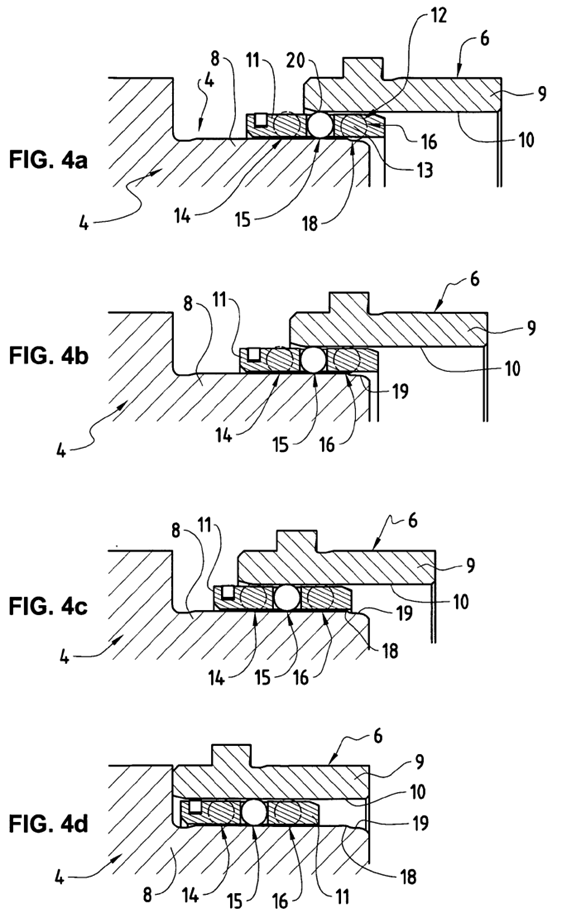
What the claim is saying is that the first row 15 and the second row 16 of ball bearings 12 touch and bear against the inner surface 10 of the guiding recess 6 at the same time as the mould is closed. This reduces the forces that each sees and this is good for reducing wear.
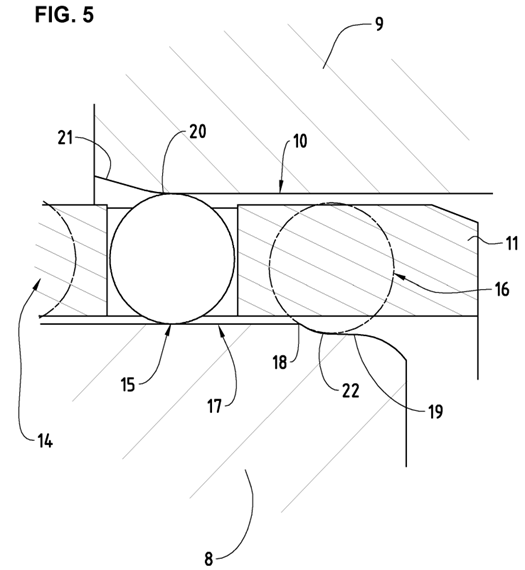
Fig. 5 shows a close up of the contact between the inner surface 10 of the guiding recess 6 and the first row 15 of ball bearings and the second row 16.
What does “abuts” mean here?
The key question was whether the claim requires that the ball bearing 16 is in contact with edge 18 with the mould in the opened state. The patentee contended that this was not necessary, because in the opened state the ball bearing could be further to the right, e.g. in contact only with smaller cylindrical surface 19, and still work fine because then the ball bearings would not be subject to pretensioning forces.
The court looked to the description and the drawings above and noted that these indicate that the ball bearings 16 are in contact with the edge 18 when the mould is in the opened state. The court also looked at the EPO file history and said this:
During examination before the European Patent Office the claimant submitted that it was “essential” or “decisive” (in the German original: “entscheidend”) for the simultaneous preloading that the second rolling body row abuts the edge (submission by Agathon before the EPO dated 23.11.2016). In response to this submission and arguments by Agathon, the EPO had issued the communication of intention to grant the patent-in-suit. In view of legal certainty, the complete turnaround in the statements made by the applicant/proprietor must be taken into account in the assessment.
How should “simultaneous” be interpreted?
This was also affected by the court’s conclusion that the claim requires the ball bearing 16 to be in contact with the edge 18. That meant that any movement towards the closed position would push the ball bearing up over the edge 18 to place it under load. Again focusing on the description and drawings, the court concluded:
… the function of features 1.8 to 1.11 is to provide for movement of second rolling body row 16 between a radially inward, unloaded position and a radially outward, loaded position immediately after the sleeve 9 has engaged with the first rolling body row 15, the result being that first 15 and second 16 rolling body rows absorb simultaneously centring and pretensioning forces.
Counterclaim for revocation
The court decided that claim 1 of the patent as granted lacked novelty over one piece of prior art (D3), but considered that dependent claim 3 did have novelty and inventive step over the substantiated attack from the defendant. One of the auxiliary requests amended claim 1 using the features of claim 3, and so this set of claims was deemed valid.
Infringement
Infringement turned on, amongst other things, the interpretation of features 1.9 and 1.11. The alleged infringement included a gap between the second row of ball bearings 16 and the edge 18 with the mould in the opened state. The patentee argued that the alleged infringement met the functionality of the invention, and that there should be either literal infringement or infringement by equivalence.
The court concluded that the alleged infringements did provide a space between the second row of ball bearings 16 and the relevant edge 18. However, based on their claim interpretation, the contact between these features was essential to achieve the technical effect of the invention.
Turning to the question of equivalence, the court noted that the alleged infringements worked more similarly to the prior art. Therefore any argument of infringement by equivalence would face a successful Gillette/Formstein defence.
Defendants put on the spot
There was a procedural point that is worth noting. In the hearing, the court asked the defendants if they would make the counterclaim for revocation conditional. In other words, if the court were to decide that the patent is not infringed, the court would then not decide on the validity of the patent.
We’ve seen this happen before – see UPC Weekly 2026 w3. In Emboline v. AorticLab, the defendant (alleged infringer) said that their counterclaim for revocation should only be considered by the court if they were found to infringe the patent. The court duly found no infringement, and so made no finding on validity. But the court ordered the defendant to pay the costs of the patentee in defending the counterclaim for revocation – both sides had incurred full costs because the validity issues have been fully argued in writing and at the oral hearing.
Presumably alive to this risk, in this case, Intercom politely declined this invitation from the court. The result of the patent being held valid only after amendment was that both sides bore their own costs for their work in the revocation counterclaim. So Intercom saved themselves having to pay this part of Agathon’s costs.


.jpeg)
.png)