Forward speaks to Daya Venture's CCO, Victorine Lançon as she tells Mewburn Ellis why 16 startups are just the beginning of a mission to improve women's healthcare in the most hands-on way possible.
Forward: features are independent pieces written for Mewburn Ellis discussing and celebrating the best of innovation and exploration from the scientific and entrepreneurial worlds.
Women are neglected in healthcare. Victorine Lançon, CCO of Daya Ventures, has a mountain of evidence to prove this. “I just gave a keynote on endometriosis,” she says. “Which affects one in ten women. It takes 58 doctor visits on average over six to ten years for diagnosis. The funding into endometriosis research is $2 per patient in the US, compared to $130 for Crohn's. This is the bias. I have endometriosis, so it's a personal example for me.”
Lançon explains that women were widely excluded from medical trials until 1993 in the US, and until the mid 1990s in Europe: “Even then it was not mandatory in Europe, meaning that most of the drugs women are using have never been tested in women before. It is why women experience twice as much side-effects as men, in both unplanned reactions and intensity. It is a huge problem in medicine.”
A 2013 study found women were 29% more likely to experience hip implant failure, likely due to anatomical differences and poor testing in women. There are some eye-opening tales from the pharma sector. “There was a drug exclusively meant for women, yet 23 of the 25 participants in the trial were male,” says Lançon, exasperated. “The drug was never meant for them! And that's a recent story.”
Lançon and her team are on a mission to close the gender health gap. Founded in 2023, Daya Ventures is a venture studio which creates femtech companies. The team at Daya identifies a niche in one of the female health sectors – menstrual, maternal, longevity, sex tech, wellness, data, chronic illness, mental health and even the space industry – and then builds a startup to address the issue. Or, if there's a startup which matches Daya's ethos then it can be invested in and absorbed into the portfolio for acceleration.
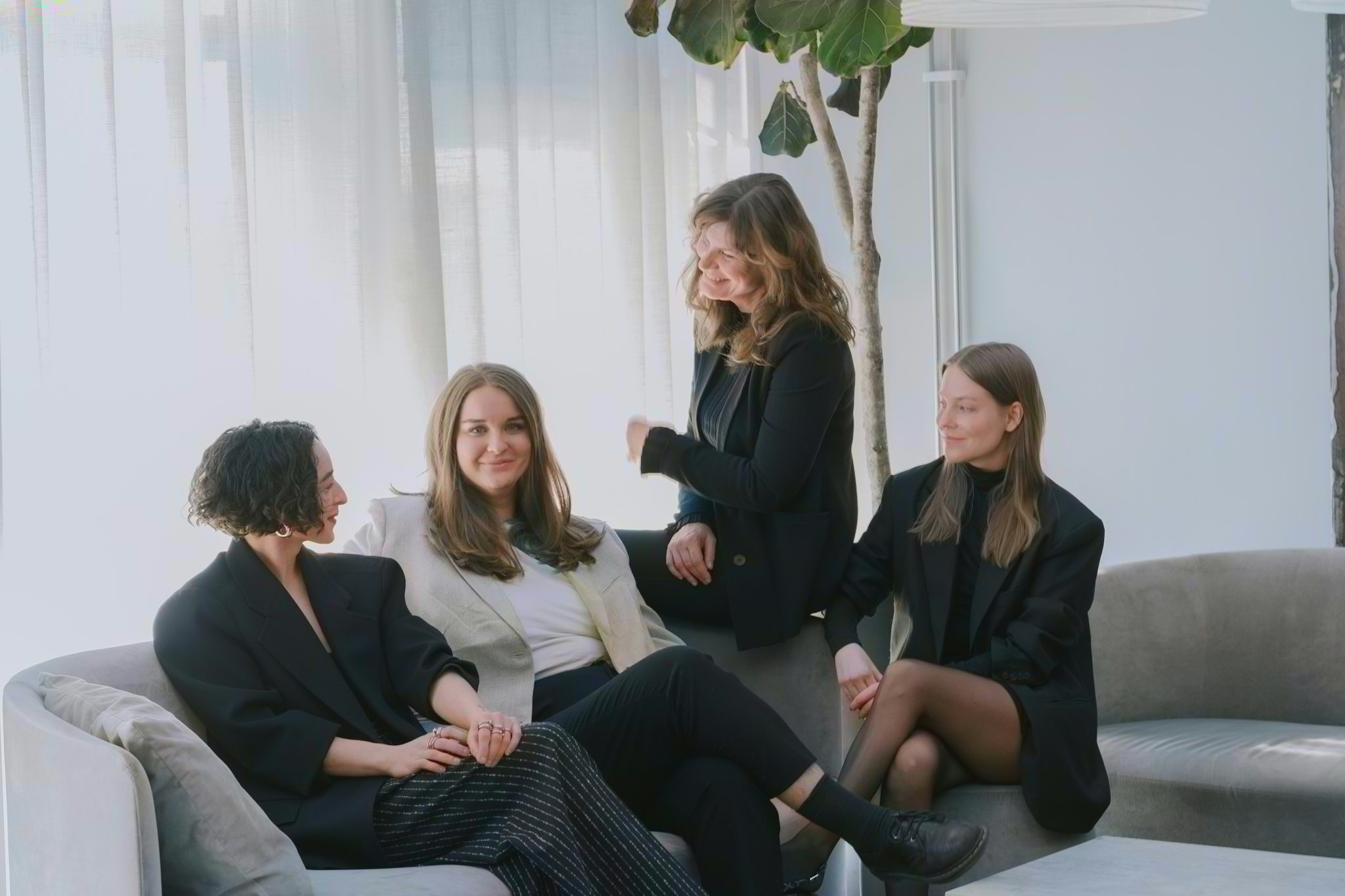
Victorine Lançon with Chief Executive Officer Malin Frithiofsson, Chief Innovation Officer Jennifer Grönqvist and Chief People Officer Jenny Lundkvist
Daya now has 16 startups on its books – a staggering achievement.
The model is unique. “Our ethos is around femtech,” says Lançon. “Which we define as issues that impact only women, women differently, or disproportionately. We start with ideation. We spend two months studying the market and society to see a market and a need. For example, for endometriosis we gather clinicians, patient advocacy groups, experts, everybody with a say in it, and run workshops to look at the tangible pain points. Why are patients navigating this alone? Why are they ignored? Where are physicians limited by structure and not scientific evidence? Then we evaluate the scientific, biological, and technical plausibility. Does the solution have legs?”
Normally here is where a team would build their own venture. Not Daya. It recruits founders to take on the idea.
“It's the hardest bit!” says Lançon. “And something we are still learning. What we have is access to an insane pool of amazing women.” Lançon reveals for this year's cohort she had over 1,000 applications from high level professionals. “And that's without actually running any open application. All that happened was our Chief People Officer wrote a post about it.”
Daya Ventures takes a 15 to 20% share of the new company. Then provides the expertise needed to grow. There are advisors and coaches to help scale. The companies in the Daya ecosystem collaborate and communicate, where needed, to ensure there is mutual support.
The impact
The portfolio is impressive. Essa has built an ergonomic tool for perineal massage, to prevent vaginal tearing during childbirth. For menopause there is MeWe&You, which builds AI-powered insights for personalised care. Omaia targets perinatal mental health with digital ICBT designed at reducing fear of birth. There is Neblina, a platform turning the scattered data from women's health apps into something researchers and drug developers can actually use - so women finally get medicine designed for their bodies.
There is tremendous variety, reflecting Daya's mission to solve any problem the healthcare market is ignoring. Probya is developing probiotic-infused products for the vaginal microbiome. Ilo is designing easy-access holidays for parents, including Montessori childcare and support for newborns. Tessering Bioscience is developing non-hormonal contraception.
One of the companies close to Lançon's heart is TrialMe, which aims to get more women into clinical trials. “In 2021 the proportion of women in phase one trials was only 26%,” she says, unimpressed. “In certain areas, the figures are even worse. We need a shift in how the industry finds trial participants, and TrialMe is really pushing it forward.”
Daya Ventures operates on a decentralised basis, and the startups can be located anywhere on the planet. This keeps things agile. “From day one we were completely decentralised,” says Lançon. “It is luck that the core team is mostly in Gothenburg.”
All the startups are 100% led by women and majority owned by women. But this is down to suitability and merit says Lançon: “All we say is the minimum founding team should be at least half women. But we don't recruit specifically for women. It's funny, because we hear all the accelerators and venture funds talk about how there are no female entrepreneurs. We have definitely not found that.”
Expanding the model
For the model to work Daya Ventures needs to make money itself – revenue will be generated at a later date by selling the equity stakes in the portfolio. Its own source of capital is crowdfunding. The latest round in October 2025 reached the initial goal of €250,000 in six hours. “We have I think 424 mostly women who have invested,” explains Lançon. “Some are first time investors. We have Dora Palfi, who co-created Imagi Labs, and other very high profile women. We raised in total €650,000 which gives us a one and a half year runway.”
The gender health gap is a global phenomenon, so Daya Ventures plans to address the issues worldwide. “We have a hub in Nairobi,” says Lançon. “We say Daya doesn't grow, it replicates. We are aware many structural gaps are contextual, so just sending entrepreneurs to Africa is not relevant. We want to provide our model to these amazing women in Africa to build their own ecosystem.”
The hub in Kenya is about to be rebranded as Daya Africa. “It will cover East Africa, but their reach could extend across the entire continent.” Other geographies could follow, meaning Daya can have a global impact. “We're discussing Japan, we're discussing Canada, and Palo Alto. There are so many spaces where this could make a difference.”
Another core concern is intellectual property. “Mewburn Ellis is a fantastic partner,” says Lançon. “They support our startups in many different ways, including education and one-on-one sessions.”
Founders are taught the importance of an intellectual property strategy from day one. Without IP protection there may be no viable commercial proposition, and there are important issues to navigate around trade secrets, patent registration, licensing, and NDAs. Mewburn Ellis also fits Daya's philosophical outlook.
“It's very important for us to have a value match,” says Lançon. “And we have that with Mewburn Ellis. I tell a story of how one of our team pitched to an accelerator that we had no connection with. They explained the product was a perineal massager, and when they were using the word vagina the male jury were giggling and hiding their faces. That kind of experience really breaks founders. It's the realisation there is so much stigma, so much shame.”
Closing the gap
Daya Ventures offers a tantalising glimpse of what can be achieved when a team of talented and creative individuals set out to fix an injustice. Lançon herself has two Bachelor's degrees in Biochemistry and Biomedical Engineering from the Karolinska Institutet and Sheffield University, and a Master's degree in Entrepreneurship from Chalmers University in her hometown Gothenburg. Her role at Daya Ventures unites all her skills, together with her desire to make a social impact: “I realised I wanted to work in a way which helped take ideas to their fullest potential.”
She hopes others are inspired by the Daya Ventures template: “We did it in femtech. But our approach could be applied to any structural biases, and there are many to pick from in the UN goals. You can take our process and apply it.”
Lançon's co-founder and CEO Malin Frithiofsson calls the gender divide more than a gap, it's a 'canyon'. With each startup rolling off the Daya Ventures production line, and with every entrepreneur motivated by their example to launch in the femtech space, the day when there is true equality in healthcare is drawing closer.
Fran Salisbury, Partner and Patent Attorney, at Mewburn Ellis comments:
“What’s striking about Daya Ventures is the combination of a highly innovative approach with an unwavering focus on impact. Their energy and enthusiasm are genuinely infectious, but they’re underpinned by a clear strategy to turn insight into action. That’s why their work has real potential to deliver meaningful improvements in women’s healthcare, not just good ideas."
Written by Charles Orton-Jones.


.png)