Metallic glasses, also known as amorphous metals, are metals with an unusual atomic structure. Unlike conventional alloys, their atoms are not arranged in a repeating crystalline lattice. This disordered structure can give metallic glasses an attractive combination of high strength, elasticity, corrosion resistance and, in some compositions, useful magnetic and electrochemical properties. Furthermore, when heated into their supercooled liquid region, some bulk metallic glasses can soften and flow without crystallising, allowing intricate shapes to be moulded with polymer-like precision while retaining metallic mechanical properties after cooling. This combination of performance and precision formability is one reason metallic glasses are being explored in applications ranging from energy storage and medical devices to aerospace engineering and micro-electromechanical systems (MEMS).
Despite decades of research, however, commercial adoption remains relatively limited. Finding suitable alloy compositions and processing them without crystallisation are significant challenges. Recent advances in high-throughput experimentation, machine learning and additive manufacturing are beginning to address these barriers. A major recent review identifies additive manufacturing, machine-learning-based prediction and inverse design among the important emerging directions for metallic glass research.
This broadening interest in metallic glasses is also reflected in patent activity. While early work focused largely on alloy compositions and processing methods for producing bulk metallic glasses, more recent innovation extends to manufacturing techniques and application-specific components. Companies across sectors including consumer electronics, aerospace, energy storage and medical technology are exploring whether metallic glasses can address engineering challenges that conventional crystalline alloys struggle to solve.
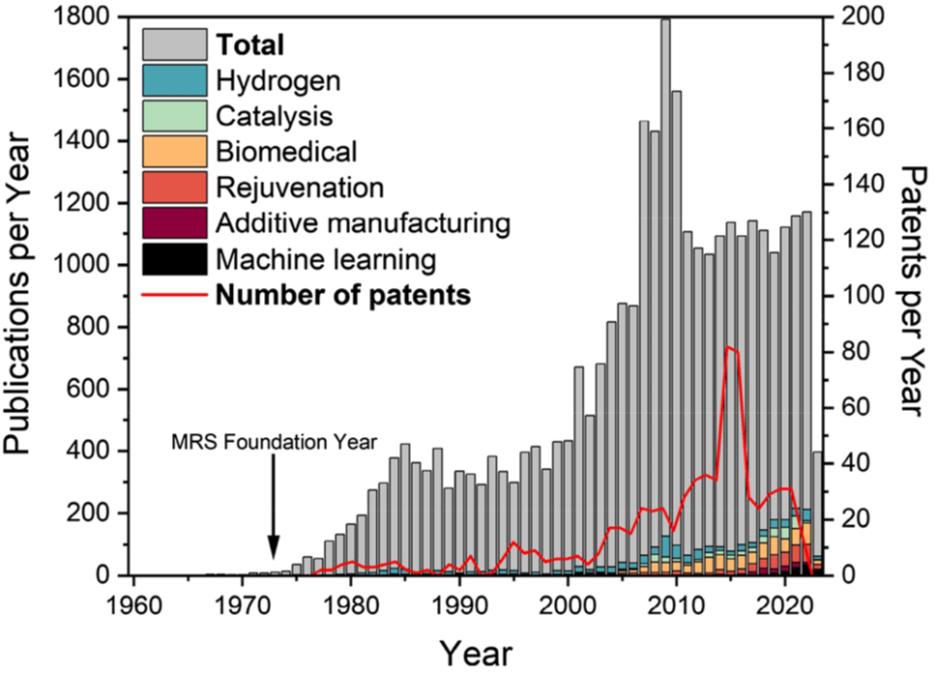
Figure 1. The publication record for metallic glasses shows a steady interest in hydrogen technology and catalysis, and (after 2005) rising interest in biomedical applications, then in rejuvenation, additive manufacturing, and analysis of glass formation and properties using machine learning [Source: Metallic glasses, Greer et al. MRS Bulletin: Vol 48: p1054-1061 Oct 2023].
But research interest alone does not necessarily translate into commercial opportunity. The key question is where metallic glasses offer a practical advantage over conventional materials, and whether that advantage justifies the challenges of manufacturing and adoption. The answer differs between applications: in space technology, the focus is on reliable operation under demanding environmental conditions; in batteries, on electrochemical performance and durability; and in medical devices, on strength, precision and corrosion resistance.
Applications in Space and Aerospace
In space and aerospace, components must operate reliably under demanding mechanical and environmental conditions while minimising weight. Metallic glasses are promising candidates for precision mechanisms that must function for long periods with little or no maintenance.
One area of particular interest is spacecraft mechanisms. NASA currently has an active research project focused on producing gears from bulk metallic glasses (BMGs). At extremely low temperatures, conventional gearboxes typically require heating and lubrication to prevent gear failure. The BMG project team is developing metallic glass alloys designed to allow gearboxes to survive extreme environments without heating or lubrication. Gearboxes developed using this technology are capable of operating at surface temperatures of –173 °C (–280 °F).
Other potential applications include springs, flexures, deployment mechanisms and satellite hinges, where dimensional stability and fatigue resistance are important. The absence of grain boundaries in metallic glasses reduces sites for crack initiation, while their large elastic strain limit allows repeated deformation without permanent plastic deformation. These properties could improve the reliability of mechanisms used in satellite deployment systems, reaction wheels and precision pointing instruments.
Metallic glasses are also being investigated for use in aerospace fasteners, optical instrument components and cryogenic mechanisms. Their high specific strength offers opportunities for weight reduction, while their corrosion resistance is attractive for components exposed to harsh operating environments. Some researchers have also suggested that metallic glasses could reduce wear in moving assemblies operating under vacuum, where conventional lubricants are less effective.
The potential value of metallic glasses therefore looks rather different across applications. In space, reliability under demanding conditions is central; in energy storage, attention shifts to electrochemical performance and durability.
Applications in batteries, catalysis, and electrochemistry
Metallic glasses are promising materials for energy storage and electrochemical devices because their disordered atomic structure can support enhanced ion transport, catalytic activity and mechanical compliance at interfaces. Those properties are potentially valuable because they address some very practical battery challenges, including capacity, degradation and cycling stability.
One of the more developed directions is the use of metallic glasses as anode materials, where amorphous alloy systems (e.g. Al , Fe or multicomponent alloys) can offer significantly higher theoretical capacities than graphite, alongside improved tolerance to the volume expansion associated with repeated charge–discharge cycling. Compared to crystalline intermetallic anodes, amorphous alloys are less densely packed and can mitigate irreversible reactions.
Research has since expanded from early Sn-based composite materials (Fuji) to oxide-free amorphous alloy anodes (MIT and Yale), including Al–Ni–La and Mg-based glasses, with the aim of increasing reversible lithium capacity. One strategy is to embed nano-sized crystalline phases in an amorphous matrix: the crystals act as active lithium storage centres, while the glassy matrix buffers their expansion and improves cycling stability. In short, amorphous metal anodes may store more charge and resist degradation better than conventional anodes, although conductivity and first-cycle losses remain challenges. So the attraction is not amorphous structure for its own sake: it is the possibility of combining greater capacity with the mechanical resilience needed to retain performance over repeated cycling.
Metallic glasses are also being investigated as solid-state electrolytes, interfacial coatings and electrocatalytic surfaces. Their structural homogeneity and high density of active sites can improve charge-transfer kinetics and help suppress degradation, including dendrite formation. Bulk metallic glass nanowire electrodes have also been demonstrated as robust electrocatalysts, exploiting MGs’ uniform structure and high surface area (Yale University’s patent). However, long-term stability, scalability and cost remain barriers. Unlike in biomedical devices, metallic glasses in batteries are still largely in development rather than widespread commercial deployment. A technically impressive improvement is only part of the story: ultimately, it must justify its manufacturing complexity and cost at commercial scale.
No major commercial battery uses metallic glass electrodes yet, but companies have explored MGs for battery hardware. This illustrates an important point: the commercial opportunity for a new material need not lie in the most obvious part of a product. For example, LG Chem patented a bulk amorphous-alloy cell casing for improved strength and impact resistance in lithium battery packs. As demand grows for more durable, higher-performance energy devices, metallic glasses could play a role in next-generation batteries, supercapacitors and hydrogen systems. Whether that role is in the active material, an interface or the surrounding hardware will depend on where their particular combination of properties creates sufficient practical value.
Applications in medical devices and biomedicine
Medical devices present different design constraints, particularly where components must combine small dimensions with strength, precision and corrosion resistance.
Biocompatible bulk metallic glasses (BMGs) have an amorphous structure - free from grain boundaries and crystallographic defects – which confers high strength, elastic strain capacity and excellent corrosion resistance. These properties are useful in minimally invasive surgical tools and micro-scale device components such as micro-scalpels, coronary guidewire components, and flexible tool shafts, where dimensional precision and wear resistance matter.
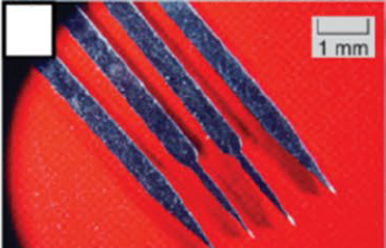
Figure 2: An example of medical device applications: miniaturised scalpels (Figure 2 (j))
In these applications, material performance can translate directly into product-level advantages: a component might be made smaller or thinner, retain a precise geometry, or better withstand wear and corrosion.
On the device front, Liquidmetal Technologies has prototyped MG casing components for implantable devices. A bulk metallic glass pacemaker enclosure, for example, can be injection-moulded into a seamless, thin and corrosion-resistant case that is radio-transparent (for wireless charging or telemetry) – an improvement on conventional Ti shells.
Metallic glasses are also being actively investigated for orthopaedic fixation devices, dental implants and cardiovascular components (including stents). In vitro studies report favourable biocompatibility, corrosion behaviour and, in some cases, improved endothelial cell responses compared with conventional alloys. The absence of grain boundaries in MGs yields smooth surfaces that are less prone to localised corrosion or ion release. Additionally, MG surfaces can be nanopatterned to modulate cell adhesion, promote desired cell differentiation, and even exhibit antibacterial effects. In parallel, metallic glass thin films and coatings are being explored as a way to enhance wear resistance, chemical stability and antibacterial performance without altering the bulk mechanical properties of the underlying implant.
Clinical adoption remains limited (there are as yet no Class III devices), but the field is moving towards device-specific implementations and surface-engineered solutions. The clearest opportunity is therefore not simply to substitute one material for another, but to exploit the properties of metallic glasses where they enable a better device: for example, a component that is stronger, thinner, more precise or more corrosion-resistant than conventional alternatives. Further R&D and clinical testing will be needed before the first generation of MG-based medical devices reaches routine use.
Beyond individual applications, two developments could help address wider barriers to adoption: more flexible manufacturing and faster identification of suitable alloys.
Faster discovery of new metallic glasses
One particularly interesting 2026 development is a new way of rapidly screening alloys for glass-forming ability, the ability of an alloy to solidify without crystallising.
Researchers at Sungkyunkwan University and the Chinese Academy of Sciences produced thin-film libraries containing composition gradients and measured changes in electrical resistivity following annealing. Approximately 3,500 compositions were tested, with smaller resistivity changes correlating with greater resistance to crystallisation. With the new screening technique, measuring an individual composition takes only seconds, allowing researchers to identify promising metallic glass compositions much faster.
Machine learning is providing another route through the enormous number of possible alloy compositions. A 2026 Nature Communications study used uncertainty-aware inverse design to discover multicomponent metallic glasses. The combination of computational prediction and rapid experimental screening could therefore substantially accelerate metallic glass discovery.
Faster discovery, however, is only part of the challenge. The next question is whether those materials offer properties that translate into meaningful advantages in real products
Additive manufacturing: from alloys to magnetic components
Additive manufacturing is becoming another important part of the metallic-glass story. Rapid laser processing offers a potential way to manufacture complex components while retaining an amorphous structure, although crystallisation during repeated heating remains a major challenge.
The European AM2SoftMag project provides an interesting example. Researchers are developing iron-rich metallic glasses specifically for additive manufacture of soft-magnetic components for electric motors. The aim is to reduce magnetic losses while avoiding environmentally critical elements such as cobalt.
More recently, researchers in the project reported an Fe-Si-B-Nb-Ni alloy that can be processed by laser powder-bed fusion while maintaining a highly amorphous structure. The next steps include reducing manufacturing defects and testing actual rotor and stator components. The challenge is therefore to translate manufacturing capability into useful components at a practical scale.
Outlook
Metallic glasses illustrate a broader point about materials innovation: interesting properties create possibilities, but commercial value emerges when those properties solve a meaningful problem. In batteries that may mean improved capacity, durability or interfaces; in medical devices it may mean smaller, stronger or more corrosion-resistant components; and in space and aerospace, reliable precision mechanisms capable of withstanding extreme temperatures and operating for long periods without maintenance. The pathways to market may be very different, but the key question is the same: where does the material offer an advantage that really matters?
That shift from interesting properties to practical applications is also reflected in the patent landscape. While composition claims remain important as new glass-forming alloys are discovered, opportunities for IP protection increasingly extend to the ways these materials are processed and used, including manufacturing methods, additive-manufacturing parameters, forming techniques, surface treatments and application-specific components.
Ultimately, commercial success will depend on translating the distinctive properties of metallic glasses into practical advantages that can be manufactured reliably and cost-effectively.