UPC Weekly brings you timely, thoughtful and joined-up insight into the evolving landscape of patent litigation at the Unified Patent Court.
2026 Week 44
This is a new first at the UPC. Where the court has found that the patent is infringed (and valid) on the merits, the successful party can start separate proceedings for a determination of damages. There has been almost no news to report in this area, until now.
Edwards and Meril have been locked in dispute on various fronts, at the UPC and elsewhere, over whether various Meril products and systems for transcatheter heart valves infringe different Edwards patents. Having succeeded on the merits in relation to EP 3669828 B2, Edwards is now asking the court to make a determination of the damages that Meril must pay.
The only previous significant case law from the UPC in this area was Fives v. REEL (UPC LD Hamburg, UPC_CFI_274/2023, 11 February 2026) which was an odd case in that Fives had obtained a decision on the merits of infringement from a German national court that the patent was infringed, and came to the UPC to set the damages. It did not go well for them. The UPC agreed that it had jurisdiction to determine damages. Fives sought damages on the basis of lost profits, with the patent infringement alleged to have led to the loss of a contract bid. The LD Hamburg dismissed the damages claim, pointing out that Fives had the burden of proof and had not shown a causal link between the patent infringement and the alleged loss of profits.
Edwards v. Meril – the decision on the merits
Edwards launched UPC infringement proceedings at the end of 2023, the oral hearing was held in February 2025 and the decision on infringement and validity was issued as Edwards v. Meril (UPC LD Munich, UPC_CFI_501/2023) on 4 April 2025. Simplifying matters quite a lot, no appeal was filed. The decision included an injunction, an order for Meril to provide information relating to the scale and distribution arrangements for the infringements, and an order that Meril should compensate Edwards for the damage due to the infringement, dating back to 5 May 2021.
UPC procedure requires that the successful party notifies the court of its intention to enforce each relevant part of the decision. The idea here is that the successful party can decide to enforce the injunction (for example) straight away, even if it is expected that there will be an appeal. In this case, Edwards announced its intention to enforce all the remedies on 14 April 2025.
The wording for the order for providing information is interesting. It comes straight from Article 61.1 UPCA, allowing the court to order the infringer to provide information on:
(a) the origin and distribution channels of the infringing products or processes;
(b) the quantities produced, manufactured, delivered, received or ordered, as well as the price obtained for the infringing products; and
(c) the identity of any third person involved in the production or distribution of the infringing products or in the use of the infringing process.
With this ordered by the court, and with the information provided as a result by Meril, the question is then what more is there to be gained by going through a full process of the determination of damages? Let’s see.
Principles for damages at the UPC
Article 68 UPCA sets out the principles for the award of damages for infringement. Basically, these are that the damages awarded should be appropriate to the harm actually suffered as a result of the infringement. As far as possible, the damages should place the patentee back to the same position as if no infringement had taken place, with the infringer not benefitting from the infringement, but the damages should not be punitive. The court is also required to take into account “all appropriate aspects, such as the negative economic consequences, including lost profits, which the injured party has suffered, [and] any unfair profits made by the infringer.”
Procedure for damages at the UPC
Despite some information on the scale of the infringement being available in the merits proceedings, this may not be enough for the patentee or the court to work out what damages should be payable. Therefore damages proceedings at the UPC have an interesting optional sub-procedure referred to as “laying open of books”, to obtain the evidence that will be necessary for the court to determine damages. This means that the proceedings look complicated, with a first part being for laying open of books, including rounds of written submissions and an oral hearing, followed by further rounds of submissions on the damages assessment with a further oral hearing.
The flowchart below spells it out – the actions by the patentee are on the left, the actions by the infringer are on the right, with the court hearings in green in the centre. The dates are approximate for a typical case.
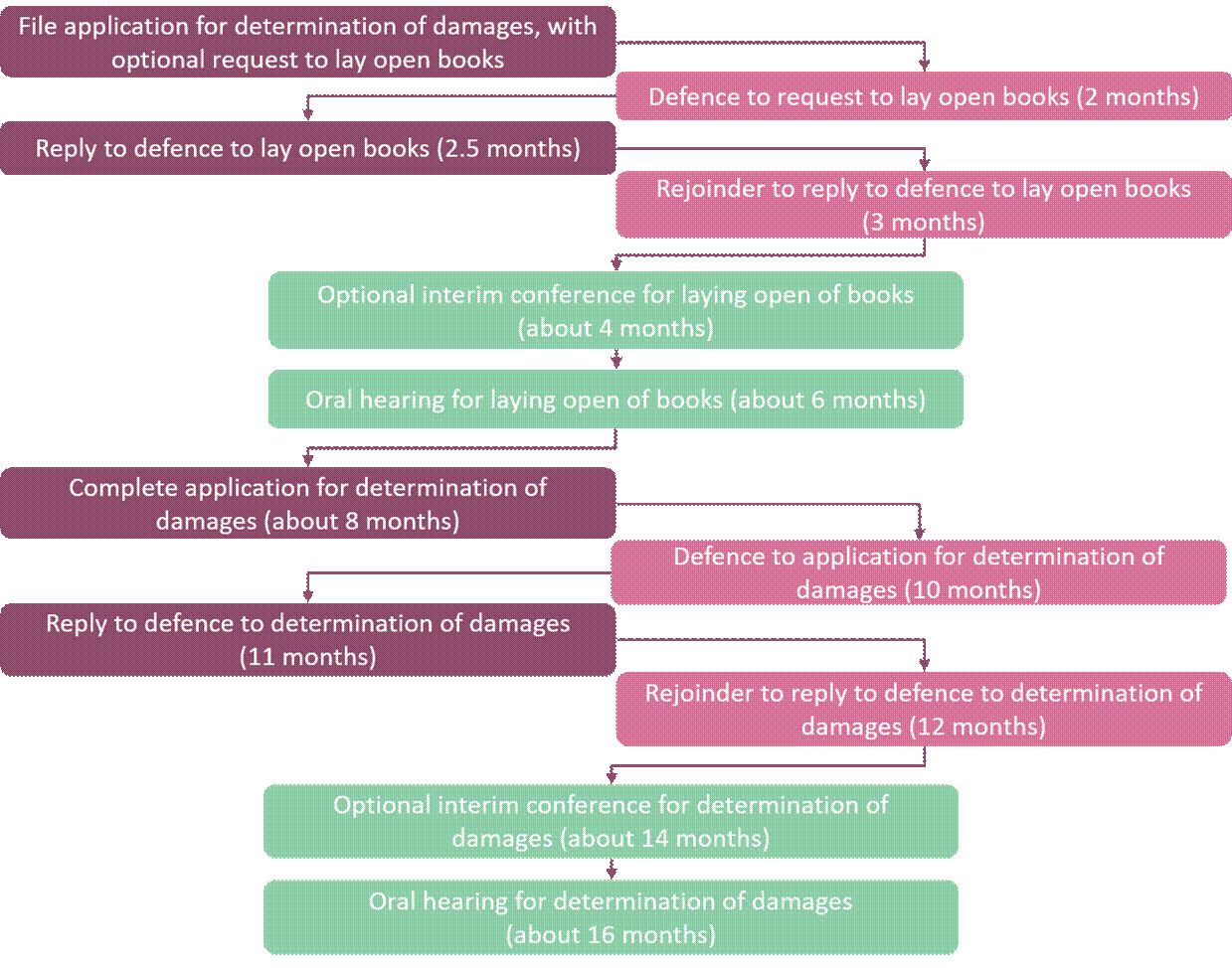
Note that since these are fresh proceedings at the UPC, the patentee needs to pay a court fee. This has the usual structure of a fixed fee and a value-based fee. So, in principle, the court fee will probably be at least as large as the court fee for the main infringement case.
Are springboard damages available?
The deadline for filing an application for the determination of damages is one year from the final decision on the merits. In this case, the deadline was 4 April 2026 and Edwards filed their application on 2 April 2026. Edwards opted to request that Meril lay open their books and so there was an oral hearing on this, with the resultant order issued in Edwards v. Meril (UPC LD Munich, UPC_CFI_1160/2026, 28 October 2026), specifically on the laying open of books.
The information already ordered from the merits decision showed that the relevant revenue to Meril for the infringing products was about €30m. However, Edwards were also seeking information on other products. These fell into various categories, such as accessory products (not themselves infringing) that would be sold alongside the infringing products.
More expansively, Edwards argued that Meril had used the infringing products as a “springboard” to launch non-infringing products, thereby securing an unlawful head start in development, validation, customer adoption and market positioning. Edwards requested that the economic consequences associated with such a springboard effect enjoyed by Meril should be taken into account in the calculation of the damages.
The court considered this carefully. They noted that the Rules of Procedure do not categorically exclude providing information about non-infringing products. However, considerations of necessity, proportionality and connectedness carried the day. On the broadest arguments advanced by Edwards, the court decided that springboard damages should not be available on the facts of the case, and so information about subsequent non-infringing products (and their accessories) should not be provided. The court’s approach was that there was not a sufficient causal connection between the infringing acts and the sales of the subsequent non-infringing products. Based on the national case law considered, it does seem possible that springboard damages might be available where there is a clearer causal link connected to the technical characteristics of the invention.
The court was satisfied that there was one scenario that would warrant further investigation, but which they did not regard as a springboard situation. That would be where an approval, tender or reimbursement agreement was made where an infringing product had been swapped out for a non-infringing product. The logic here was that there was already an infringing act in the form of an offer, and so compensation may be needed even though ultimately there was no supply of infringing products.
Where next?
Meril have 12 weeks to provide the relevant detailed information. Also, the parties have agreed that the next stage of the damages proceedings will only start 4 months after Meril have provided the ordered information. This diverges significantly from the example timeline suggested above. It’s clear that in complex cases, the damages proceedings may well take longer than the merits proceedings.
In this case, the parties have been given leave to appeal and so this is not necessarily the final word on springboard damages at the UPC.
However, it seems likely that damages proceedings will remain relatively rare at the UPC, with the information available in the merits proceedings typically enabling the parties to see a landing zone for settlement to avoid the need to ask the UPC to determine damages.