Micrima's Imogen Clarke and David Gibbins speaks to Mewburn Ellis Forward, about how they've opened a clinic to make density scans a normal part of early cancer detection and how women will benefit from this.
Forward: features are independent pieces written for Mewburn Ellis discussing and celebrating the best of innovation and exploration from the scientific and entrepreneurial worlds.
In June 2026, medical technology company Micrima opened a breast density scanning clinic in Bristol. It is the first of its type in the UK.
By harnessing the power of radiowave technology, the clinic offers a new option for women who want to get a better understanding of their breast health.
“We are currently the only regulated breast density device using direct radio frequency measurement,” says Imogen Clarke, partnerships and growth manager at Micrima.
.jpg?width=1024&height=707&name=0H1A4334%20(1).jpg)
Imogen Clarke, partnerships and growth manager at Micrima
Knowing breast density is important for cancer detection, but rarely measured, so this is a major leap forward, Clarke explains: “The issue with this is that if you have dense tissue and get a standard mammogram, up to 40% of cancers can be missed, so you will need to go in for additional screening, delaying diagnostic time, affecting the patient experience and also increasing costs for healthcare providers. If you knew your density before going in for screening, then you could make a more informed decision on the type of imaging you have, such as ultrasound, MRI et cetera.”
Breasts are made up of fatty tissue and dense fibroglandular tissue. The proportion of dense tissue varies from woman to woman and can change over a lifetime but isn’t something you can gauge by look or feel. Research has shown that having dense breasts can make you 4 to 6 times more likely to develop breast cancer. Density can also obscure cancer, making it harder to find, when viewed on a mammogram.
Giving women the knowledge of their own breast density could help them and their clinicians make informed choices about monitoring and screening. Yet Micrima’s own study found 86% of women don’t know theirs. With around one in seven women developing breast cancer in their lifetime, increasing the prevalence of breast density scanning could help to catch cancer earlier or avoid missing it.
The system developed by Micrima is a combination of hardware and software. The scanning hardware, a handheld loop-like calliper attached to a central unit, uses gentle radio-frequency technology to scan the breast, without the compression seen in mammograms. This provides the density measurement. The software combines that measurement with the patient's own clinical profile, including information about family, lifestyle, reproductive factors, and established risk models. The result is a personalised breast cancer risk profile and visual density map, which can be provided as a one-off measurement or may be tracked over time for improved breast awareness.
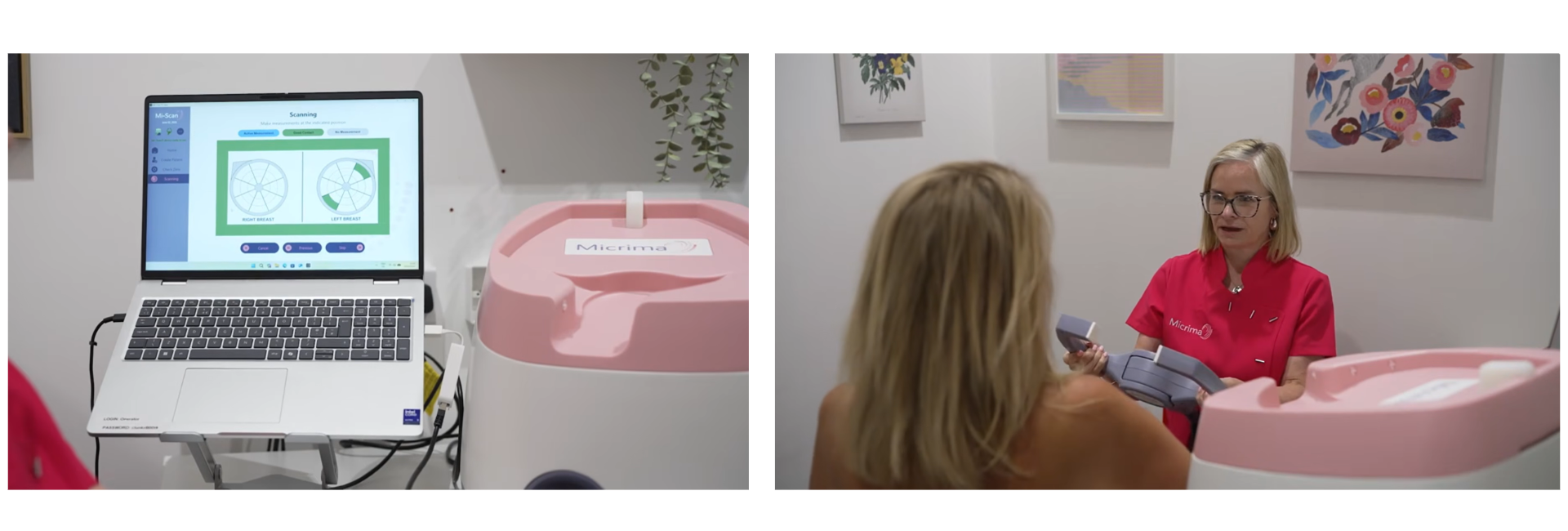 Mi~Scan product and demonstration
The breast density scale
The BI-RADS (American College of Radiology's Breast Imaging Reporting and Data System) categorises breast tissue into 1 of 4 levels of density for each breast.
|
From lab to marketplace
The origins of the technology created by Micrima is a classic spin-out story of pivoting and repurposing innovative tech. The core IP began life not in medicine, but in the search for another kind of hidden killer: landmines.
“A guy called Ralph Benjamin developed the original technology as part of a landmine project he was working on at the University of Bristol, partly funded by the MoD,” says David Gibbins, head of product delivery and technology at Micrima.
Benjamin teamed up on the landmine project with an engineer called Ian Craddock, and Alan Preece, a medical physicist with experience researching breast tissue. Together they would go on to found Micrima. They combined their knowledge to apply the lessons from radio frequency-based landmine scanning to the detection of breast cancer, receiving a grant from the University of Bristol and setting up a project team. Gibbins was one of the young researchers to join them.
In 2012 Micrima was spun-out of the University of Bristol with a focus on tumour detection. Recently it pivoted from searching for tumours to measuring breast density. This aims to offer a proactive, preventative step in the fight against breast cancer. While it may seem like a big leap from landmines to breasts, Gibbins explains why it made sense to switch industries.
“There was a big focus on microwave imaging for breasts at that time,” he recalls. “Microwaves work very well on things that aren’t solid. Anything quite large like your whole body would absorb all of the energy, so you need something smaller in scale to look at.” Since breasts project outside of the body and are small in size, “they make an ideal candidate for radio frequency imaging.”
The new project, led by Craddock and Preece, started working on the development of a radar scanner for breast cancer detection. “Just like landmines in the ground, we applied the technology to find foreign objects within the breast,” he explains. “A radar-technique bounces signals off the concealed object to build up an image.”
The team worked on this for a number of years before the spin-out. In 2015 it received its CE mark for the MARIA radio-wave breast imaging system. It wasn’t until 2022 that the company once again pivoted, this time to focus on scanning for breast density rather than imaging for tumours. Gibbins explains that they made the call because while they had made good advances in creating an imaging product to identify tumours, it would require further work and investment. “We took a lot of what we had learned with the hardware and the techniques and pivoted to create a density measurement tool which was easier to bring to market,” he says. “And we knew it would create just as big an impact.”
The technology
The system took two years to develop before it was ready for clinical studies. “Radio-waves are challenging to work with,” says Gibbins. “The engineering knowledge, skill and experience needed to control, generate, and measure is very technically challenging.”
With these clinical trials and necessary approvals it took a further year and a half to get through the whole regulatory process. “The process is slow,” says Gibbins. “First you need a product that works, on the technical and medical development side. Then you have your clinical investigation. Then the CE marking process is slow – it took us about a year to get to the top of the pile. Approval itself was pretty smooth as there was a strong technical file.”
“Funding the business in this time was tricky, as you can't make any money because you can't sell anything without approval,” he adds.
Mi-Scan (the hardware) is now a CE-marked Class IIa medical device, certified to the same regulatory standard as devices used across the NHS. Its performance has been studied in clinical research with NHS partners. Mi-Score (the software) uses Tyrer-Cuzick and BOADICEA, two of the most widely used breast cancer risk models, recognised in NHS risk pathways, drawing on six categories of evidence to build a patient's profile.
Commercial and legal strategy
Protecting the company’s intellectual property was also of critical importance for the spin out. Micrima has an international patent portfolio covering innovations such as the antenna used in the product, the hardware, the density algorithm used in the software and the use of radio-waves within general breast cancer detection. “IP and patents are a core part of our business and very important,” he explains. “While you can protect a lot of stuff by not releasing it to the public, you also have to protect the core elements of the technology otherwise you’re not attractive to investors.”
With patents in place and regulatory hurdles cleared, Micrima has been free to go to market and commercialise, focusing initially on its home city of Bristol.
The team has developed three different routes to market. One is through a clinic, opened in June in the city’s Glass Wharf area, where people can book directly and visit for a scan.
The company is also working closely with employers, to encourage them to add Micrima’s offering to their health benefits. Along with this, they are planning to offer educational workshops on the factors around breast health. They’re trialling this offer to businesses with local offices with a view to rolling it out nationally.
Finally, Micrima is offering the service through private clinics, GPs and hospitals. “In this instance, they would become delivery partners, trained up on using the device and keeping one on site,” explains Imogen Clarke.
The mission to make breast density scanning routine
The company would love to eventually integrate with the NHS, but for the time being they are focused on the private sector where preventative care is more readily available. “Ideally, we’d love to see Micrima used as part of a general health check, something you can measure over time and spot any changes through.”
Having already raised over $20 million in seed and early-stage capital, the company expects to raise again in the coming months to expand throughout the UK and explore other markets.
As Gibbins explains, the team is keen to help as many women as possible: “That’s why we do this – to make a difference. We’re taking something that hasn’t been done before and using it to help women. There are plenty of other areas we could work on in our field, but working on a medical device that can help people is more rewarding.”
Juliana Murray, Senior Associate and Patent Attorney at Mewburn Ellis comments:
'Micrima's launch of the UK's first breast density scanning clinic is an exciting milestone for women's health. By providing greater insight into an important factor linked to both cancer risk and detection, this innovative technology has the potential to empower more informed decision-making and contribute to earlier intervention. It will be fascinating to follow Micrima's journey as they continue to champion greater awareness and make this valuable health information available to more women."
Written by Gabriella Griffith.
/JULIANA%20MURRAY%20author%20circle.png?width=100&height=100&name=JULIANA%20MURRAY%20author%20circle.png)
.png)
.png)