UPC Weekly brings you timely, thoughtful and joined-up insight into the evolving landscape of patent litigation at the Unified Patent Court.
2026 Week 41
What does a patentee need to show to prove infringement? Some great lessons this week from Inficon v. Elitech (UPC LD Düsseldorf, UPC_CFI_137/2025, 06 October 2026) which is an infringement action with counterclaim for revocation all about gas leakage detectors. The LD Düsseldorf decided that the patent was valid but not infringed. Here we’ll concentrate exclusively on infringement.
The patent
The patent in dispute is EP 3567356 B1. It’s short and worth a read to understand the issues in full. The background part of the description explains that prior art sniffing leak detectors are known and have the sample gas inlet and the reference gas inlet both in the tip probe. The prior art also uses a small pump to drive gas flow and to switch measurements between the sample gas and the reference gas. The measurements are typically infra-red based measurements. The clever part is placing the reference gas inlet remote from the probe and ensuring that the reference gas is buffered and mixed so that any target gas present in the reference gas should be much diluted compared with the sample gas, when the tip probe is placed close to a leak.
The claims
Claim 1 maps nicely onto the embodiment shown in Fig. 2 of the patent. Claims 5 and 6 are also included because the court referred to them when interpreting claim 1.
1. Sniffing leak detector (10) comprising
a handheld device (44) with a sniffer tip probe comprising a sample gas inlet (12),
a reference gas inlet (14),
a gas analyzer (16), and
a switching valve (20) adapted to alternatingly connect the sample gas inlet (12) to the gas analyzer (16) and the reference gas inlet (14) to the gas analyzer (16) in a gas conducting manner, such that either the gas drawn through the sample gas inlet (12) or the gas drawn through the reference gas inlet (14) is analyzed by the gas analyzer (16),
characterized in that
the reference gas inlet (14) is not arranged on the sniffer tip probe and thereby in a remote distance from the sample gas inlet (12), and
the sniffing leak detector (10) comprises a reference gas conduit (26), which connects the reference gas inlet (14) and the switching valve (20), and further comprises a buffer chamber (40) defining a buffer volume (42), which permits to homogeneously mix gas drawn into the buffer chamber (40) through the reference gas inlet (14) with remaining gas in the buffer chamber (40).
…
5. Sniffing leak detector (10) according to anyone of claims 1to 4, wherein the buffer chamber (40) comprises a buffer chamber inlet connected to the reference gas inlet (14) and a buffer chamber outlet connected to the switching valve (20), wherein the buffer chamber outlet is off-set to the buffer chamber inlet with regard to the buffer chamber inlet.
6. Sniffing leak detector (10) according to anyone of claims 1 to 5 wherein the buffer chamber (40) comprises a swirling mechanism adapted to cause turbulences in the gas stream entering the buffer chamber (40) through the reference gas inlet (14).
The embodiment and the alleged infringement
Fig. 2 of the patent Alleged infringement
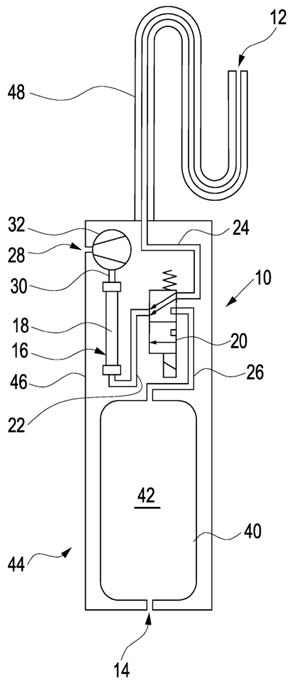
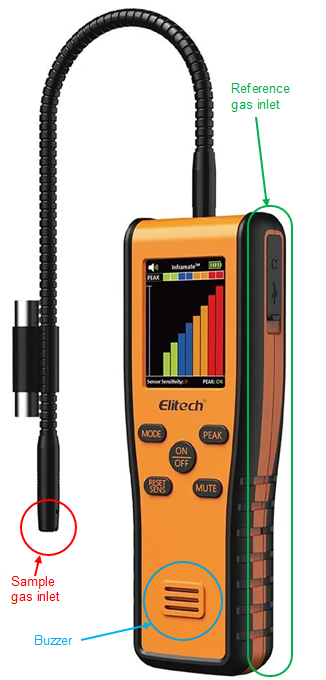
Claim interpretation
Some features of the claim did not require detailed assessment. It was clear that the alleged infringement has a sniffer tip probe with a sample gas inlet, for example, as shown in the comparison between Fig. 2 of the patent and the alleged infringement.
However, the defendant did push back against many elements of the patentee’s claim interpretation. On essentially all of these, the court sided with the patentee. In particular, the court rejected interpretations of features that attempted to import narrowing limitations from the detailed description. The court did not follow the defendant’s argument that the reference gas inlet must be a special, dedicated inlet, or that the reference gas conduit must be a specific tube or pipe. This was important, because in fact the flow path for the reference gas in the alleged infringement relied on gas flowing through the gap between the moulded halves of the housing. In the image above, the friendly-looking holes at the bottom of the front of the device are not gas inlets but are holes for a buzzer (marked in blue). The reference gas inlet is shown generally in green as the line at which the halves of the housing meet.
So far, none of this is surprising. The wording of the claims is reasonably clear and broader than the exemplary wording in the description relied on by the defendants.
The key feature for the court to interpret is the final, underlined part of the claim defining the buffer chamber. We turn to that next.
Repercussive effect of dependent claims
The defendant once again argued for a narrow interpretation of the structure of the buffer chamber, for example that the buffer chamber should be a separately identifiable structure in the device, such as shown in Fig. 2 (reference 40). The court disagreed again, in view of the broad wording of the independent claim. They went further than this, noting that claim 5 in effect focused its scope towards a separately identifiable buffer chamber with its own boundaries as illustrated in Fig. 2. And so claim 1 must be broader:
110. Since subclaims do not narrow the scope of a main claim but the scope of the main claim is broader than the scope of the subclaim(s), the skilled person infers from subclaim 5 that the main claim 1 is not limited to a structural separate component with boundaries.
The court ran the same point with claim 6. The defendant contended that the interior of the housing could not be the buffer chamber because it contained structures that would impede flow or mixing of the reference gas. The court decided that the buffer chamber defined in claim 1 must also be broader than claim 6.
These points nicely illustrate when claim interpretation arguments relying on dependent claims work best. The UPC Court of Appeal noted in Amgen v. Sanofi (UPC_CoA_528/2024, 25 November 2025) that a dependent claim should not be used to interpret the main claim when the dependent claim simply adds further features rather than providing a more specific description of a feature of the main claim. A positive example of repercussive effect working at the UPC (this time between different independent claims which the court assumed must have different scope) was in Canon v. Katun (UPC LD Düsseldorf, UPC_CFI_351/2024, 11 February 2026), reported in UPC Weekly 2026 w7.
Functional features interpreted
The court looked to the description to understand the functional requirement in the claim of homogeneous mixing of the reference gas. Paragraph 0014 of the description explained that the buffer chamber ensures that brief influxes of the sample gas will be mixed with gas already in the chamber, meaning that short spikes will be averaged out over time. The court accepted that perfectly homogeneous mixing was not required, but that sufficient mixing was required in order to achieve this time-averaging effect.
But … no infringement
The court decided that there was no infringement. This was despite essentially agreeing with the patentee on all of the issues of claim interpretation. What happened?
The court was not persuaded that the alleged infringement provides sufficient mixing of the reference gas. Or more particularly, the court was not persuaded that the patentee had provided enough evidence of this.
With the statement of claim, the patentee filed experimental evidence that shows that about 80% of the reference gas intake happens at the gripping area of the device – the lower part of the indicated green area in the image above. The reference gas enters into the internal space of the housing and is ultimately received at the inlet to the valve in the device, leading to the gas analyzer. The experimental evidence also showed that there was a time delay between the reference gas being released outside the housing and being detected by the device.
The court accepted that with the dispersed nature of the reference gas inlet, there would naturally be mixing of the reference gas entering the housing from different directions. However, there was no evidence that there was sufficient mixing of the incoming reference gas with gas already inside the housing that would lead to suitable averaging out of short term fluctuations of the target gas concentration over time. Indeed, presumably, the measurement data showed that there was not this averaging out effect.
Where is the burden of proof?
The court characterised the patentee’s experimental evidence as “unconvincing and inconclusive”. Slightly frustratingly, the actual measurements relied on are not included in the decision and are not available from the court file without a special request to the court for access. So we can’t take an independent view on what the measurement data does or doesn’t prove.
It is clear at the UPC that the burden of proof is on the patentee to show technical infringement. The usual front-loading considerations apply. But since the patentee provided experimental evidence with the statement of claim, the evidence was clearly provided early enough. The problem was that it did not in fact show infringement, in the view of the court.
Usually, a party presenting evidence of fact can rely on Rule 171.2 RoP:
171.2. A statement of fact that is not specifically contested by any party shall be held to be true as between the parties.
In this case, the impression is that the defendant generally denied infringement, including in respect of the “homogeneously mixing” feature, but did not provide any counter evidence in support of this denial. Is this enough to amount to homogeneous mixing of the reference gas being “specifically contested”?
The court said it didn’t matter in this case, because the evidence provided by the patentee didn’t show what was asserted.
What’s the effect of this? Perhaps the best way to think about it is that the “fact” here is the set of measurements carried out by the patentee. This fact can be held as true between the parties because the lack of counter-evidence from the defendant means that the measurements have not been specifically contested.
However, the conclusion drawn from the measurements is not a fact – it is based on an interpretation of the claim which is a matter of law. This is nicely explained by the CoA in Sinocare v. Abbott (UPC_CoA_899/2025, 30 March 2025, para. 66) and is not subject to Rule 171.2 RoP. The court’s determination of the limits of the meaning of “to homogeneously mix” is a matter of law. In effect, the court’s view is that the (uncontested) measurements do not show that there is sufficient mixing of the reference gas to average out short term fluctuations of the target gas concentration over time.
What is left open in the decision is whether further measurements would have helped the patentee, for example by trying to illustrate any time-averaging effect that may be provided in some conditions for the alleged infringing device. And a related point, not yet explored at the UPC, is whether the patentee would be prevented from bringing a fresh infringement action with further and better evidence against the same alleged infringement.


.png)
.jpeg)