Whilst 2025 was not a particularly notable year for pharmaceutical trade mark decisions, the UK and EU courts still issued useful guidance for trade mark owners in the pharma industry. In addition to this, the UKIPO has issued a much-anticipated ‘Practice Amendment Notice’ (‘PAN 1/25’) following the Supreme Court’s decision in SkyKick UK Ltd v Sky Ltd [2024] UKSC 36.
In this article we discuss a couple of decisions from the UK and EU which are particularly important in the pharmaceutical space, as well as the implications of PAN 1/25 for pharmaceutical brand owners.
Abbott v Sinocare [2025] EWHC 206 (Ch)
Whilst shape marks are registrable in the UK, brand owners often struggle to overcome at least one of the two following hurdles when registering their shape marks:
- Proving that their shape mark is inherently distinctive, or if it is not, proving that it has acquired distinctiveness.
- Proving that their shape mark does not consist exclusively of characteristics which are necessary to obtain a technical result.
In Abbott v Sinocare, the High Court of England and Wales issued a decision to invalidate a registered 3D shape representing the on-body unit (OBU) of a continuous glucose monitoring (CGM) system for both of these reasons.
In 2022, Abbott registered the following 3D shape mark in the UK for “Sensor-based glucose monitors; continuous glucose monitoring systems” in class 10.
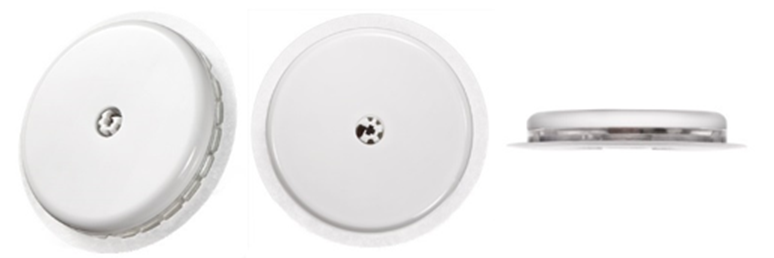
The Abbott Mark
When Sinocare launched its CGM system in the UK in January 2024, the iCan i3 CGM system, Abbott brought a claim for trade mark infringement.
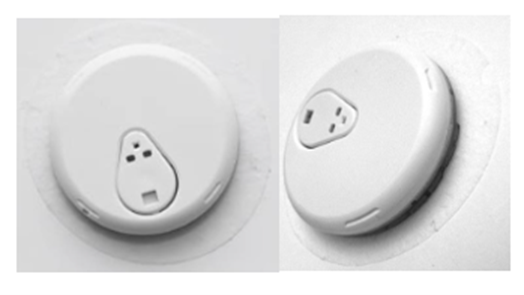 The Sinocare product
Sinocare counterclaimed that the mark was invalidly registered, being devoid of distinctive character and consisting exclusively of characteristics of the goods which are necessary to obtain a technical result.
1. Distinctive character
The High Court ruled that Abbott’s 3D shape mark for its continuous glucose monitoring (CGM) system was not distinctive enough to function as a trade mark. Abbott did not argue that the mark was inherently distinctive; instead, it relied on acquired distinctiveness through extensive use and marketing. Despite selling over 25 million units in the UK and spending more than $50 million USD on marketing, the Court found that Abbott’s marketing focused on presenting the product’s functional aspects rather than educating consumers to see the shape as a badge of origin. The traditional marks carried the burden of indicating trade origin, not the shape itself.
Survey evidence submitted by Abbott was also criticised and did not convincingly show that consumers associated the shape with Abbott as the source of the goods.
As a result, the mark was found not to have acquired distinctiveness by the relevant date, and the registration was invalidated for a lack of distinctiveness.
2. Exclusively functional shape
The Court also found that the essential characteristics of the registered shape were all necessary to obtain a technical result. The circular design of the on-body unit (OBU) was dictated by the technical requirements of the CGM system, housing the sensor and transmission electronics in a way that enables the device to function effectively.
UK Trade mark law does not allow registration of shapes that are essential to achieve a technical result, as this would unfairly restrict competition and prevent others from using similar functional designs. The judge concluded that the shape was not arbitrary or decorative, but rather a direct consequence of the product’s technical function.
Implications and takeaways
- This decision highlights the challenges pharmaceutical brand owners face when seeking trade mark protection for product shapes, especially where the design is dictated by technical function rather than branding. Brand owners should be mindful that extensive use and marketing alone may not be sufficient to establish acquired distinctiveness if the shape itself does not operate as a badge of origin in the minds of consumers. These issues are discussed in more detail in our special report on non-traditional marks in the pharmaceutical industry.
- Moreover, the ruling serves as a warning that functional designs, even if widely recognised by consumers, are unlikely to be registrable as trade marks under UK law. Pharmaceutical companies must consider alternative strategies for protecting their innovations, such as patents or design rights, to secure exclusivity in the market.
European General Court Decision of Dr. August Wolff GmbH & Co. KG Arzneimittel v EUIPO
In 2011, Dr. August Wolff GmbH & Co. KG Arzneimittel subsequently designated the European Union under their International Registration for Vagisan for various cosmetic and pharmaceutical products in classes 3 and 5, including intimate healthcare products.
In 2017, Combe International, who is the proprietor of various earlier Vagisil registrations in, inter alia, the UK, Spain, Italy, Poland, and Portugal, sought to invalidate the Vagisan mark based on a likelihood of confusion with its Vagisil marks.
The EUIPO’s Cancellation Division upheld the invalidity based on Combe’s earlier UK marks on 11 September 2019, citing a likelihood of confusion under Article 8(1)(b) of the EUTMR. The EUIPO’s Board of Appeal confirmed the decision.
Dr. Wolff appealed this appeal decision to the General Court, seeking its annulment.
Likelihood of confusion
On the question of whether there was a likelihood of confusion, the Court upheld the findings of the Board of Appeal. The Court confirmed that the marks Vagisan and Vagisil were visually and phonetically similar to an average degree and that the goods were identical or similar.
The Board of Appeal had, however, overestimated the distinctiveness of the marks as a whole. The Board of Appeal found that the common element “vagi” of the signs is a reference to the English word “vagina” and would allude to the purpose of those goods. While the element “vagi” might be perceived as alluding to the purpose of the goods at issue, the Court found that it wouldn’t be negligible in the overall impression. The Court considered that since “vagi” was placed at the beginning of both signs and had significant length and comprised two of three syllables in both of the marks, it would not be neglected in the overall impact. Dr. Wolff’s argument that the relevant public would focus on the endings, “sil” and “san” respectively, was not heard.
The Court concluded that there was a visual overlap in the letters “vagis” as well as the phonetic overlap with regard to the “vagi” elements, and a conceptual overlap with regard to the weakly distinctive element “vagi”.
Although the Board of Appeal had overestimated the distinctiveness of the marks as a whole, the weak distinctiveness of the element “vagi” was not sufficient to change the overall conclusion that there was a likelihood of confusion for the identical goods.
On this premise, the General Court dismissed the appeal. The decision of the EUIPO’s Board of Appeal was upheld, and the EU designation for Vagisan was invalidated.
Implications and takeaways
- Pharmaceutical brand owners should be mindful that just because their mark only shares a weak element with a registered mark, this will not necessarily prevent a finding of confusion. The overall similarity and the identical nature of the goods were decisive in this case, despite a finding that “vagi-“ is weakly distinctive and allusive to the goods’ purpose.
- Further, even when parts of the marks are weakly distinctiveness, identical goods will significantly increase the likelihood of confusion. For pharmaceutical brand owners, this reinforces the need for careful clearance searches and early risk assessment when launching products in crowded therapeutic categories, as similarity of goods can tip the balance even where the shared elements of the marks are not especially distinctive. This may require being quite specific about the nature or purpose of the goods in order to distinguish from other marks registered for different pharmaceutical goods.
Bad Faith and the UKIPO’s ‘Practice Amendment Notice’ (‘PAN 1/25’)
The UKIPO’s PAN 1/25 clarifies the changes to the UKIPO’s examination practice following the Supreme Court decision in SkyKick, which set out the principles for assessing bad faith. It includes a number of important considerations for pharmaceutical companies looking to register their marks in the UK.
- Increased scrutiny of broad specifications – Following PAN 1/25, UKIPO examiners may routinely raise objections to applications which they believe have been filed in bad faith, marking a change from their current practice.
Specifically, examiners will now consider whether “the specification is so manifestly and self-evidently broad that a bad faith objection should be raised”. This may occur, for example, where an application is filed covering a very broad list of goods/services in many classes.
In the SkyKick decision the Supreme Court found that the broad term “computer software” was applied for in bad faith. However, PAN 1/25 makes clear that, at this stage, examiners will not automatically object to broad terms such as “pharmaceuticals” or “computer software”, although they will consider the application as a whole and consider a number of relevant factors, such as the nature and size of the applicant’s business. - Requirement for a clear commercial rationale - If a bad faith objection is raised, applicants should be prepared to provide a commercial rationale explaining why they have chosen the particular goods/services. This includes being able to substantiate this with evidence, which might include business plans or strategy documents.
One example would be if the application is for “pharmaceutical preparations” and applicant is a pharmaceutical company developing a variety of drugs for many conditions and ailments. The commercial rationale may be that the mark is intended to be a ‘house mark’ covering the whole variety of drugs. In such cases, applicants should be prepared to explain why such terms are appropriate given the size and nature of their business and their commercial strategy. - Impact on opposition and cancellation actions - Whilst PAN 1/25 primarily addresses the UKIPO’s examination practice, it is also relevant to opposition and cancellation actions. Pharmaceutical brand owners facing opposition or cancellation actions should be aware that PAN 1/25 provides an additional avenue for counterattack, which is especially useful when the opposing party relies on registrations that are too recent to be challenged for non-use. For example, it may be used to narrow the specification of the earlier registered mark by removing unjustifiably broad terms. This tool can be strategically deployed to undermine the other party’s case, increase the likelihood of a favourable outcome, or apply pressure during settlement discussions.
For pharmaceutical companies initiating opposition or cancellation actions, it is crucial to carefully select the goods and services on which to base their claims. Relying on overly broad or general terms, such as “pharmaceuticals” or “pharmaceutical preparations”, may expose the company to counterclaims of bad faith, particularly in light of the increased scrutiny introduced by PAN 1/25. Pharmaceutical brand owners should ensure that the terms relied on reflect a genuine commercial rationale and they would be prepared to defend against a potential bad faith allegation.
Find out more about our Pharmaceutical Trade Mark experts on our spotlight page.

.png)
.png)