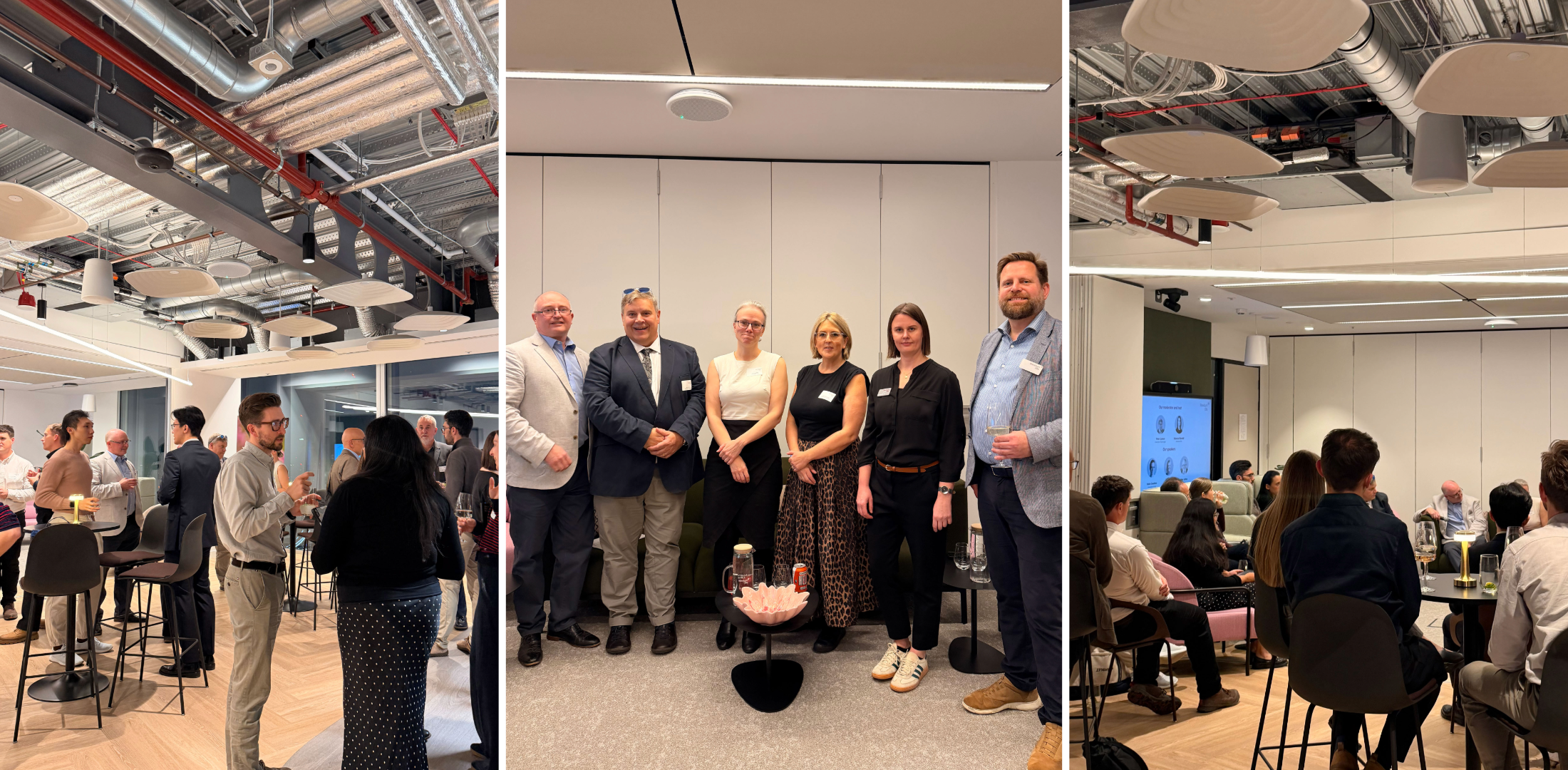
On Thursday 22 October 2026, we were delighted to host our panel discussion and networking event ‘Sustainable Solutions: From Innovation to Market’.
How can chemistry become not only more sustainable, but more resilient to an increasingly unpredictable world? That was the question at the heart of our recent event, which brought together experts from academia and industry to explore how sustainability driven innovation can be translated into practical, scalable solutions.
The discussion was led by Pete Licence, Pro-Vice Chancellor at the University of East Anglia, alongside Libby Gibson, Co-lead of Great British Chemicals and Professor of Energy Materials at Newcastle University, Helen Sneddon, former Head of Green Chemistry at GSK and Director of the Green Chemistry Centre of Excellence at the University of York, and Mike Sutton, Corporate Technical Fellow at Lubrizol.
Together, they considered what resilience means for modern chemistry, what is needed to build momentum for change, and how sustainable principles can be put into practice.
Pete began by sharing the evolutionary story of Resilient Chemistry and how it represents the “next-click” in the green chemistry movement. At its core is the idea of making molecules – via sustainable pathways – that can withstand disruption to supply chains and markets caused by challenges such as climate change and conflict. Pete then invited the speakers to share their perspectives on what resilience means to them, how we build momentum and effect change, and how we translate principles into practice.
What followed was a lively, engaging and thought-provoking discussion, with plenty of lighter moments along the way, including a round of Desert Island Discs and a nod to Dr Seuss’ The Lorax as Pete introduced us to the concept of “Seuss-tainability”.
Our key takeaways
- Resilience requires us to think beyond the molecule: Chemistry does not exist in isolation. The origin of feedstocks, manufacturing routes, supply chains and the ability to continue supplying customers all form part of the resilience equation. As Libby put it “we need to think of the future value of the product when working at the lab bench”.
- Changing feedstocks can create new possibilities: Moving away from traditional petrochemical sources presents significant questions, but looking to different feedstocks can also create opportunities for creativity and innovation. As Helen put it “Starting from different (non-petrol) feedstocks leaves more scope for creativity”.
- Innovation needs demand as well as discovery: Scientific and technological advances alone are not enough. Where new solutions cost more, customers also need to see the value and be willing to adopt alternative approaches. As Mike Sutton neatly put it “It can’t be all push, we need some pull”.
- Collaboration is an essential part of resilience: Knowing where others have complementary expertise, working with start-ups and fostering local collaboration can all help ideas move beyond the laboratory.
- Resilience and sustainability need to be considered together: One interesting question raised was the potential tension between the two: the most sustainable option may not always be the most resilient. Building the chemistry of the future means considering both.
And, of course, the discussion continued well beyond the panel, with plenty of lively conversation and networking over drinks and canapés, not to mention lots of compliments on the rather spectacular views of London by night! We would like to thank our panellists, chair and all attendees for contributing to such an insightful discussion.