The space industry is booming. James Lockyer, analyst at Peel Hunt, gives Mewburn Ellis a tour of the technologies set to reshape the industry.
Forward: features are independent pieces written for Mewburn Ellis discussing and celebrating the best of innovation and exploration from the scientific and entrepreneurial worlds.
What's next in the space race
“If you want to fly to Mars you need to be precise at take-off,” says James Lockyer, space analyst at Peel Hunt. “Because when you are in space you can't change direction. The journey takes six months to a year. So the trajectory needs to be just right. You've got to predict it and time it perfectly.”
Lockyer is an expert on space. One of his jobs at Peel Hunt, a UK-listed investment bank, is to identify outstanding space companies in the UK and beyond, highlight them to his institutional investor clients, allowing his investment banking colleagues to help them grow via M&A and fundraising.
It's an unusual role. There aren't many investment bankers who can discuss the merits of a new satellite platform, the orbital mechanics of a mission to Mars, as well as how everyday habits, such as ordering a takeaway via an app, are linked to Space, so with the boom in interest in the space industry, Lockyer is in a unique position to sense trends in the industry.
At the time of our interview Mars is very much in the news, with a wave of announcements. China plans to launch its Tianwen-3 lander in 2028, to return with samples in 2031. Japan's Martian Moons eXploration probe launched in October to collect samples from Mars’ largest moon Phobos. And NASA made progress with the agency's Mars Telecommunications Network – to create a telecoms hub for rovers and spacecraft on the surface of the planet.
Fascination with space is at a level not seen since the original moon landing.
“It's been compared to when Netscape IPO'd in the 1990s,” says Lockyer. “After then, investors had to make a decision about how to respond to the internet. It was something you couldn't ignore. The IPO of SpaceX focused minds on space in the same way.”
He gave Mewburn Ellis a glimpse into what's coming next.
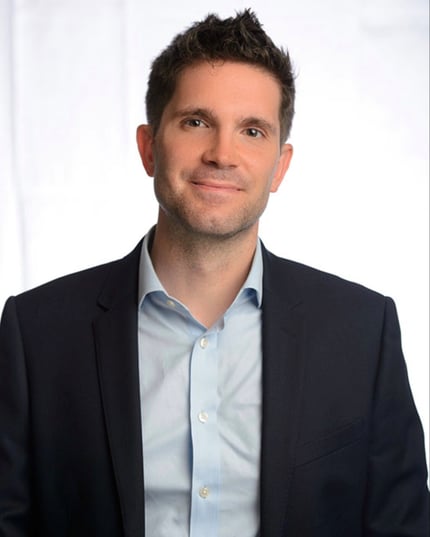
James Lockyer, Equity Analyst at Peel Hunt
The birth of new industries
So what is Lockyer seeing on the far and distant frontiers of space entrepreneurship? “An easy one to understand is making fibre optic cables in space. Fibre optics are made of glass or silica. When manufactured on Earth there may be slight imperfections because of gravity or slight movements. If the fibre optic cables are made in space, the outcome can be more perfect.”
The same is true for biotech. “Proteins, for example, are affected by gravity in their shape and movement. Researchers say there are advantages to putting the same proteins in space, free of the distorting effects of gravity.” In theory, gravity-free environments allow proteins to form larger, purer crystals with neater molecular organisation. These higher-quality crystals more easily reveal their 3D structures, enabling a better understanding of their function.
3D cell growth in particular can be superior in micro-gravity. Cells can grow in three-dimensional structures without gravity distorting the shape. There are research implications too. Academics at UCLA and the Forsyth Institute in Cambridge published results on bone loss on the International Space Station, and how this may help to test therapies for osteoporosis. Clinical trials on Earth are slow, but astronauts lose around 1% of bone density a month in space, accelerating research cycles.
“There's a UK pharma company called Mass Balance which recently sent up a pineapple-sized lab into space to see how proteins grow and react under weak gravity,” says Lockyer. “They wanted to test the theory of whether they would grow more perfectly in space.”
The Mass Balance mini-lab contains sensors, chemicals and control elements, and is designed to orbit for a few months, beaming back data to Earth. Mass Balance CEO Toby Call explained, “When you take away gravity, a lot of weird and wonderful things happen, some of which will be very valuable for life sciences and pharma,” adding, “Microgravity is a new tool that is underexploited.”
Power stations in space are a headline grabber. Are they within sight? “They are in pilot stage,” reveals Lockyer. “There's a UK company called Space Solar that's looking to do solar power in space. You can see how that works, with 24/7 access to the sun at 100% efficiency. The power can be beamed down via laser or microwave. This reduces the need for ground-based energy and can send energy to parts of the world which are hard to serve with a traditional grid.”
Space Solar's CASSIOPeiA is designed to be 1.7km in diameter and 4km long, orbiting at 36,000km from Earth. The weight of each unit is 800 tonnes, twice the mass of the International Space Station – currently a challenge to put into orbit. Excitement around the company is more than abstract, however: Space Solar completed a successful test of its microwave power-beaming technology at Queen's University Belfast. The Chief Executive of the UK Space Agency remarked, “This successful test is a really important milestone on the way to making space-based solar power a reality. Safe, wireless, 360 degree energy transmission is a game changer, and demonstrates the UK’s leading position in this new energy revolution, quite literally harnessing the power of space to benefit life on Earth.”
And there's a focus on data centres. PwC, a professional services company, predicts $31.6 trillion in capital expenditure on data centres to 2050, to build the compute capacity for artificial intelligence. The prospect of diverting a portion of this cash pile to fund data centres in space, free of planning permission constraints and water consumption objections, is tantalising.
“The energy for data centres could come from solar,” says Lockyer. “Which leaves Earth-based power free to power our homes, which makes cost more manageable. And cooling in space is more cost effective too.”
How to think about space
These examples showcase the breadth of innovation in the space industry. Lockyer believes the best way to analyse potential is to understand the esoteric nature of space development.
Breakthroughs can only happen sequentially. Take the trip to Mars. “Ideally you want to get into space, and then land on the moon, re-fuel there, and then take off for Mars. About 80% of fuel capacity of a rocket is used just getting off Earth. There is polar ice on the moon, so there is the potential to build a fuelling station there. But first we need to build on the moon. We need to mine, then build the infrastructure to convert the ice into rocket propellant. So there's a sequence. You can't do the last bit without the first steps.”
The same is true for many innovations. “Take quantum computers,” says Lockyer. “Generally speaking, quantum computers need to be very cold, so the cold of space could be suitable. But the computer needs power, so we need power sources in space before we send up computers.” To put the power sources in space, we first need more economical rockets. The sequential nature of space innovation means many great ideas must be put on hold whilst other technologies develop.
Another key concept is the role of creativity in maximising space technology. Satellites are a great example. The current trend for fitting commercial satellites with cameras and telecoms technology is revolutionising industries far beyond the initial scope.
“The cameras on satellites were great for mapping,” says Lockyer. “Now we are seeing real time applications, such as Ukraine using satellites to track the location of Russian forces. What else can you use them for? In the financial industry, insurers can use images to confirm if an oil rig is on fire. Hedge funds can use the data to predict oil prices, maybe in tandem with thermal heat detection imagery.”
The use cases are flourishing. “There's a UK company called SatVu which provides high resolution thermal imagery. It might be possible to work out how full oil tankers are, which is useful for oil traders. Or investors in retail can see how crowded car parks are outside supermarkets to forecast demand.”
A previous obstacle was poor visibility, from cloud, rain and fog. That barrier is being overcome, opening up new revenue streams. “A Finnish company called ICEYE does synthetic aperture radar,” says Lockyer. “It can see through the clouds. ICEYE raised money twice in the last year as a private company at a euro10 billion valuation. It can track the impact of natural disasters, mapping flooding or the impact of hurricanes on buildings.” A case study promoted by ICEYE shows how oil trafficking can be tracked from space: even under cover of night, illicit ship to ship transfers can be identified.
Another tip Lockyer recommends to newcomers to the subject is to learn the vocabulary of space – for example, know LEO (Low Earth Orbit) from VLEO (Very Low Earth Orbit). The two have distinct characteristics.
“LEO satellites last around four to five years, compared to 12 to 15 years for outer orbit satellites,” he explains. “The low cost of launching LEO satellites means they don't need to last as long. It's cheap to put a replacement up.” Getting closer to the Earth with VLEO means cameras can take sharper images, and shorter communications distances mean lower latency. The emergence of startups such as Surrey-based Stars Edge, which makes a Very Low Earth Orbit satellite platform able to host telecoms equipment and other devices, illustrates the merits of the VLEO approach.
The risks
As an advisor to investors, Lockyer also has a duty to offer a balanced view of the rate of progress, and to highlight risks for any space venture. One phenomenon in particular is the notorious Kessler Syndrome. Originally proposed by scientists Donald J. Kessler and Burton G. Cour-Palais in 1978, it describes satellites colliding, triggering a catastrophic chain-reaction of debris.
“The Kessler Syndrome is a domino effect,” says Lockyer. “There are something like 30,000 known active satellites in space. There are a few hundred thousand non-satellites greater than 10 centimetres. And a million or so fragments smaller than that. That's a lot of potential for collisions. And solar flares can knock something out.”
Is it likely? “I've heard contrarian voices in the space industry say since it hasn't happened yet, it won't happen. What we are seeing is satellites with the ability to make small manoeuvres. Two British companies, Space DOTS and Spaceflux, measure, sense and record activity in space. They call themselves awareness companies.” Space DOTS claims one in five spacecraft experience anomalies or failures due to orbital threats, more than justifying the model of selling environmental data to space operators.
Another risk is military threats. “Adversaries could set off a Kessler Syndrome,” says Lockyer. “And there is jamming. If an adversary jammed our GPS the satellites may be fine, but the signal is unusable. So there is a market for anti-jamming technology.” A recent academic paper claims Russia has been jamming GPS since 2019. Sweden accused Russia of jamming GPS signals over the Baltic Sea more than 700 times in 2025, and at one point the aircraft of the president of the European Commission was reportedly forced to land in Bulgaria using paper maps.
Dominating space may be key to future conflicts. Lockyer, a mathematician by training, identifies a crucial area: “Lagrange Points are points in space between two objects, where the gravitational force of one is exactly the same as the other. That means you are stable in that position, you can hover. There are certain locations in space, such as Lagrange Points, where ownership is important.” The same would be true of building the first moon base and power station in space. “If you are the first, you can effectively control the moon, and then access to the entirety of space. Countries are realising what is at stake.”
It's hard not to envy Lockyer, working at the forefront of the space industry as these technologies transfer from theory to reality. His enthusiasm means he's a regular guest on podcasts and panels in the finance world. “I want to raise awareness of the UK space sector,” he says. “We talk to so many brilliant companies, and we want more people to understand their stories.”
The entrepreneurs he works with are looking to the heavens, dreaming of launching technologies with the power to transform life as we know it.
“Doing it challenges me philosophically,” says Lockyer. “It is mind blowing. The possibilities are likely to be beyond what we can conceive right now. It is the future and that's why I started doing it. There are borders on Earth, but there are no borders in space.”
Dan Thornton, Partner and Patent Attorney at Mewburn Ellis comments:
"James has demonstrated the breadth of innovation that makes the space sector so compelling. Technologies developed for use in orbit can create possibilities far beyond their space aspects. For valuable IP that means anticipating an invention’s long-term value and full commercial chain. Where possible, including terrestrial features will push coverage to where we have greater legal certainty and activity to support greater IP-based revenue generation on Earth as well as in orbit, for example.”
Written by Charles Orten-Jones.