UPC Weekly brings you timely, thoughtful and joined-up insight into the evolving landscape of patent litigation at the Unified Patent Court.
2026 Week 34
The headlines are easy – first, the UPC says that it applies the EPO approach to added matter and then says that intermediate generalisations can be just as bad at the UPC as at the EPO. But here we have the opportunity to really dig into how the UPC Court of Appeal (CoA) assessed an intermediate generalisation in a difficult case and came to the conclusion that there was no added matter.
The case is Sibio v. Abbott (UPC CoA, 13 August 2026). This is the second time that the UPC Court of Appeal (in exactly the same composition as before) has had to consider the validity of EP 3831283 B1 after previously affirming a preliminary injunction against Sibio based on the patent.
The “gold” standard at the EPO
The requirement for claimed subject matter to be “directly and unambiguously derivable” from an original application traces a path through various EPO Enlarged Board of Appeal decisions, notably G 3/89, G 11/91, G 2/98 and G 1/03. These specific decisions were mainly concerned with slightly different issues, such as the allowability of corrections, disclaimers or entitlement to priority. Another disclaimers case was in G 2/10, in which the Enlarged Board of Appeal said that its general definition of the requirements of Article 123(2) EPC:
… has become the generally accepted, one could also say the "gold" standard, for assessing any amendment for its compliance with Article 123(2) EPC.
And the test itself (again in the context of disclaimers, but applied more generally by the EPO):
An amendment to a claim by the introduction of a disclaimer disclaiming from it subject-matter disclosed in the application as filed infringes Article 123(2) EPC if the subject-matter remaining in the claim after the introduction of the disclaimer is not, be it explicitly or implicitly, directly and unambiguously disclosed to the skilled person using common general knowledge, in the application as filed.
Why refer to this as the gold standard? The intention seems to be that it is a strict assessment, or a mark of quality. But it’s not particularly clear why this test should need to be, or be deemed to be, higher quality or stricter than other assessments to be carried out by the EPO, such as whether a claimed invention involves an inventive step. Anyway, we’re at risk of digressing, so let’s get back on track.
UPC CoA decision on the preliminary injunction
In UPC Weekly 2025 w8, we reviewed the CoA decision in the original PI case based on the same patent. In that decision, the CoA set out its statement of the test for added subject matter like this:
In order to ascertain if there is added matter, the Court must thus first ascertain what the skilled person would derive directly and unambiguously using his common general knowledge and seen objectively and relative to the date of filing, from the whole of the application as filed, whereby implicitly disclosed subject-matter, i.e. matter that is a clear and unambiguous consequence of what is explicitly mentioned, shall also be considered as part of its content.
It was notable that nowhere in the decision did the UPC CoA refer to the EPO’s approach to added subject matter. In words, the UPC test looks similar to the EPO’s approach, but with greater emphasis on what is meant by “implicit disclosure”.
Bearing in mind the threshold of “more likely than not” for validity assessment in a PI application, the first instance PI decision had held that the patent was probably invalid for added matter and therefore the PI had been denied. However, the CoA overturned this, considering that there was probably no added matter and so granting the PI.
UPC CoA decision on the merits
Sibio had filed an action for revocation of the patent. This was heard by the Paris Central Division after the issuance of the CoA decision on the PI that the patent was probably valid. Unsurprisingly, the Paris CD decided that the patent was not invalid and dismissed the revocation action. On the issue of added subject matter, the Paris CD explained their view that the CoA approach in the PI appeal to added matter had been consistent with the EPO’s approach.
In Sibio v. Abbott (UPC CoA, 13 August 2026), the CoA decided to drive the point home that in their view they were also applying the EPO Enlarged Board of Appeal approach:
There is added matter if the subject-matter of the patent extends beyond the content of the application as filed. In order to ascertain whether there is added matter, the Court must first ascertain what the skilled person would derive directly and unambiguously using his common general knowledge and seen objectively and relative to the date of filing, from the whole of the application as filed, whereby implicitly disclosed subject-matter, i.e. matter that is a clear and unambiguous consequence of what is explicitly mentioned, shall also be considered as part of its content (UPC-CoA-382/2024, 14 February 2025, Abbott v Sibionics). This test is the same as the so-called ’gold standard’ established by the Enlarged Board of Appeal of the European Patent Office in G2/10.
This is exactly the same as the statement from the PI appeal but with the added explanation that this is the same as in G 2/10. So we have heard, loud and clear. Having said that, there is still the question of whether the UPC CoA applies this test at the same level of strictness as the EPO. Does it?
The intermediate generalisation question
In this case, the granted claim was based on a set of general features (having literal basis in a “clause” statement in the original application) but with further features added. Basis for some of these further features was found only in the detailed description of the embodiments of the invention. The CoA confirmed that there can be an added matter problem if the resultant amended claim is an intermediate generalisation by selecting only some of the features from the described embodiment and adding these to the claim. In effect, the claim is a combination of the original features of the claim plus the embodiment but with some features of the embodiment omitted.
The CoA confirmed that this type of amendment is not allowed if there is a clearly recognisable functional or structural relationship among the omitted features and the claim features. But this is not a one-size-fits-all test. What matters is whether and how the omitted features contribute to the technical effect of the invention. Where the omitted features are essential to the invention, there is an unallowable intermediate generalisation.
The claimed features and the embodiment
It’s impossible to get to the nub of the issues here without seeing some claim language and some pictures. The formatting of the claim is important, as is the feature numbering added by the CoA, so these are reproduced below. The key features for considering added matter are shown in pink text.
|
1.0 |
An on-body device, comprising: |
|
1.1 |
(1) a glucose sensor assembly (3702, 4702) comprising: |
|
1.1.1 |
a proximal section comprising a connector support (3604, 4706) coupled with a proximal portion (3310) of a glucose sensor (3300, 4704); |
|
1.1.2 |
a distal tail section comprising a distal portion (3302) of the glucose sensor (3300, 4704) configured to be positioned under a skin surface and in contact with a bodily fluid of a subject; |
|
1.2 |
(2) an enclosure comprising: |
|
1.2.1 |
a top portion (5002); and |
|
1.2.2 |
a base portion (5004) configured to be adhered to the skin surface of the subject by an adhesive patch (3802, 5104); and |
|
1.3 |
(3) sensor electronics positioned with the enclosure, the sensor electronics comprising a processor (4804), and a communications facility, |
|
1.4 |
wherein the base portion of the enclosure comprises a recess (3704, 4710) in a bottom exterior surface, the recess (3704, 4710) comprising a distal-facing opening, |
|
1.5 |
wherein the connector support (3604, 4706) is received through the distal-facing opening and into the recess (3704, 4710), and |
|
1.6 |
wherein the glucose sensor (3300, 4704) is electrically coupled with the sensor electronics by the connector support when the connector support is received into the recess (3704, 4710). |
The claim defines that the device has three parts – the enclosure, the sensor electronics located inside the enclosure, and a glucose sensor assembly. The features relied on by Sibio for their added matter attack were features 1.4-1.6. These define the way in which the connector support fits into a recess in the base of the enclosure and electrically couples with the sensor electronics.
These features can be seen in the three drawings below.
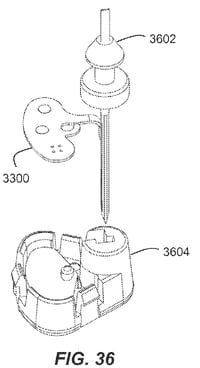
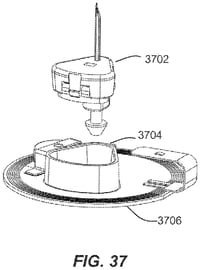
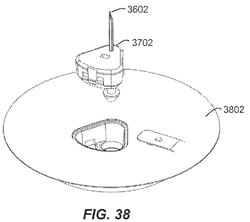
The relevant part of the description explained that the connector support 3604 includes an elastomeric seal backing. Furthermore, the recess or socket 3704 is described as including a second elastomeric unit with electrical contacts. Fitting the connector support 3604 into the socket 3704 presses the electrical contacts together and seals them within the socket 3704 and sensor assembly 3702. Sibio’s argument was that omitting the elastomeric seal meant that the claim included an unallowable intermediate generalisation from the original disclosure.
Overall technical effect of invention is key
The CoA’s view is clear – there can be added matter in these circumstances. Where it will bite is when there is a clearly recognisable functional or structural relationship among the omitted features and the features that are added to the claim.
The CoA considered that they should keep in mind the overall technical aim of the invention, which in this case was to allow assembly of the on-body device during its application to a user, while allowing the applicator for the device to be freely moved over the skin before adhering the device to the skin in the application step. This is relevant to whether there is an unallowable intermediate generalisation, for example where the omitted features contribute to the technical effect of the invention.
An important element of the CoA reasoning was that the elastomeric sealing was not necessary for achieving the technical effect of the invention. However, the CoA did accept that sealing was a requirement of claim 1, even though it is not explicitly stated in the claim. This was based on the general teaching of the application and on the skilled person’s common general knowledge.
The CoA relied on parts of the original disclosure that were not inside the scope of the granted claim, saying that the skilled person would take note of these to understand whether the omitted features were essential to the invention.
The upshot was that the CoA decided that while sealing was an implicit requirement of claim 1, the omission of the elastomeric sealing member that was disclosed in combination with the features in pink in claim 1 did not amount to added matter.
Holistic – not just for inventive step
In our view, this approach to the assessment of added matter by the UPC is not what would normally be expected from an EPO opposition division or Board of Appeal. The difference stems from the readiness of the UPC to take the overall technical effect of the invention into account in a holistic manner. We see this also with the UPC approach to inventive step and how it contrasts with the EPO’s approach.
With this framing, the UPC can consider whether omitted features in an intermediate generalisation would be understood by the skilled person as being of importance to that overall technical effect.
What does this mean for the parties? Here, Sibio had the burden at first instance and on appeal of proving invalidity of the patent due to added matter. The claim as granted was pulled together from various parts of the original disclosure and so would have appeared to be vulnerable to an added matter attack. The CoA’s affirmation and further explanation of its previous position on the same patent takes their approach some way from the EPO’s more typically literal method, even when both are seeking to apply the same Enlarged Board of Appeal gold standard to the same question.



.jpeg)
.png)