UPC Weekly brings you timely, thoughtful and joined-up insight into the evolving landscape of patent litigation at the Unified Patent Court.
2026 Week 30
Something that crops up a lot at the EPO is where a claim is novel over the closest prior art in view of two different features. This week we’re taking a look at how the UPC deals with the same situation. Every case turns on its own facts and merits but there are emerging themes.
The watershed decisions of the UPC Court of Appeal (CoA) in Meril v. Edwards and Amgen v. Sanofi / Regeneron set the framework for the UPC’s assessment of inventive step – a holistic approach taking into account the objective problem identifiable from the patent. A claim is obvious where there is motivation for the skilled person to solve the objective problem in a manner that falls inside the scope of the claim.
At the EPO – bring out the “partial problems”
The UPC CoA approach to inventive step is not the same as the EPO’s problem-solution approach. The big difference is in the construction of the “objective technical problem” at the EPO, which is based on identifying the technical effect of the novel feature of the claim compared with the closest prior art. Typically, the EPO objective technical problem will differ depending on which closest prior art document is selected.
So what happens when the claim differs from the prior art in view of two features that are not particularly related to each other? This is where the normal problem-solution approach comes unstuck. Formulating an objective technical problem to cover the technical effects of both distinguishing features becomes difficult without including pointers to the claimed invention. But having a more generic objective technical problem means that it becomes harder to assert that the skilled person would modify the prior art using both differences in an obvious manner to reach the invention. The more unrelated the differences, the less likely the skilled person would bring them together. So, is the claim more likely to be inventive?
Well, no. The EPO developed the “partial problems” approach to take account of this (see EPO Guidelines G-VII, 7). This requires finding that the claim is “merely an aggregation or juxtaposition of features and not a true combination”. A combination would have synergy between the distinguishing features of the claim. Where there is no such synergy, the EPO says that the objective technical problem is treated as an aggregation of several "partial problems". Then, for each partial problem, an assessment is made of whether the distinguishing feature is obvious (using the problem-solution approach for that partial problem).
And at the UPC?
Because the UPC CoA decided not to endorse the problem-solution approach, actually its approach to the same situation feels more natural. Taking a more holistic approach and considering what the patent itself says it is adding to the state of the art, the UPC has a more consistent formulation of the objective problem, which does not vary depending on the prior art starting point used to assess obviousness.
Having identified the objective problem and the skilled person, the UPC CoA says:
The claimed solution is obvious when at the relevant date the skilled person, starting from a realistic starting point in the state of the art in the relevant field of technology, wishing to solve the objective problem, would (and not only: could) have arrived at the claimed solution.
How to differentiate between could and would? Like this:
The skilled person has no inventive skills and no imagination and requires a pointer or motivation that, starting from a realistic starting point, directs them to implement a next step in the direction of the claimed invention. As a general rule, a claimed solution must be considered not inventive / obvious when the skilled person would take the next step prompted by the pointer or as a matter of routine, and arrive at the claimed invention.
So there must be a pointer or motivation for a finding of obviousness. Or, and this will be important, it can be deemed to be “a matter of routine”.
Interdependence can be enough, even with no synergy
In TCL Europe v. Corning (UPC CD Munich, 24 February 2026), the Munich Central Division (CD) was dealing with a standalone revocation action. A separate infringement action with counterclaim for revocation was decided later by the Mannheim LD in Corning v. TCL Deutschland (UPC LD Mannheim, 16 April 2026) but which relied on the same assessment of validity.
The patent in the dispute is EP 3296274 B1, which claims a method for making glass useful for liquid crystal displays. TCL threw many grounds of invalidity at the patent, including added matter and insufficiency, but here we’ll concentrate on inventive step.
Although claim 1 defines a method, the key feature related to the composition of the glass, which was presented in the claim as an allowable range of mole % for each oxide as:
SiO2: 64.0-71.0
Al2O3: 9.0-12.0
B2O3: 7.0-12.0
MgO: 1.0-3.0
CaO: 6.0-11.5
SrO: 0-1.0
BaO: 0-0.1
with the additional requirement for at least 0.01 mol% Sn, with further limitations of the relative proportion of Al2O3 compared with MgO, CaO, SrO and BaO, and with the requirement that the method is carried out “purposely using neither arsenic nor antimony”.
On inventive step, the court considered document D20. Example 15 of that document had two differences compared with claim 1: a BaO content of 0.21 mol% and an Sb2O3 (antimony oxide) content of 0.02 mol%. The claimant argued that these features could be considered separately using the EPO’s partial problems approach. In this case, the court did not agree:
… the claim features of the Patent, even if they would not be synergetic in the sense of having a special combination effect, are in any event interdependent in providing a solution to the objective problem. This is the inventive concept underlying the invention. Ignoring these interdependencies and dividing the objective problem up into separate problems amounts to hindsight reasoning which is to be avoided in the assessment of inventive step.
The revocation action was dismissed by the CD. The Mannheim LD upheld the finding on validity and also found the patent to be infringed.
Mere juxtaposition
Promosome v. BioNTech (UPC LD Munich, 7 July 2026) is an infringement action with a counterclaim for revocation based on EP 2401365 B1. With the LD deciding that claim 1 as granted lacked novelty over documents D1 or D2, the patentee turned to AR4 and the court assessed its inventive step.
Claim 1 of AR4 was a combination of claims 1 and 10 as granted. Without going into detail of the technical aspects of the invention (the claims define methods of improving full-length protein expression efficiency), the court agreed with the defendants that the distinguishing features of claim 1 of AR4 could be found separately in prior art documents D9 and D10.
The defendants argued that the UPC should apply the EPO’s partial problems approach in these circumstances. The LD declined to do that, but reached a conclusion that would have been the same as at the EPO. The description showed the methods of original claims 1 and 10 being used separately to increase protein expression efficiency – so they are both aiming to do the same thing – but there was nothing in the patent’s description that the LD could see suggested that the two methods cooperated or were interdependent. The patentee sought to provide evidence of synergy, but this was deemed late-filed and was not admitted.
Dealing the final blow, the court said:
the combination of features of AR4 constitutes a mere aggregation of two independent methods, whereby the features of these methods do not interact functionally to produce an effect that goes beyond mere addition in solving the objective problem of increasing protein expression efficiency. In other words, the features are simply juxtaposed … The skilled person would, as a matter of routine, combine these two methods.
The patent was found not infringed and was revoked for invalidity.
Two distinguishing features solving the same problem
And bringing us up to date and covering off the technical bases we have Raimund Beck v. Baussmann (UPC CD Munich, 21 July 2026) dealing with a revocation action against EP 4283140 B1.
The patent claims a fastening element made of wood and for attaching wood components together. Fig. 2 of the patent shows an example, with the interest being in the angle β2 at the tip and the angle α2 in the tapering segment behind the tip.
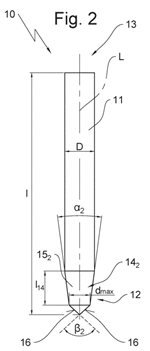
Having found that claim 1 of the patent lacked novelty, the court turned to AR1 which defined that angle β2 at the tip is 65-110° and that α2 is 5-20°. These angles were the distinguishing features over prior art document D5 used to assess inventive step.
Interestingly, the claimant (applicant for revocation) did not assert a partial problems approach, or that the effects of these two differences should be considered separately. The court’s view was that there was no motivation to the skilled person to modify D5 to make these two changes to address the court’s formulation of the objective problem. Both distinguishing features, at least arguably, helped to address that objective problem.
So, the patent as amended was deemed inventive.
Summing up
As we said at the top, each case turns on its own facts. When in this situation with multiple distinguishing features over the prior art, the patentee will need to get around the “matter of routine” backstop in the CoA inventive step test. Clearly, substantiated synergy between the features will be useful, but the bar is lower than this. Having the features address the same (potentially general) objective problem may be enough, to the extent that the features can be argued to be interdependent.



.png)