UPC Weekly brings you timely, thoughtful and joined-up insight into the evolving landscape of patent litigation at the Unified Patent Court.
2026 Week 32
We see it all the time. UPC infringement actions or preliminary injunction proceedings are started based on a European patent that was originally opted out of the UPC. The opt-out is withdrawn and the patent is asserted at the UPC. In a typical case, this allows the patentee to have their cake and then eat it – to be opted out to shelter against the risk of central revocation proceedings at the UPC and then to withdraw the opt-out to gain access to the UPC’s broad territorial reach for enforcement.
The benefits seem all too obvious. Why wouldn’t you do this? Well, there are two main answers – risk of lock-out and lack of access to a unitary patent.
Lock-out risk
To add a bit of jeopardy to the otherwise-attractive opt-out option, there’s a possibility of being locked out of the UPC system permanently. If you opt out your European patent and you or someone else starts national court proceedings in a UPC country based on that European patent, then you can’t ever validly withdraw the opt-out to get back into the UPC system.
Unitary patents vs opted-out European patents
One of the main drivers for setting up the UPC was to provide a court for litigating European unitary patents (UPs). There is no other court that has jurisdiction over infringement and validity of UPs, and so naturally you can’t opt a UP out of the UPC.
There’s a tension between these two options. Validating a European patent in each country of interest by the traditional route allows you to opt out of the UPC. On the other hand, obtaining a UP gives significant cost advantages, being much cheaper to obtain and maintain for the UPC territory. (How much cheaper? You can check using this.)
What we saw at the start of the UPC was a huge rush of opt-outs being filed. These were allowed in the sunrise period of 3 months before the UPC opened for business in June 2023. UP requests could also be filed, from the beginning of 2023. Comparing the statistics for these in the graph below, we can see that the number of opt-outs overwhelmed the number of UPs. This was because it was possible to opt-out pre-existing European patents, whereas you could only obtain a UP for European patents granted after 1 June 2023.
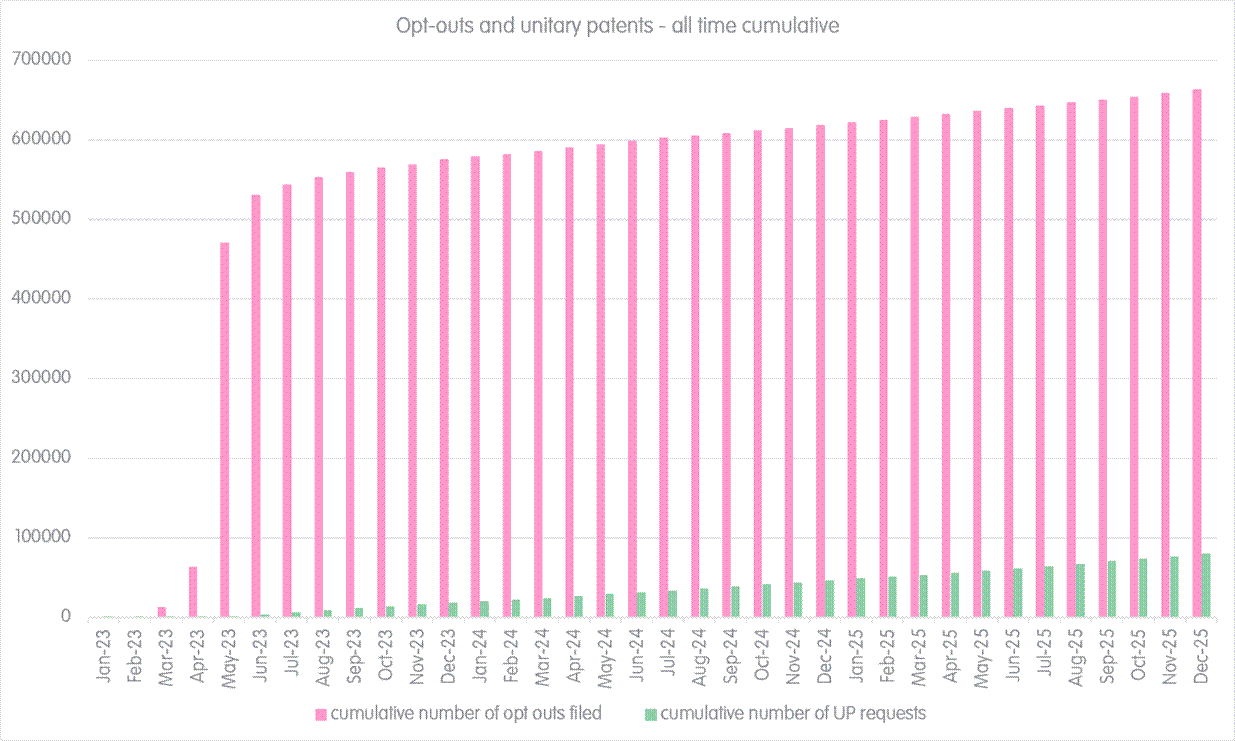
But we can strip out this transitional effect. The vast majority of opt-outs were filed in March-June 2023 due to the uncertainty about the risk of central revocation. So, instead, the graph below looks at the progress of filing of opt-outs during 2024 and 2025, compared with the progress of UP requests over the same time period.
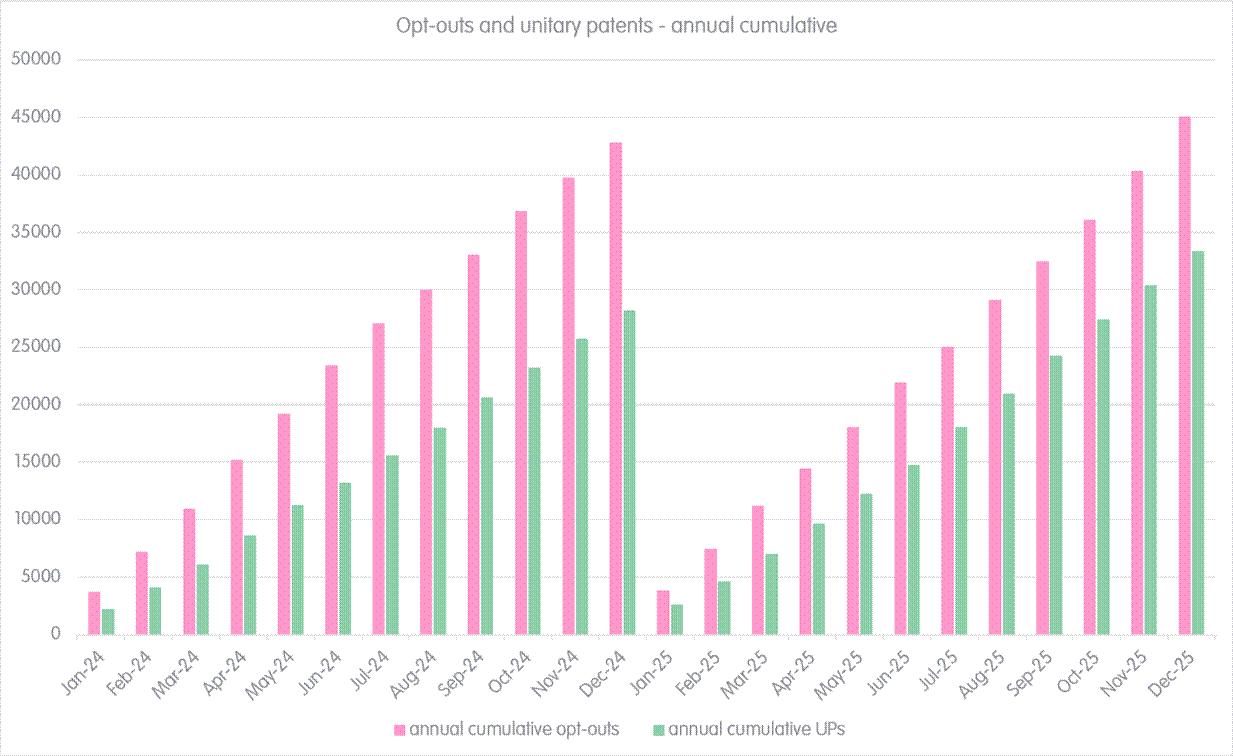
It’s pretty clear. Patent proprietors are still opting out some European patents, but this is relatively steady. At the same time (but obviously for different European patents), UPs are being requested. The rate of UP uptake is increasing a little more quickly. In 2024, 25.6% of all granted European patents were registered as UPs. This increased to 28.7% for 2025 and stands at 30.6% so far in 2026.
[Sources for data: UPC Annual Review 2025 and EPO Statistics & Trends Centre.]
What about for “important patents”?
We’ve spoken quite a bit about opting out of the UPC – see UPC Weekly 2024 w24 (Opting-out from the UPC: the Who, the When and the Why) for the basics.
In UPC Weekly 2025 w38, we showed the results of some further research comparing the opt-out status of patents that were subject to EPO oppositions. Typically, opposed patents are more likely to be opted out than non-opposed patents. This correlates with an expectation that if the opposition fails, maybe the attacker would consider filing a central revocation action at the UPC.
But, interestingly, the take-up rate for UPs is not really affected by EPO oppositions, even for cases with multiple opponents (a sign of importance of the patent to competitors in the industry). What does change is the number of European patents which are neither opted out nor UP – this is the middle ground that is squeezed out.
When opting out goes wrong
Silimed v. Polytech (UPC CoA, 29 June 2026) is a decision of the UPC Court of Appeal (CoA) about whether EP 2581193 B1 is subject to the jurisdiction of the UPC. The facts of the case are pretty unusual but they show something important.
The European patent was granted to Polytech in 2015. In 2017, Silimed started entitlement proceedings in the German national courts to take ownership of the patent from Polytech. A decision in Silimed’s favour on entitlement was reached on 28 November 2024 and this became final on 5 January 2026.
In the meantime, in March 2023, Polytech had opted the patent out of the UPC.
On 8 January 2026, Silimed sent a cease-and-desist letter to Polytech, alleging infringement of the patent. The following day, a company related to Polytech filed a national German revocation action against the patent.
On 4 February 2026, Silimed withdrew the opt-out at the UPC and, the next day, started an infringement action at the UPC. Polytech filed a preliminary objection, arguing that the withdrawal of the opt-out was not effective, due to the existence of national revocation proceedings against the patent in Germany, filed while the opt-out was still in place.
Realising that they may be in a difficult position, Silimed filed an application to remove the opt-out filed by Polytech in 2023, arguing that it was not authorised. This was based on the argument that Polytech was never entitled to the patent, in view of the (later) decision of the German courts. The CoA dismissed this. At the time the opt-out was filed, the “right” proprietor had filed it. Silimed had not been able to show that the German decision on entitlement had retroactive effect reaching back to the time when the opt-out was filed. So the patent is locked out of the UPC and the UPC infringement action has been stopped in its tracks.
Early opt-outs?
In Omnia v. Sidel (UPC CD Paris, 7 May 2026), Omnia launched proceedings for declarations of non-infringement (DNI) against two Sidel patents: EP 4594194 B1 (granted 22 April 2026) and EP 4624351 B1 (a divisional granted 20 May 2026).
What’s unusual about the case is that the DNI action was filed 3 March 2026, well before the patents were granted. Sidel then filed opt-outs of the patent applications on 2 and 8 April 2026 and raised a preliminary objection in the UPC proceedings, arguing that the UPC does not have jurisdiction due to the opt-outs.
The Paris Central Division (CD) noted that it is not unusual for UPC actions to be started before grant of the patent – we have seen this in various PI applications and the UPC has not queried this. The line drawn by the CD is that a DNI action can be filed before grant, provided that the patent is granted by the time that the DNI defence is due to be filed. Therefore, in this case, the DNI action was validly filed, before the filing of the opt-outs, and so the opt-outs are not effective. The UPC therefore has jurisdiction for the DNI application.
For applicants who really want to avoid the jurisdiction of the UPC, filing an opt-out well before grant of the European patent is therefore sensible.


.png)
.png)