UPC Weekly brings you timely, thoughtful and joined-up insight into the evolving landscape of patent litigation at the Unified Patent Court.
2026 Week 23
As a new court, covering 18 countries, it was always expected that the UPC would need to deal with complex questions about its jurisdiction. And how should this interact with the jurisdiction of other courts, especially when validity of the patent is raised as a defence? The UPC Court of Appeal (CoA) has taken some of these questions by the scruff of the neck and set out a practical guide for the UPC divisions to step through when working out how to proceed. This is all laid out in Kodak v. Fujifilm (CoA, 2 June 2026).
Following the CJEU’s approach in BSH v. Electrolux, the Mannheim LD decided at first instance in Fujifilm v. Kodak (18 July 2025) that EP 3511174 B1 as amended was infringed in the UK and was considered valid as between the parties. The same court had previously decided that the patent as amended was valid and infringed in Germany, this decision being taken before the CJEU gave its view in BSH. Following the first instance decision, Fujifilm sought to enforce the injunction, including with penalty payment orders, while in the meantime Kodak was appealing.
Some facts
Actually, the jurisdictional facts of the case are relatively easy:
- the European patent was only in force in Germany and the UK
- the defendants were all domiciled in Germany
- the action was brought before a suitable local division of the UPC
- the claimant requested an injunction and damages in respect of at least Germany and the UK
- the defendants counterclaimed for invalidity of the patent
The appeal
Kodak appealed the first instance decision in respect of jurisdiction and also on the issues of infringement and validity. The substantive points themselves are properly interesting and we will come to those in a subsequent article because here we just concentrate on jurisdiction.
The UPC’s long arm jurisdiction
While there is a referral pending to the CJEU on the UPC’s long arm jurisdiction (see UPC Weekly 2026 w10), this is on a somewhat technical point and relates to the UPC’s jurisdiction over a non-EU defendant.
In this Fujifilm case, the three Kodak defendants were all domiciled in Germany and there was an allegation of infringement of the European patent in Germany. On the basic question of whether the UPC should also have jurisdiction to decide on infringement of the same European patent in the UK, the application of BSH is clear and the answer is yes. Not surprising so far. The CoA pointed out that national courts of the UPC states would have jurisdiction in the same circumstances and the UPC should not have narrower jurisdiction.
Some terminology and some shortcuts
Having decided that the Mannheim LD was correct to accept jurisdiction for UK infringement, the CoA went on to give more general guidance for UPC divisions on exercising their jurisdiction. This takes up nearly two pages of the sprawling headnotes of the decision. What the court is explaining is how the UPC should deal with different parts of a European patent. A European patent can cover any permutation of the European Patent Convention (EPC) states via a national validation process in each state. Some of the EPC states are in the European Union (EU), and some but not all of these are in the UPC. Some others are not in the EU but are in the Lugano Convention, which is an international convention having a similar aim to the Brussels Regulation covering international jurisdiction. And some others still are in the EPC but are not in the EU or the Lugano Convention.
As ever with Europe, you end up needing a map. And because Moldova has just joined the EPC, we needed a fresh one. The one below shows the different categories of country inside the European Patent Convention system.
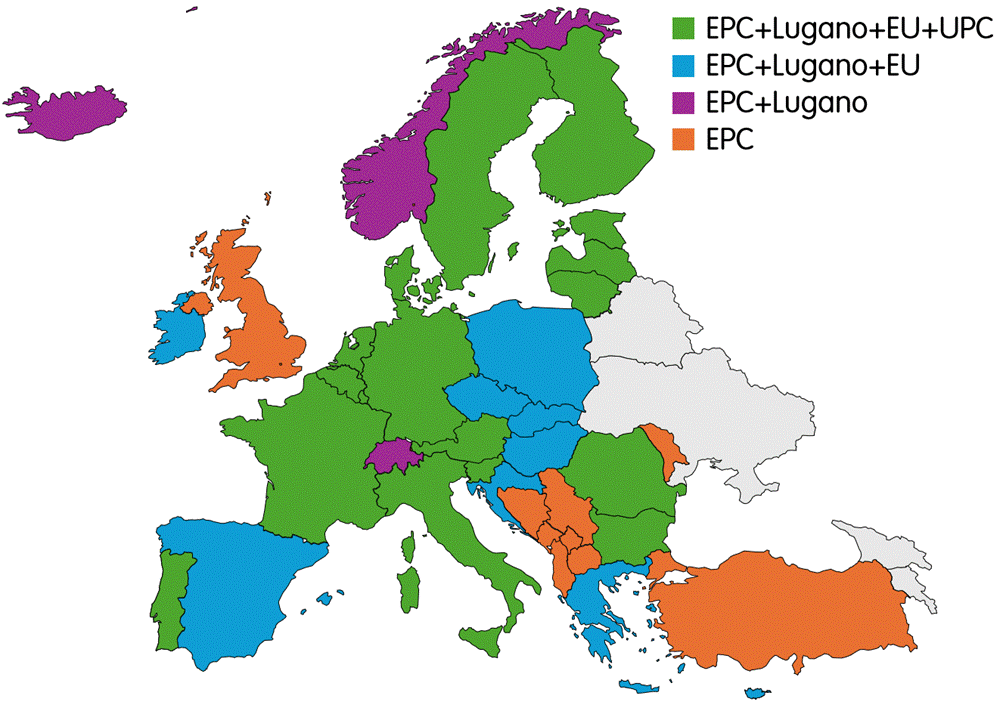
While the CoA was extremely careful not to single out individual countries in their generic discussion, we don’t need to be quite so polite. So here we can take different example countries for each category:
- example UPC country: Germany (DE)
- example EU-but-not-UPC country: Spain (ES)
- example Lugano-but-not-EU country: Switzerland (CH)
- example EPC-but-not-Lugano country: United Kingdom (UK)
We’ll refer to the parts of the European patent validated in each of these countries as EP(DE), EP(ES), EP(CH) and EP(UK).
Guidance for exercising jurisdiction
The CoA set out various scenarios in which infringement of the EP is asserted inside and outside the UPC, but assuming that the relevant UPC division has jurisdiction to decide on the infringement, and the defendant raises invalidity of the patent as a defence.
The CoA confirmed that where invalidity is asserted for EP(ES) or for EP(CH), then the court cannot consider the validity of such patents, but the court can still decide on infringement.
Where invalidity is asserted for EP(UK), then the court can consider invalidity on an inter partes basis and can decide on infringement.
Then the court stepped through various scenarios as to how it would address different invalidity issues:
Scenario I
If a revocation action is filed at the UPC with respect to EP(ES), EP(CH) or EP(UK) then the court must declare that it lacks jurisdiction to decide on that revocation action.
Scenario II
This is where an infringement action is brought for EP(DE) and also for EP(ES), EP(CH) or EP(UK) and the court decides that the EP(DE) is infringed but is invalid.
Here the court will offer the patentee the chance to withdraw the infringement action in respect EP(ES), EP(CH) or EP(UK). Assuming that the patentee does not withdraw:
- For EP(ES) and EP(CH), the defendant should be given the chance to file a national revocation action. If a national revocation action is filed, the UPC court should stay the proceedings in respect of EP(ES)/EP(CH) until there is a final decision on the national revocation action. If no revocation action is filed, the court must assume that the patent is valid and should decide the infringement action on that basis.
- For EP(UK), if the patentee does not withdraw the infringement action, the infringement action should normally be dismissed.
- If the UPC court considers that the patent would be held valid by the relevant national court, the UPC court may issue a decision that is conditional on the patent not being held invalid to a relevant extent
- If the national court does hold the patent to be valid, the UPC court decision can become final (e.g. an injunction awarded can become permanent)
- If the national court holds the patent invalid to a relevant extent, then the UPC decision on infringement for that country falls away. In this case the patentee can ask the UPC court for consequential orders within 2 months of the national court decision (including a request for a stay pending a final decision from the national court).
Note the difference in treatment between EP(ES)/EP(CH) and EP(UK). It is apparently not intended by the CoA that the defendant should be forced to file a revocation action in the UK to avoid the presumption of validity that would apply for EP(ES)/EP(CH).
Scenario III
Here again an infringement action is brought for EP(DE) and also for EP(ES), EP(CH) or EP(UK). But in this case the court decides that the EP(DE) is valid and infringed in the UPC territory.
In this case, for EP(ES), EP(CH) and EP(UK):
-
- If the UPC court considers that the patent would be held valid by the relevant national court, the UPC court may issue a decision that is conditional on the patent not being held invalid to a relevant extent
- If the national court does hold the patent to be valid, the UPC court decision can become final (e.g. an injunction awarded can become permanent)
- If the national court holds the patent invalid to a relevant extent, then the UPC decision on infringement for that country falls away. In this case the patentee can ask the UPC court for consequential orders within 2 months of the national court decision (including a request for a stay pending a final decision from the national court).
Hard law meets comity and practicality
The CoA decision refers to “comity” several times, meaning mutual courtesy and respect between different courts. The CoA applies the expected principles to EP(ES) and EP(CH) in view of the status of Spain and Switzerland as an EU member and a signatory of the Lugano Convention, respectively, because this is the outcome of the Brussels Regulation and the Lugano Convention.
The key point to note is that there is no clear requirement on the UPC to adopt similar or more generous provisions for EP(UK) (and of course other EPC states that are outside the EU and Lugano regime). But, for reasons of comity, this is the approach that the CoA is effectively mandating for all UPC divisions. It will be interesting to see if courts outside the UPC adopt symmetrical approaches.



.png)