Two weeks ago, we reported on the UPC Court of Appeal’s referral to the Court of Justice of the European Union (CJEU), to provide guidance on whether the UPC has jurisdiction over a non-EU based defendant for alleged infringement of a European patent in a non-UPC EU country – see UPC Weekly 2026 w10. In that case, there is a particular defendant domiciled in the UPC territory that is a service provider, required by EU product safety regulations, in order for the alleged infringement product to be sold in the EU. The CJEU is asked to consider whether that defendant can be an “anchor defendant”, giving the UPC jurisdiction over the non-EU based defendant’s sales in Spain.
Now, the UPC Court of Appeal (CoA) has clarified in Adobe v. KeeeX that there is a clear limit to the long arm of the UPC, in particular when there is no defendant located within the territory of the UPC.
Background
KeeeX SAS brought an infringement action based on EP2949070 against a number of defendants including Adobe entities, OpenAI entities, and Truepic Inc. amongst others. All defendants were based in the US or Ireland. The US is of course not a UPC member state. Ireland is an EU member state, but is not a UPC member state because it has signed but not yet ratified the UPC Agreement. Therefore, none of the defendants were domiciled within the UPC territory.
At first instance, the UPC Paris Local Division (LD) held that it had jurisdiction not only over infringement within UPC member states, but also for infringement outside of UPC territory, including in Switzerland, Spain, the UK, Ireland, Norway and Poland. This was based on the LD’s interpretation of the CJEU’s approach in BSH v. Electrolux.
Appeal
The CoA overturned the LD’s order insofar as it asserted jurisdiction for infringement outside of the UPC territory in Switzerland, Spain, the UK, Ireland, Norway and Poland.
In the view of the CoA, the BSH case allows the jurisdiction of an EU court to be extended to “third country” territories outside of the EU, provided that a defendant is domiciled within the territory of the EU court. But for Adobe and the other defendants, none were domiciled within a UPC member state and so the UPC’s jurisdiction did not extend outside the UPC territory in this case.
The CoA did however clarify that the UPC does have jurisdiction for defendants domiciled outside of the territory of the UPC (under Art. 7(2) Brussels Regulation), but only for allegedly infringing acts within the UPC. In that case, jurisdiction is strictly limited to damage occurring within the UPC territory and cannot be extended to non-UPC countries.
Additionally, in some specific circumstances, the UPC could have “ancillary” jurisdiction for defendants domiciled outside of the UPC territory, for infringement outside of the UPC territory. The specific circumstances require that the infringement also gives rise to damage within the EU, and (i) property belonging to the defendant is located in a UPC member state, and (ii) the dispute has sufficient connection with that UPC member state (Art. 71b(3) Brussels Regulation). In the present case, the CoA decided that KeeeX had not adequately explained if or how these requirements were met in their statement of claim.
So, when does the UPC have jurisdiction if all defendants are domiciled outside of the UPC?
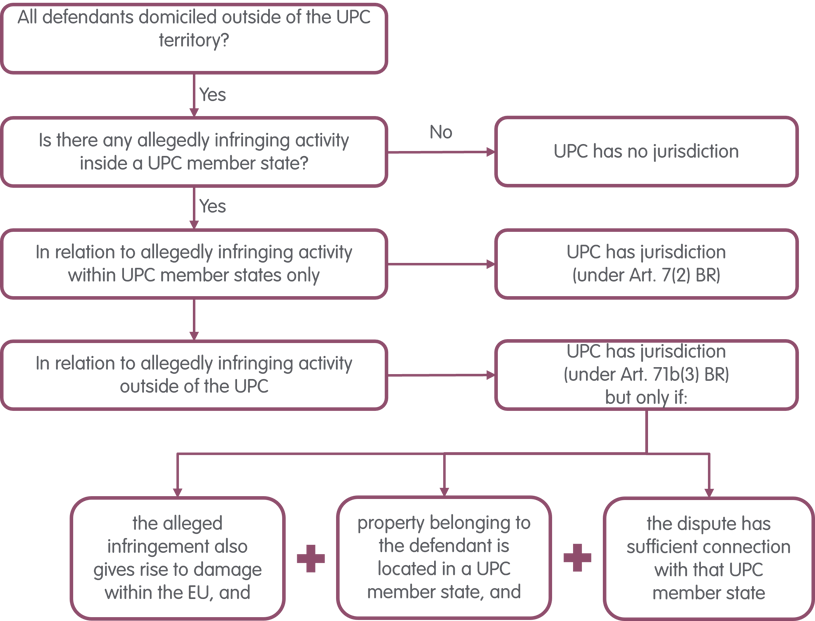
What does this mean in practice?
Claimants looking to sue defendants based outside of the UPC territory must do more than gesture at jurisdiction in their statement of claim. Where such a claimant wants the UPC to reach beyond the UPC territory, at the outset the claimant must set out both the legal basis relied upon and the facts and evidence said to justify it.
Reliance on Art. 7(2) BR confines the case to infringement within the UPC territory only.
For infringing acts outside of the UPC territory:
- Art. 4 BR can be relied upon when the defendant is domiciled in a UPC member state;
- Art. 8 BR may in some situations be relied upon when the defendant is closely connected to an “anchor defendant” that is domiciled in a UPC member state, and
- Art. 71b(3) BR may in some specific situations be relied upon, but a fully developed pleading is required at the outset, providing clear indication of the non-EU-domiciled defendant, a demonstration of harm within the EU, evidence of non-trivial assets in a UPC member state, and evidence that the dispute has sufficient connection with that member state.
Fully bottoming out the limits of the jurisdiction of the UPC was never going to be straightforward, but this guidance from the CoA fills in another piece of the puzzle.


.png)
.png)