UPC Weekly brings you timely, thoughtful and joined-up insight into the evolving landscape of patent litigation at the Unified Patent Court.
2026 Week 24
There’s more to the UPC than long arm jurisdiction. Last week we looked at just one part of the UPC Court of Appeal (CoA) decision in Kodak v. Fujifilm (CoA, 2 June 2026). But behind the guidance for implementing the courts’ jurisdiction, there was an all-you-can-eat buffet of substantive patent law, hitting points on priority, numerical ranges, prior use and more.
First instance
The Mannheim LD decided at first instance in Fujifilm v. Kodak (2 April 2025) and Fujifilm v. Kodak (18 July 2025) that EP 3511174 B1 as amended was infringed in Germany and UK, and was valid in Germany and also valid (as between the parties) for UK. Following the first instance decision, Fujifilm sought to enforce the granted injunction, including with penalty payment orders.
The appeal
Kodak appealed everything in sight, including jurisdiction for UK, infringement and validity. Despite losing on the jurisdictional points, Kodak managed to turn the outcome in the case around, with the CoA deciding that the patent was not infringed in Germany or UK, but for different reasons for each. How did they get there, and what can we learn from the CoA decision?
The patent
EP 3511174 B1 claimed two priority dates – one in 2017 and one in 2018. The patent is all about lithographic printing and specifically the structure and properties of a lithographic printing plate precursor. We won’t go deep into the technology but it is worth having the main claim to hand to understand different parts of the CoA decision. Here is claim 1 as amended, with the feature numbering used by the CoA. Note that the claims as granted did not include reference numbers.
A lithographic printing plate precursor comprising:
1.1 an aluminum support (10), and
1.2 an image recording layer on the aluminum support,
1.3 wherein the aluminum support (10) includes an anodized film (20) on a surface of the image recording layer side,
1.4 the anodized film has micropores (30) extending in a depth direction from the surface of the anodized film on the image recording layer side,
1.5 the micropores (30) include at least large-diameter pores (130) whose maximum diameter inside the anodized film (34, 122) is in a range of 0.01 µm to 0.30 µm,
1.6 and wherein an average value of depths of the large-diameter pores (130) to the bottom from the surface of the anodized film (D) is in a range of 100 nm to 1500 nm,
1.7’ an average pore diameter of the micropores in the surface of the anodized film (124) is in a range of 10% to 50% of the maximum diameter of the micropores inside the anodized film,
1.8 a thickness (X, F) of the anodized film (10) is in a range of 550 nm to 2850 nm, and
1.9 the image recording layer contains an acid color former.
Lots of the technical discussion centred on the porosity defined in the claim, which is shown schematically in Fig. 1 of the patent: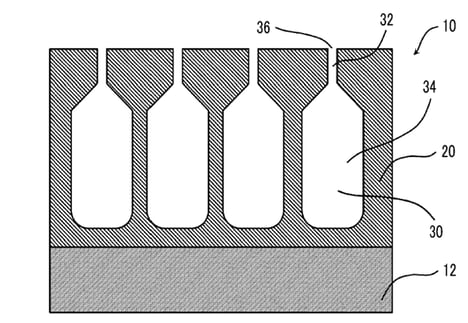
An easy way to think about the pores is that they can be bottle-shaped, so that they have a narrow neck 32 opening at the surface of the anodized film 20 and a wider part 34 inside the anodized film. But bear in mind that this is a big simplification and that it turns out that real life products do not quite look like this.
The amendment
Kodak filed a counterclaim for revocation in response to the infringement action. Fujifilm filed a main request to amend claim 1 and to limit its assertion of infringement to just one of 4 products originally asserted to infringe. The amendment in feature 1.7 was to limit the original defined range of “90% or less” to “in a range of 10% to 50%”.
Interpretation of numerical ranges
Only interpretation of features 1.4-1.7’ was in dispute between the parties. Kodak made arguments essentially saying that the court should read further limitations into the format of the large-diameter pores. The CoA did not agree, concentrating on the features in the (product) claim rather than features that would be specific to a described manufacturing route.
Kodak also argued that the interpretation of the numerical range in feature 1.7’ must take into account real life fluctuations due to the manufacturing process and the measurement method. The argument was that numerical ranges should be given a special interpretation in view of real life circumstances where statistical fluctuations would lead to uncertainty both in the absolute dimensions of the pores but also in the manner in which they were to be measured. The aim was to persuade the CoA to interpret the range to cover an average pore diameter at the surface of slightly more than 50% of the maximum pore diameter inside the film.
The CoA did not agree:
Contrary to what Kodak suggests, there is no general rule that the skilled person would always and automatically take into account fluctuations which are due to the manufacturing process and the measurement method and in doing so would automatically add deviations to the – as such precise – numerical value in a claim feature. This may be a result of claim interpretation but is not inherent to the use of a numerical value in a claim.
An important part of the court’s reasoning here was that while the claim does give precise numerical ranges, these are expressed as being applied to average values, and therefore would already inherently take any fluctuations into account.
Priority
At first instance, the Local Division decided that first priority date was valid. This was in part based on lack of substantiation from Kodak, who had initially only argued about the disclosure of the claims of the priority application rather than the whole disclosure.
The CoA did not agree, deciding that Kodak had indeed given enough substantiation in their original arguments, and disregarding late submissions from Fujifilm on this issue. The CoA confirmed that the test for entitlement to priority is the same as the test for added matter, in effect confirming the EPO’s G 2/98 without mentioning it. The result was that the first priority date was not valid for the amended claim, and so the relevant date for the patent was the second priority date.
Novelty for ranges
The CoA acknowledged that where a claim is defined using numerical ranges:
… lack of novelty is found if the state of the art contains either by way of description or by other means of disclosure an individual product that for each and every feature that the claim defines by way of ranges has a particular value or subrange that falls into the claimed ranges (and the subrange not extending beyond the claimed range).
Alleged public prior use
This was not considered by the LD at first instance because the alleged public prior use fell after the first priority date. With the CoA deciding that the patent was only entitled to the second priority date, the court considered Kodak’s evidence of prior use.
Based on evidence filed in the rejoinder at first instance, Kodak argued that two prior use plates had a diameter ratio as required by feature 1.7’ of 57% and 56% respectively. Based on the claim interpretation, the CoA decided that these plates would not take away the novelty of amended claim 1 (falling outside the range of 10% to 50%).
Kodak filed further experimental evidence in the appeal, based on different batches of plates. However, the CoA did not admit this evidence, saying that it could have been found at first instance and should have been submitted then. Kodak contended that these plates showed a value of 47% but the CoA was persuaded by the counter-evidence from Fujifilm that a proper measurement led to a value of 57%.
Inherency and unusual parameters
Turning to the documentary prior art, the court considered whether the skilled person would inevitably arrive at a product falling inside the scope of claim 1 when carrying out certain examples in the prior art. Kodak tried to persuade the court that there should be a reversal of the burden of proof so that it would be for Fujifilm to show that carrying out the prior art did not lead to a product falling inside the “unusual parameter” range defined in claim 1. The CoA effectively endorsed this principle, but said it did not apply in this case because there were other distinguishing features of the claim:
The reversal of the burden of proof may apply where the Patent uses an unusual parameter feature which represents the only distinction over otherwise identical known products, but Kodak has not shown this is the case here.
Conclusion on validity
The CoA decided that the claims were novel and inventive over the prior art. For inventive step, the court referred briefly to its own case law in Amgen v. Sanofi. Kodak had submitted an obviousness attack starting from the alleged public prior use plates. The argument was that there was no technical effect in going from 56% or 57% to 50% to fall inside the scope of the claim. The CoA rejected this as late-filed, but note that the same argument came back for a defence to infringement.
Conclusion on technical infringement
The court relies on its claim interpretation to decide that the Kodak products fall inside the scope of amended claim 1. This was based in particular based on the measurements of the pore characteristics as defined in the claim.
So with all of this groundwork, it’s a surprise to find that the CoA decided that there was no infringement of the patent either in Germany or UK. What happened?
No infringement in Germany
Kodak raised a defence based on Article 28 UPCA in respect of Germany:
Any person, who, if a national patent had been granted in respect of an invention, would have had, in a Contracting Member State, a right based on prior use of that invention or a right of personal possession of that invention, shall enjoy, in that Contracting Member State, the same rights in respect of a patent for the same invention.
The CoA observed that German national law must be applied to assess this defence in respect of Germany. The facts were that Kodak had established that they were using the 56% / 57% plates before the second priority date. The question was therefore whether Kodak was allowed to rely on the later-made changes that reduced this to below 50%, on the grounds that this change did not achieve an additional advantage compared with the 56% / 57% plates.
The outcome was that this defence applied and therefore there was no infringement in Germany. This overturns the first instance decision which was that there was insufficient evidence for the secret prior use defence. The success of this defence was contingent on the successful attack on the first priority date.
It’s worth noting that there are other instances of a secret prior use defence being raised at the UPC, see Yellow Sphere v. Knaus Tabbert (LD Düsseldorf, 10 April 2025) and Hologic v. Siemens Healthineers (LD Düsseldorf, 10 June 2026) where it failed on the facts. But see also Heraeus v. Vibrantz (LD Munich, 10 October 2025), discussed in UPC Weekly 2025 w43, where a secret prior use defence won the day.
No infringement in UK
There was no corresponding secret prior use defence deployed in respect of the UK. But the CoA decided that in fact it is Kodak Ltd (a UK domiciled company and not named as a defendant) who imports the products into the UK. Therefore the CoA court considered that there was no infringement by the German defendants of the EP(UK).
An important additional point made by the CoA is that the UPC can hear actions for patent infringement based on allegations of joint tortfeasorship, but on the facts is this case there was no infringement by the German defendants based on joint tortfeasorship.
End result
The patent was maintained in amended form in Germany and Kodak’s counterclaim for revocation was dismissed, with costs consequences for Kodak.
The infringement actions in respect of Germany and UK were dismissed. Fujifilm has to bear the costs of the infringement action and Kodak can now launch proceedings for compensation in respect of the remedies ordered and enforced at first instance by Fujifilm.
It has been incredibly interesting to watch this case unfold. In addition to the new guidance on jurisdiction from the CoA, the main lesson to be taken is that the CoA will reach their own view on difficult substantive questions. Although Kodak did not win on all points in their appeal, they won on enough to lead to the conclusion that there was no infringement.


.png)