2026 Week 3
Being sued for patent infringement at the UPC is a full-on experience. The front-loading of the procedure and the urgent time limits mean that far-reaching strategic decisions need to be taken at a very early stage. A key one is this: you think you have reasonable, but maybe not slam-dunk, arguments for non-infringement. Should you bolster your defence with a counterclaim for revocation?
In most cases, the answer is surely yes. Given that the Local Divisions of the UPC clearly prefer not to bifurcate validity from infringement, the defendant may be able to deploy effective squeeze arguments, trapping the patentee between non-infringed and invalid claim interpretations. But the risk of bringing a counterclaim for revocation is that this significantly increases the complexity and cost of the case. We have seen UPC cases where the defendant succeeds in their non-infringement arguments but not in their counterclaim for revocation, and ends up paying the costs of the patent proprietor in the counterclaim.
These issues were in play in Emboline v. AorticLab, a 13 January 2026 decision from the Munich Local Division of the UPC considering infringement of EP 2129425 B1. Here, the defendant succeeded in their non-infringement arguments and structured their requests to the court so that their counterclaim for revocation would only be considered if there was infringement. Although the court accepted that this was possible, it did not have much benefit for the defendant on the face of the case, although maybe there were wider considerations in play.
But before we come on to these procedural points, the substantive issue of infringement turned on a purpose-based point of claim interpretation which is well worth an airing.
Technical aspects of the invention
This is one of those cases where you can work out the technical field based on the names of the parties. The background section of the patent sets out various objectives for the invention, focusing on the need for acute and/or chronic protection from the risk of emboli originating from the heart or aorta travelling in the bloodstream. Further practical considerations are also set out, including the possibility that such protection may also need to be removable or compatible with future interventional procedures.
Read in the context of the recent guidance from the UPC Court of Appeal, these explanations would make an excellent basis for setting out the objective problem to be solved for a consideration of inventive step. But despite validity being in issue in the case originally, the court didn’t consider inventive step, because the counterclaim for revocation didn’t come into play.
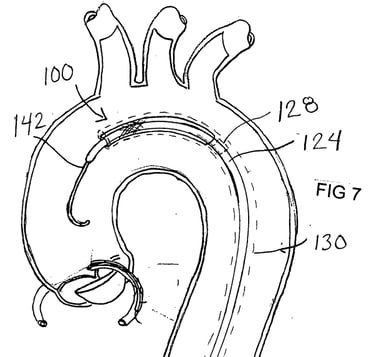
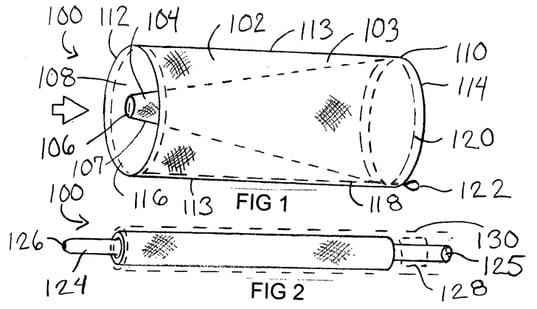
Figs. 7 and 8 show the device being advanced into position in in the aorta and then expanded into a deployed condition. Fig. 1 shows the device by itself in the deployed condition. Fig. 2 shows the device on the delivery catheter 126 in the undeployed condition.

Claimed invention
Claim 1 is long, but easy to understand in the light of the drawings:
1. An embolic protection device, comprising:
an approximately cylindrical outer structure (102) made of a filter mesh material;
an approximately conical inner structure (104) made of a filter mesh material positioned inside of the cylindrical outer structure (102);
wherein on a downstream end (110) of the embolic protection device (100), a wider end of the conical inner structure (104) is joined to the cylindrical outer structure (102);
wherein an upstream end (108) of the embolic protection device (100) is open for blood to flow between the conical inner structure (104) and the cylindrical outer structure (102); with a space between the conical inner structure (104) and the cylindrical outer structure (102) defining a collection chamber (103) for captured emboli;
wherein the narrow upstream end of the conical inner structure (104) has a catheter port (106) configured for passage of a catheter shaft through the catheter port (106);
characterised in that the device further comprises at least one retraction member (116, 120) encircling the circumference of the cylindrical outer structure (102);
and a pull loop (122) or other graspable structure (122) near to the downstream end (110), wherein said pull loop (122) or other graspable structure near to the downstream end (110) is connected to the retraction members (116, 120) and is engageable by a hook (154) on the distal end of an elongated member (156) within a retrieval catheter (152).
The device is intended to be placed into patient’s aorta as shown in the drawings and expanded so that it forms a filter basket to capture emboli. The narrow end of the interior cone has an aperture for passage of a catheter. The key feature of the claim is the “pull loop or other graspable structure”. This is required to be engageable by a hook for retrieval of the device from the patient, but the hook and the retrieval catheter are not part of the claimed device.
The alleged infringement
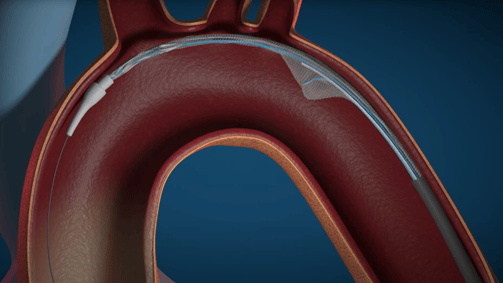
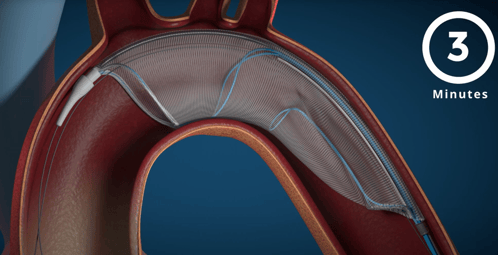
The alleged infringement is the defendant’s FLOWer Transcatheter Antiembolic Filter which serves the same overall function in the context of being used during surgery, but which is intended to be pulled out at the end of surgery using the same catheter. There is therefore no step of engaging a hook into a graspable structure of the device. The sequence of its deployment, structure and removal can be seen from these views captured from the defendant’s website.

Claim interpretation and infringement assessment
The court had many features of the claim to interpret, including the meaning of “approximately cylindrical” and “approximately conical”. But they rested their decision on the “pull loop or other graspable structure”. The claimant argued that any structure that is engageable by a hook would be a graspable structure, irrespective of whether this was the intended purpose of the structure.
Although the alleged infringement had features which would allow engagement with a hook, this was not in fact how the device would normally be removed. And furthermore, the use of a hook in this way would rupture the mesh of the filter.
The court accepted that their interpretation was affected by the technical field of the invention. They colourfully noted that their view might be different for a plumber seeking to remove a lodged object from a drainpipe. But in the context of retrieval of the device from the blood vessel, the use of a hook would not constitute proper, professional and intended use of the alleged infringement:
However, at least in the case of a medical device, the possibility of use in accordance with the patented teaching can only be assumed if such use is in line with professional practice and with the recognised rules of medical science.
The court therefore decided that there was no infringement.
The vanishing counterclaim
The defendant had counterclaimed for invalidity of the patent. During the oral hearing, the defendant stated that the court should only consider the counterclaim if there was a finding of infringement.
The court considered this point. They concluded that it is allowable for a party to limit their case in this way, in particular where the other party is not disadvantaged.
Therefore the court did not rule on the counterclaim for revocation.
But … costs
It’s possible that the defendant took this step with the counterclaim at least in part to reduce the risk of an adverse costs award in case the court decided that the patent was valid. Given that the costs for counterclaims for revocation are typically as high or higher than the main action for infringement, this aim would be sensible. Or maybe there were bigger-picture issues in play.
However, the court decided that the defendant’s step to make the counterclaim conditional meant that they were responsible for there being no decision on validity. Therefore the court took the view that the defendant must pay the patentee’s costs for defending against the revocation counterclaim.
The court decided that the value of the infringement proceedings and the counterclaim were the same, with the patentee bearing the costs of the unsuccessful infringement action and the defendant bearing the costs of the unused revocation counterclaim. And so the net result was that each party had to bear their own costs. This leaves open the question about the prospects for success of the counterclaim. Had it been considered, and succeeded even in part, then the defendant would probably have ended in a significantly better position on costs.



.png)