This week’s update sees the UPC Court of Appeal uphold one and overturn another order from the same Local Division on preliminary injunctions for the same product.
In UPC Weekly 2025 w46 we reviewed a series of first instance preliminary injunction (PI) decisions for medical devices. Appeals from two of those PI cases covering the same continuous glucose monitoring (CGM) product have now been decided by the UPC Court of Appeal (CoA) and provide yet more insights into claim interpretation at the UPC and various other nuggets.
Recap: grounds for a UPC PI
Assuming that the claimant is the patentee or otherwise has standing, in order to grant an inter partes PI, the court needs to be satisfied that:
- the patent is (probably) valid
- the relevant product (probably) does infringe the patent
- there is an infringing act, or infringement is imminent
- the patentee has acted without undue delay
- the PI is necessary and the balance of interests favours the PI being granted
First instance EP 4344633 B1: Abbott v. Sinocare (The Hague LD 17 October 2025)
EP 4344633 B1 claims a sensor assembly which in practice is part of an on-body device adhered to the skin and for locating a sensor under the skin of the user.
Sinocare’s product is the GlucoMen iCan system for continuous glucose monitoring. The system has a sensor device, a transmitter device and a mobile app. The GlucoMen iCan had been registered as a medical product on the EUDAMED database, and a distribution agreement was announced between Sinocare and Menarini, both in early December 2024. Various online test purchases of the product had been made by Abbott at the end of April 2025. The patent was granted 4 June 2025, and the PI application was filed at The Hague LD in early July 2025. The court had no problem concluding that Abbott had moved fast enough, presumably on the basis that the PI application could not have been filed before grant.
Sinocare defended against the PI by arguing against infringement based on claim interpretation. One of their main arguments was that claim 1 should be interpreted narrowly so that it was limited to a specific embodiment in the patent. The LD disagreed. In part, this was based on some of the dependent claims more clearly being directed to that embodiment, and so the court considered that claim 1 should be given a broader interpretation than the dependent claims.
On validity, the court was satisfied that claim 1 was novel and inventive. One interesting point was that Sinocare argued that some of the dependent claims included added matter. The court dealt with this by concluding that this objection did not apply to the main claims and therefore there was no need to decide on this point in the context of PI proceedings.
There was evidence that the GlucoMen iCan was available in the cash pay market, made possible by the CE marking, but not yet approved in the (much larger) reimbursement market. The risk of price erosion therefore led the court to decide that the PI was necessary and proportionate. The wording of the PI was to prohibit infringement of the patent “in particular” by acts relating to the GlucoMen iCan (or components thereof), rather than by reference to the wording of the claims.
Appeal EP 4344633 B1: Sinocare v. Abbott (UPC CoA 30 March 2026)
As mentioned above, this case included both Sinocare (a Chinese company) and Menarini (and Italian company). At first instance, the court’s jurisdiction had been challenged in respect of Sinocare but not Menarini.
On appeal, Menarini attempted to challenge jurisdiction (specifically whether The Hague LD should be competent) but the CoA shut this down, saying that this could not be raised for the first time on appeal. But in any event the CoA noted that the product was offered on a website available throughout Europe, including the Netherlands, and so The Hague LD did have jurisdiction.
With respect to Sinocare, jurisdiction had been challenged at first instance. The CoA took the view that Sinocare was participating in the alleged infringing activities in Europe by having a strategic partnership with Menarini. Sinocare was responsible for obtaining the CE certification for the product, which additionally was sold in a co-branded way. So the CoA decided that the jurisdictional challenge failed.
On claim interpretation, the CoA broadly agreed with the first instance decision. They took the view that original embodiments in the patent which are not inside the scope of claim 1 should not be used to interpret claim 1. In reply to the arguments proposing to limit the scope of protection to specific embodiments in the patent, the CoA said:
In general, a claim is not limited to the embodiments described in the patent. Embodiments are included in the patent description to explain and clarify the claimed invention, not to limit the claim to the specifics of the described embodiment. … It is true that paragraph [0084]states that Figures 34-35 show an embodiment of the invention as claimed in claim 1, but this is not necessarily the only embodiment protected by the claim.
The CoA also noted that some dependent claims explicitly recited some limitations that the appellants argued were implicitly required in claim 1. This wording of the dependent claims would not be needed if claim 1 was limited as argued, and so the CoA decided that claim 1 was broader.
The appellants raised a new argument of added matter against claim 1. Although the wording of claim 1 was present in the original application, the added matter objection was raised based on the LD’s interpretation of the claim. This was assisted by the dependent claims referred to above, which were used by the CoA to interpret the scope of claim 1, but those dependent claims were not present in the original application. The CoA dismissed this argument as late-filed, but also said that they considered that there was no added matter, finding support for the dependent claims in the description.
On substantive patentability, the CoA also agreed with the LD, finding that the claims were probably novel and inventive.
Overall, the CoA agreed with the LD that the patent is probably infringed and upheld the PI. The urgency requirement was considered to be satisfied at least in view of the speed with which Abbott filed the PI application – within a month after grant of the patent. One wrinkle is that Sinocare has had a similar product on the market since October 2023, with the GlucoMen iCan launched more recently. Without changing the wording of the injunction, the CoA noted Abbott’s stipulation that the PI is not intended to cover the previous product.
First instance EP 3988471 B2: Abbott v. Sinocare (The Hague LD 22 October 2025)
This separate case was also heard at The Hague LD at first instance and with exactly the same panel of judges as the first case. The alleged infringement was the overall GlucoMen iCan system, including the mobile phone app.
Abbott’s patent in this case is EP 3988471 B2, which was maintained in amended form after an EPO opposition. Claim 1 is lengthy, defining a glucose monitoring system including the sensor, transmitter unit and a receiver unit (e.g. mobile phone). Most of the claim concerned what the display on the receiver unit could show to the user in relation to the glucose measurements. Part of this is a “timeline graph” of glucose levels. The key part of claim 1 is shown below (with feature numbering added by the court):
A glucose monitoring system, comprising:
a glucose sensor (101) …
a transmitter unit (102) …
a receiver unit (104, 200) comprising a processor, and a user interface having a display (210) …
…
1.13 and wherein … the display (210) is configured to render the timeline graph screen (400) on the display (210),
1.13(a) wherein the timeline graph screen (400) comprises a timeline graph comprising the plurality of monitored glucose levels,
1.13(b) wherein the timeline graph comprises a lower glucose target indicator (312) and upper glucose level target indicator (314) that can be changed by the user,
1.13(c) wherein the timeline graph includes event data icons (318),
1.13(d) and wherein, in response to user selection of a particular even data icon (318) by using an input button or touching the event data icon on the display (210), the display (210) is configured to display details of the selected event.
According to the user guide of the GlucoMen iCan, the app can display this screen, showing a “trend graph” glucose level (in mmol/L) against time, with certain events shown below the graph:
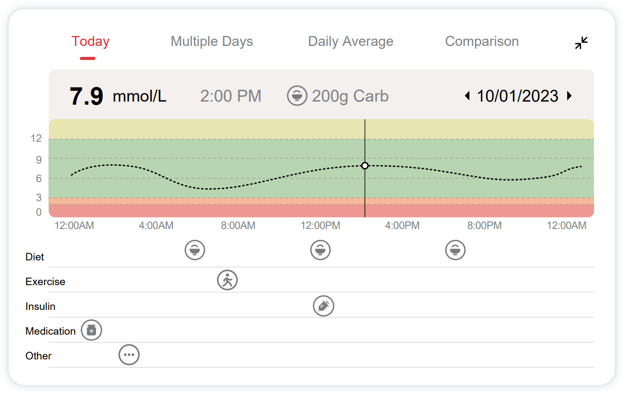
The key question for infringement was therefore whether the app meets the requirement that: “the timeline graph includes event data icons”. Abbott argued that this feature is satisfied if the screen showing the graph also shows the event data icons.
The LD considered that the layout of the display was the main teaching of the patent, and so a different layout of the display would be meaningful, even though it may provide the same function. On this basis, they decided that the GlucoMen iCan display shown above was not inside the scope of claim 1, because the event data icons are shown on a separate panel, below the timeline graph.
The PI was not granted, on the grounds of lack of infringement. But the court was satisfied that there had been no unreasonable delay, on the basis that it had only been possible for Abbott to assess the GlucoMen iCan from late April 2025, with the PI proceedings being launched on 27 June 2025.
Appeal EP 3988471 B2: Abbott v. Sinocare (UPC CoA 17 April 2026)
The CoA overturned the LD order, deciding to grant the PI.
The key part of the decision is the interpretation of the parts of the claim defining the timeline graph and the event data icons. What was important to the CoA was not whether the event data icons were strictly overlaid onto the timeline graph, but whether the event data icons were correlated to the same timeline.
The Court of Appeal therefore disagrees with the interpretation of the LD The Hague and the Respondents that the monitored glucose levels and the event data icons must always be included in the same “panel” or section of the timeline graph screen. … claim 1 only requires that the monitored glucose levels and the event data icons are included in the same timeline graph. The claim does not require both to be in the same area of the graph or within a certain range of one another.
I admit having hoped that this appeal would have ended up considering infringement by equivalence, but the CoA did not need it.
The claim defines the whole system including a receiver unit, which typically would be a mobile phone. The defendants were therefore to be indirectly infringing the patent by the supply of the GlucoMen iCan system, including the mobile phone app.
The LD order had not considered validity. The CoA considered the patent to be probably valid, agreeing with the outcome of the EPO opposition. For inventive step, the claim was distinguished over the starting point prior art by the event data icons feature. The defendants argued that this was a non-technical feature and so should not be taken into account for assessment of inventive step.
The CoA took the opportunity to fully endorse the EPO approach to this issue, referring to the COMVIK approach (T 641/00):
A claim feature should not be excluded from the assessment of inventive step merely because it is a non-technical feature, i.e. a feature which, on its own, would be considered a “non-invention” under Art. 52(2) EPC. A feature that is non-technical as such may still contribute to the technical character of the claimed invention as a whole by its interaction with the other claim features. Therefore, the interrelationship and functioning of the claim features must be assessed together.
The CoA explained that features of claim 1 together provide improved user-machine interaction that facilitates the user’s diabetes management and glycemic control, commenting that this is clearly technical in nature. Going further, they stated that even features 1.13 themselves can be seen as technical in nature.
Using the UPC’s more holistic approach to inventive step requires a more general construction of an objective problem for the invention to solve. This can be contrasted with the EPO’s focus on the technical effect of the differences between the claimed invention and the closest prior art. Therefore, considering the interaction between (arguably) non-technical features and the remaining elements of the claim sits more naturally with the UPC approach than with the EPO’s problem-solution approach.
The CoA then turned to the question of urgency – had the patentee acted fast enough to secure a PI? The alleged infringement and the timing of its introduction into the European market were as explained above, with 24 April 2025 being the decisive starting point date for the patentee to investigate and start their PI preparations. The PI application was filed on 27 June 2025.
Unlike the case above, the patent had been granted for some time, and had been in EPO opposition proceedings. The EPO opposition division issued a negative preliminary opinion. The CoA found it understandable that the patentee had wanted to wait for the OD written decision on the opposition before filing the PI application. However, I detect a warning shot in the CoA conclusion on urgency, suggesting that 8 weeks might be at the longer end of acceptable:
In conclusion, the Court of Appeal is of the opinion that the Appellant acted with sufficient diligence after the launch of the product and receipt of the samples on 29 April 2025. Although a delay of eight weeks to start PI-proceedings is relatively long, the requirements of urgency have been fulfilled under the circumstances of this case.
The CoA therefore ordered the PI in general terms, restraining infringement of claims 1 and 14 of the patent in the relevant countries, rather than reciting the wording of these claims or identifying the infringing product.



.png)