Women-focused initiatives are helping to shape a more equal legal profession. Mewburn attorneys Fran Salisbury, Amy Crouch, and Lucy Coe explain what's on offer, and why they got involved.
Forward: features are independent pieces written for Mewburn Ellis discussing and celebrating the best of innovation and exploration from the scientific and entrepreneurial worlds.
Equality in the legal profession was hard won. In 1914 Oxford law graduate Gwyneth Bebb lost her bid to qualify as a solicitor. The Law Society argued successfully in the Court of Appeal that the word 'person' in legislation did not include women. At the time women could not even sit on juries.
The 1919 Sex Disqualification (Removal) Act removed barriers preventing women from entering professions such as the law. A year later Madge Easton Anderson became the first woman admitted to practice as a lawyer in the UK. In 1922 Ivy Williams became the first woman called to the Bar.
Major milestones are remarkably recent. In 2023 Sue Carr became the first woman to serve as Lord Chief Justice, breaking an 800 year sequence of men.
Today gender equality in the legal profession is enshrined in law, but the reality is still variable.
“The statistics show that just 21% of patent lawyers are female,” says Amy Crouch, partner and patent litigator at Mewburn Ellis. “There's been great progress, but there is still a long way to go.”
Fran Salisbury, partner and Women's Champion at Mewburn Ellis, says the picture is complex: “IP law, and particularly patent law, is still a male dominated profession. It’s quite specialism dependent – engineering based technologies tend to skew more heavily male, but in life sciences we’re becoming more evenly split. Recently, I've turned up to oral proceedings where both teams are either all women or led by women. I’ve also had cases where the Opposition Division, which is the judicial bench, can be all female or led by women. And that wasn't the case when I started my career. I was often the only woman in the room.”
It’s not just about the numbers though. “The next phase is about how we ensure the profession works equally well for women and men. Making sure we’re supporting different ways of working and succeeding,” says Salisbury. “Women are often masking their true selves at work, such as changing the way they communicate, share emotions, or talk about their families, in order to 'fit in' with what’s expected of a lawyer. We want to change the system so they stop playing a role and can be themselves.”
That involves addressing issues such as maternity leave and returning to work, menopause, and other cultural issues relating to gender, such as unconscious bias, which might impact promotion prospects and the number of women rising to the top.
Dedicated women’s networks and communities have a role to play here. They create space for open discussion, for shared experiences, and for mentoring and practical support. They can also help organisations learn from one another and adopt better practices more quickly.
For those wanting to build connections, develop their careers, or contribute to wider change in the profession, there are a number of influential movements worth knowing about.
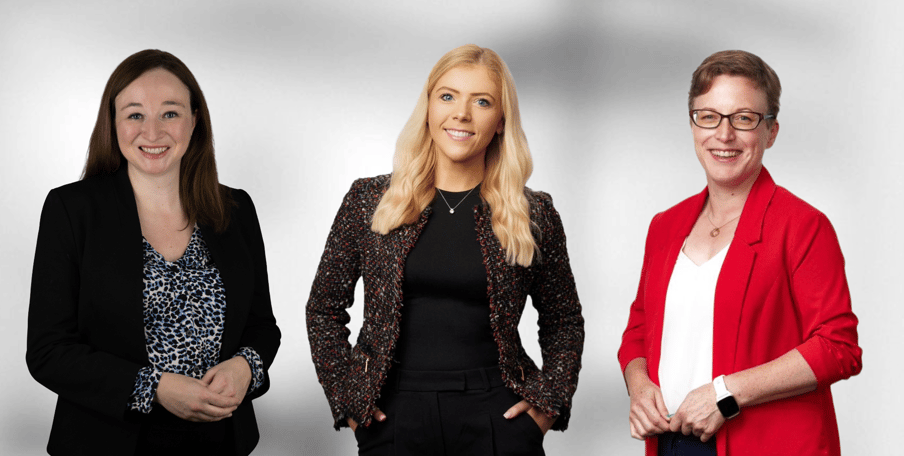
Amy Crouch (Partner, Solicitor, Patent Litigator) , Lucy Coe (Partner, Patent Attorney) and Fran Salisbury (Partner, Patent Attorney, Women's Champion)
Women in IP from IP Inclusive
Women in IP is part of the IP Inclusive initiative in the UK. Lucy Coe, Partner and Patent Attorney specialising in EPO oppositions and litigation at Mewburn Ellis, is the Women in IP Committee Lead.
“The main aim of Women in IP is to tackle issues that people face as women in the UK IP sector,” says Coe. “We provide career guidance support, and host events including panel discussions and informal networking opportunities. We have also recently launched our mentoring scheme.”
The community is open to anyone. “It's not just for lawyers and attorneys,” says Coe. “It's for paralegals, business services, and everyone who works in IP.”
Women in IP provides support not only for individuals, but also for UK IP firms, offering best practice guidance to help organisations improve equality, diversity and inclusion. “We recently recorded a video (available here) asking people why they like being part of Women in IP. Everyone mentioned the community and people they have met. Women in IP gives you access to people at different firms that you wouldn’t otherwise meet. If you are just starting your career, you can have a conversation with a managing partner at another firm, who will share their experiences and advice. It's a great way to connect and learn from each other. It’s also a good way for firms to learn from each other too.”
The sense of collaboration is a key strength, says Coe. “Some people may wonder why people at competitor firms are so willing to offer help and advice. It's because we want the UK IP industry to collectively be a better place for women. That is why these networks are so important.”
It's worth noting the relationship to the parent body IP Inclusive. This is a body with multiple communities in addition to Women in IP, such as IP Out for LGBTQAI+ people, IPause supporting IP professionals going through or expecting to go through (peri) menopause, IP Ability for disabled people, carers and their allies covering disability, neurodiversity and health conditions of all kinds, IP & ME for ethnic minority professionals, and IP Futures for developing IP professionals in the first ten years of their career.
Running these initiatives under a single body means IP Inclusive can provide even greater support to IP professionals. Events are often co-hosted by two or more communities so that more people can be reached, and the communities support one another as allies. Women in IP is currently the largest IP Inclusive community. “We have nearly 2,000 members in our LinkedIn group,” says Coe. “The UK IP sector isn't that big, so in that context we are a really big community.”
ChIPs
“ChIPs stands for Chiefs in Intellectual Property, and it was founded in the US in 2005,” explains Crouch. “The creators were chief IP counsels at various tech companies in Silicon Valley. The aim is to promote women in tech, law, and policy, so it has a broad remit.” Today, it has more than 9,000 members in more than 30 global chapters.
Crouch was part of the team that launched the London chapter of ChIPs. “In Europe the biggest thing we do is organise an annual summit, in a different city each year. It is getting bigger and bigger. This year we hosted around 140 people in Copenhagen, and the discussion panels included one with judges from the Unified Patent Court.”
One of the most prominent successes of the UK ChIPs chapter has been its work with judges on revising the patent court guide to encourage the use of junior advocates in patent cases. “Junior advocates are more diverse, both in terms of gender, and in other ways,” says Crouch. “The new approach is working well. We are seeing judges asking parties whether they'll be using junior advocates, who are getting more time on their feet.”
Encouraging judges to be more vocal about equal representation is also delivering results. Crouch reports: “When we talk to UPC judges some of them mention they've not heard a woman speak. Even when women are on UPC teams, they are not being heard in the room.” This is yet another sign of a cultural bias, says Salisbury. “Because UPC judges are two-thirds male, the deck is already stacked towards men in senior roles. So we have a brand new court system which is already bringing in the bad habits of balance.”
This is the kind of issue ChIPs is able to debate and take action on. Crouch encourages anyone who wishes to get involved with ChIPs to get in touch. “It's free to join!” she says. “We organise all sorts of events. And it's spreading across Europe. The German chapters are having a resurgence. It is also open to men. We want everyone to be part of these initiatives.”
AIPLA
For professionals who deal with the US the outstanding body is AIPLA. “It's the American Intellectual Property Law Association,” says Salisbury. “It's massive and covers all areas of IP.”
Salisbury sits on the Women in IP Law Committee, where she is involved in the Personal and Professional Development Subcommittee. “We look at everything from highlighting new entrants into the profession to providing support around menopause, and everything in between. There's a very active working mums' sub-group, and we maintain a list of potential speakers to ensure women are being considered for speaking opportunities.”
AIPLA's Women in IP Law Committee has initiatives on leadership, presence and branding, employee retention, professional development and umpteen other topics. There's an online community too.
AIPLA extends far beyond North America. “One of the biggest things is the global shout out,” says Salisbury. “This is a global networking event that happens on the same day, and all around the world IP organisations and firms host networking events at the same times – it’s fun to log onto the calls to see what other women around the world are up to for their event”.
Women in IP hosts a breakfast event at each of the AIPLA conferences, and these are always sold out. “An ally said to me recently the Women in IP breakfast is the most fun event of the entire conference. One reason to go is that it's just a sociable thing to do, to learn and be part of a community who have a good time sharing expertise and experiences. We’ve seen lifelong friendships form through the committee, as well as new business relationships.”
Salisbury emphasises this point. “These organisations offer uplifting experiences. You can have such a good time meeting people and exchanging views. The ethos is incredibly positive.”
Get involved
Getting involved with an industry body gives legal professionals the chance to make an impact on how workplaces treat women. Coe, Salisbury and Crouch rattle off a long list of areas which still need attention, including the authority gap – the persistent bias whereby women are taken less seriously than men, even when they have the same or greater expertise or experience; unconscious bias – for example, assuming a role such as judge would be male by default.
Something as routine as a woman returning from maternity leave can be tricky to navigate, even in well-meaning law-firms. “There are all sorts of questions,” says Salisbury. “When you return, will your work that you left be returned to you? What is expected on your first week back? How quickly will you be back up to speed?”
When policies or guidance are developed, it’s important that they are widely known and supported. “A law-firm may have a return to work guidance or menopause policy,” says Coe, “It is important that everyone reads the policy, even if it isn’t directly relevant to them personally. Everyone will know someone at work who is going through the menopause, or returning from extended leave, so it’s important that everyone knows how to best support them.”
Naturally, there is no one-size solution to these issues. There are ongoing debates on a variety of key issues. “Some traits may be more commonly associated with women, but they are not exclusive. At its heart, this work is about creating a system where everyone can thrive, regardless of gender. If we can build a profession that works well for the breadth of women’s experiences, we move closer to one that works well for most people,” says Salisbury.
Getting involved in a campaign to advance women in the legal sector is an opportunity to shape these discussions. The impact can be felt far beyond your own firm.
Coe adds: “It’s also important that we learn from, and share advice with, the IP industry in other countries. For example, Women in IP recently hosted an event co-hosted with IP attorneys from Australia and New Zealand, for a UK, AU and NZ audience. It's very important to share how to make progress in this space, and that’s part of the reason I am proud to work for Mewburn Ellis. We are a trailblazer. We are able to showcase the benefits of our policies, so that other companies in the UK and beyond can make changes in their organisations too.”
While many of these initiatives are focused on women’s experiences, they are not exclusive spaces. Their impact is strongest when they bring a wider group into the conversation.
“I think it’s really important that men are part of this,” says Coe. “Gender equality isn’t something women can or should address on their own. It benefits from shared understanding and different perspectives.”
Across organisations such as Women in IP, ChIPs and AIPLA, there is a growing emphasis on allyship. Events are open to all, and many actively encourage attendees to bring a colleague or ally with them. “There’s real value in having men in the room,” Coe continues. “It helps build awareness of day-to-day experiences that might otherwise go unnoticed, and creates space for more open, constructive discussion.”
For Salisbury, this collaborative approach is essential to long-term change. “The more people who are part of these conversations, the more impact they can have. This is about creating a profession where everyone can thrive.”
Getting involved in industry initiatives offers a practical way to contribute to that progress, whether by sharing experiences, supporting colleagues, or helping shape better workplace practices.
“We can now thrive in the profession precisely because we are women, not in spite of it,” says Salisbury. “That's the change we are now seeing. These organisations give us the tools to change things for the better for everyone.”
Written by Charles Orton-Jones.



.png)