UPC Weekly brings you timely, thoughtful and joined-up insight into the evolving landscape of patent litigation at the Unified Patent Court.
2026 Week 47
Should “a” mean “one” in a patent claim? The UPC Court of Appeal gave a firm view on this in X v. Essetre (UPC_CoA_0000885/2025, 20 November 2026). This is a great decision to read – it’s just 25 pages long and deals with claim interpretation, several invalidity grounds and rounds it off with some food for thought about the practical reality of successfully attacking only some of the granted claims.
To get the most out of the decision, it’s really worth reading and understanding the patent EP 2875923 B1 itself. To help, the main claim and the gist of the invention is explained below with some drawings.
Primer – big mechanical machines
The invention is intended for making large prefabricated wooden walls, such as for the sides of a building. Machining both sides of these walls is necessary, to trim the sides and cut out window apertures for example. Assuming that you just want to have one set of machining tools for doing the machining, this means that it’s necessary to “overturn” the wall – machining one side and then flipping it over to machine the other side.
In response to the revocation action, the patentee filed an amendment as a main request. The amended claim is below with the new features shown with underlining, and a feature shown in bold that we will be coming back to:
1. A machine (10) for machining walls, particularly for walls made of wood or multilayer walls and the like, comprising a portal (11) with one or more working heads (12), and a working surface (13) for resting a wall (14) to be machined, said portal (11) and said working surface (13) being configured for the movement of one with respect to the other, said machine for machining walls being characterized in that said working surface (13) comprises a first and second opposite support and movement frames (17, 18), both provided with means for translation and rotation (19, 20) with respect to a fixed base frame (21) and configured so as to allow each support and movement frame (17, 18) to provide the following configurations:
- a lowered substantially horizontal configuration for machining a wall (14),
- an inclined configuration that faces the other opposite support and movement frame (17, 18) for turning over a wall (14) supported by said first support and movement frame (17) onto said second opposite support and movement frame (18), by a lateral retraction of the said support and movement frames relatively to the said fixed base frame (21) and simultaneous rotation of the said support and movement frames (17, 18).
This all makes much more sense with a few drawings from the patent:
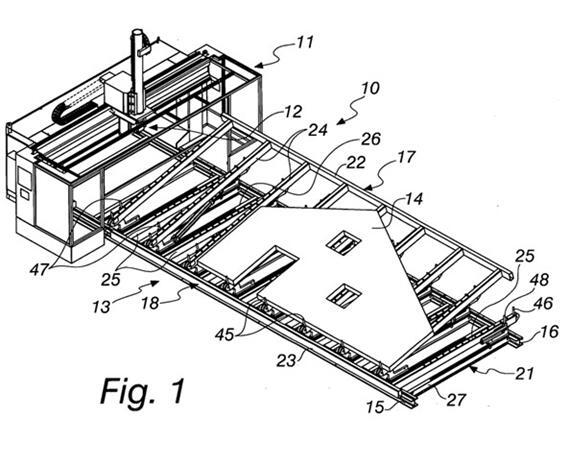 |
This is the overall machine. A wall 14 to be machined is supported on first frame 17 which is tilted up slightly. |
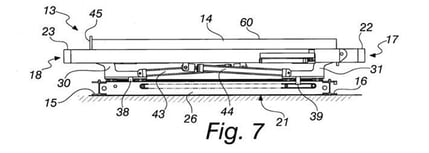 |
Frames 17 and 18 are horizontal and interdigitated. The first surface 60 of wall 14 is ready for machining. |
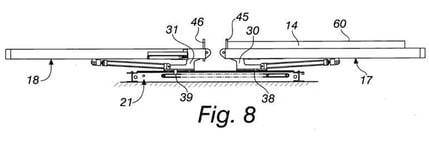 |
Frames 17 and 18 retreat sideways, still horizontal, with the wall 14 supported only on frame 17. |
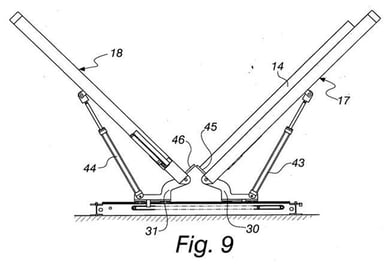 |
Frames 17 and 18 are rotated upwards to start turning the wall 14. |
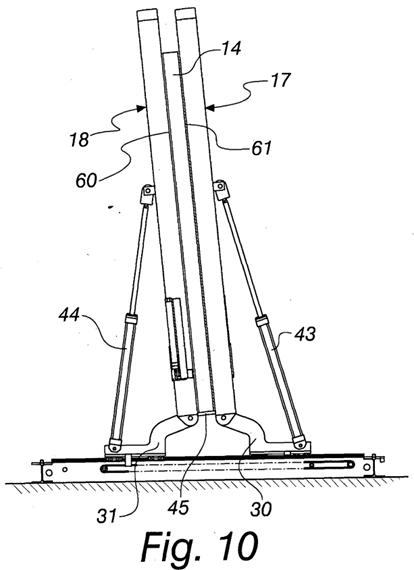 |
Frames 17 and 18 continue rotating, to sandwich the wall 14 between them. |
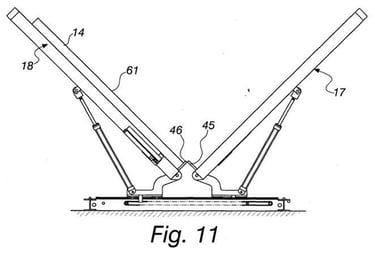 |
Wall 14 is transferred to frame 18 and the frames 17 and 18 are rotated back down to the horizontal so that the second surface 61 of the wall 14 can be machined next. |
What happened at first instance?
The claimant sought revocation of most but not all of the claims of the patent. Dependent claims 2, 7 and 8 were not attacked. As we reported briefly in UPC Weekly 2025 w32, the Central Division Paris decided that amended claim 1 was valid. See X v. Essetre (UPC CD Paris, UPC_CFI_239/2024, 28 July 2025). The amendment to the claim was submitted to address a prior art attack based on this YouTube video, which shows a wall being constructed on a main carriage, then flipped onto a separate lateral carriage. See also this other YouTube video which more simply shows a “butterfly table”.
An eye-catching feature of the relatively brief CD Paris decision was their interpretation of claim 1. In their view, the ordinary meaning of “a working surface” in common language would be “one working surface”, thereby excluding two working surfaces. This was reinforced by the explanations in the description, adopting the “a patent is its own lexicon” principle from CoA case law. This was the interpretation argued for by the patentee.
Addressing objections of added matter, lack of clarity, lack of novelty and obviousness, the CD concluded that the amended main claim was valid.
The outcome of the decision was that claim 1 as amended was upheld and that the wording of all of the original dependent claims was maintained (although the scope of each one changed in view of the amendment to claim 1). A wrinkle with the decision, though, was that the CD reproduced not the main request but the narrower first auxiliary request in the operative part of their decision.
The appeal – back to basics
The Court of Appeal decision in X v. Essetre (UPC_CoA_0000885/2025, 20 November 2026) is significantly longer than the first instance one. Although the outcome is not hugely different to first instance, the reasoning of the CoA is worth looking at.
What does “a working surface” mean?
The CoA over-ruled the CD here. In the view of the CoA, it is clear that claim 1 is not limited to only one working surface, either in view of the plain wording of the claim itself or in the context of the description. Enough said, really, but see paragraphs 35-38 of the decision for the CoA’s three detailed reasons on this point.
Clarity
The appellant argued that amended claim 1 was unclear. The CoA agreed with its own case law that such an attack on an amended claim is permitted, but only to the extent that it is the amendment that has caused a lack of clarity.
The appellant’s argument was that the new feature added to claim 1 could be interpreted in four different ways and was therefore ambiguous. Using an expression familiar from EPO Board of Appeal case law, the CoA said that “with a mind willing to understand”, the skilled person would have no difficulty in understanding the scope of claim 1 as limited by the amendment.
Added matter – no intermediate generalisation
The appellant had raised an objection of added matter to the amended claim, arguing that it represented an intermediate generalisation. The CoA referred to its previous case law on this topic, as reviewed in UPC Weekly 2026 w34, and concluded that there was no added matter caused by the amended in view of the multiple and general references in the description to the features added to the claim.
Novelty and inventive step
With their clear interpretation of claim 1 as allowing one or more working surfaces, the CoA started afresh with an assessment of patentability. Their view was that amended claim 1 was patentable over the prior art (in particular the first video linked above) in view of the structure and operation of the first and second opposite support and movement frames (17, 18) – the parts that can move laterally and rotate in order to flip the wall.
So … which claims survive and in what form?
This is a feature of UPC procedure that EPO practitioners will need to get used to. At the EPO, it would be completely normal (as in this case) for a patentee to submit a full amended claim set in response to an opposition. The outcome of a typical EPO opposition, if amendments are needed, would be that the patent is maintained in amended form with the main claim amended and the dependent claims remaining, but adjusted as needed for conformity with the amendments to the main claim. And so the scope of the dependent claims would change at least with the scope of the main claim.
In this UPC case, granted claims 2, 7 and 8 were not attacked. From the point of view of the UPC, they are not part of the revocation action at all. Therefore they would survive the revocation action in any event.
Although the patentee had submitted their main request with amended claim 1 and then the wording of granted dependent claims 2-10, the CoA allowed them during the oral hearing to withdraw claims 2, 7 and 8 from this request.
The outcome of the whole case is that the attacked claims are limited by the amendments to claim 1, but that claims 2, 7 and 8 remain in force in their as-granted form, meaning that they are only limited by granted (not amended) claim 1. Making the whole thing murkier, though, is that claims 7 and 8 as granted are dependent on “one or more of the preceding claims”. Therefore, actually what has happened is that, in the UPC territory, there are two sets of claims that exist in parallel. The first set consists of amended claims 1, 3, 4, 5, 6, 9, and 10 listed at the end of the CoA decision (in part to address the error in the CD decision). The second set consists of granted claim 2 (dependent on granted claim 1) and granted claims 7 and 8 (dependent on granted claim 1 or any of their preceding granted claims). That sounds complicated, and it is.