Sequencing

& Bioanalytics

Genetic sequencing technology has been revolutionised over the last two decades, firstly with the development of ‘next generation sequencing’ and then with third generation sequencing. The former recombines genomic fragments that are sequenced in parallel and the latter has allowed read-lengths to increase while reducing the size of the sequencing machines.

These technologies have made whole genome or exome sequencing fast and relatively inexpensive (currently in the order of $1000 for a whole human genome). This opens vast opportunities in the field of healthcare and beyond, making personalised medicine therapies possible.

Mewburn Ellis has supported the industry throughout each phase of its development. We have helped our clients to protect modified polymerases with improved accuracy and nanopore based single molecule sequencing methods, to name but two examples.

We also have considerable experience of providing IP protection for core platforms in other bioanalytic techniques, as well as their innovative applications in research, agriculture and medicine. This includes drafting, portfolio building and contentious work for the leading companies in the development of nucleic acid amplification, microarray technologies, and microfluidic "lab-on-a-chip" devices. Many of our experienced patent attorneys have laboratory experience in this area and are supported by talented new recruits with up-to-date practical expertise.

Patent_Landscape_in_Bioinformatics_and_Digital_Health_Special_Report_2021-2-Compressed

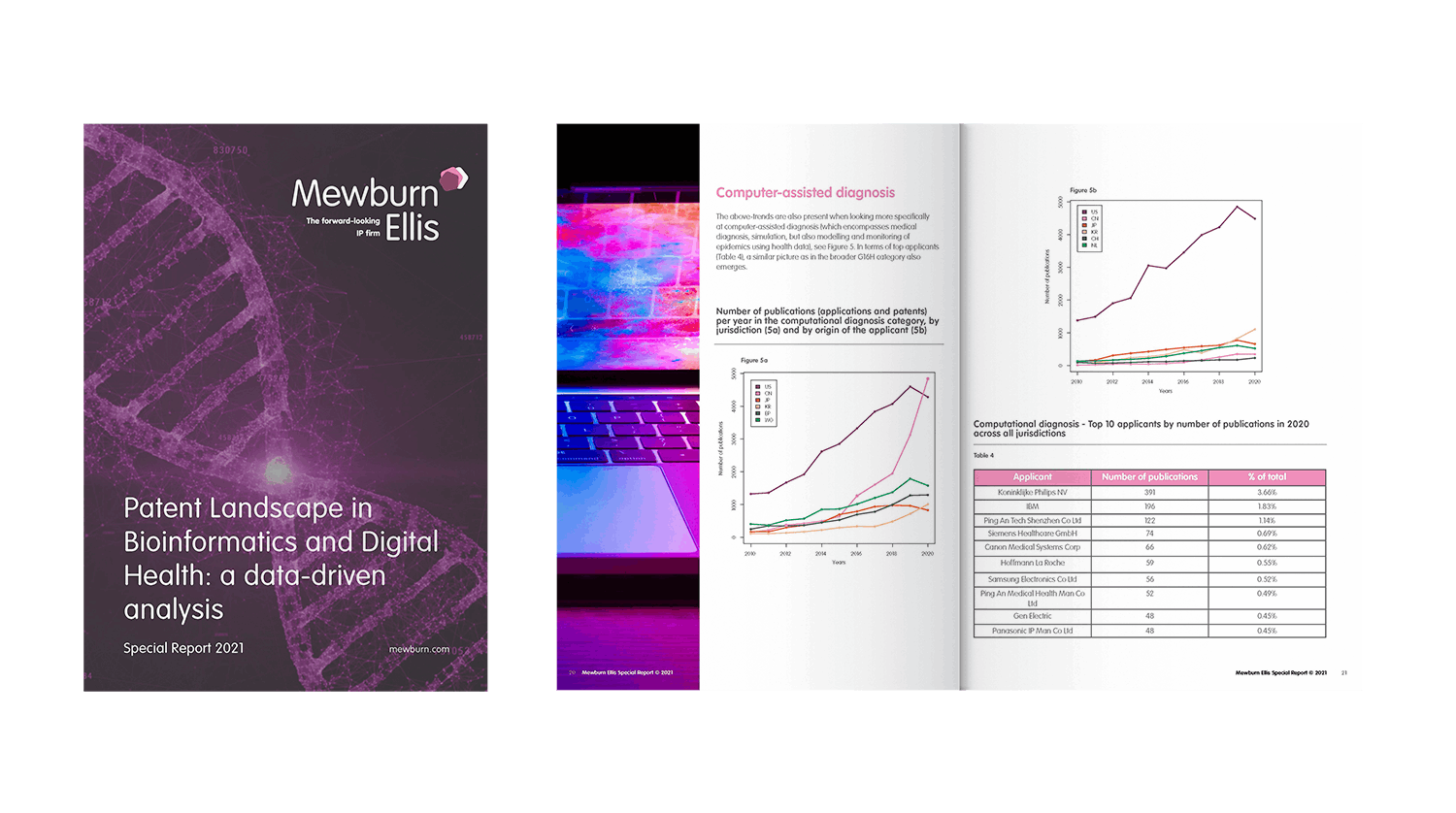
Patent Landscape in Bioinformatics and Digital Health: a data-driven analysis

Special Report

The words "digital health", "data driven" and "AI" have been on everyone's lips and in many headlines in the healthcare and life sciences sectors over the last couple of years. However, navigating this rapidly changing landscape can be challenging for those in charge of managing the IP associated with the innovations underpinning these changes.  

In this Special Report, we set out to collect data on the patent landscape in the fields of bioinformatics and digital health, to see whether the growth we and our clients see in the field is reflected in the data and whether insights can be gained from the data that will assist in designing better, more informed IP strategies.


Read our blogs

Beyond PROTACs and molecular glues: where next for heterobifunctional drug discovery?

Beyond PROTACs and molecular glues: where next for heterobifunctional drug discovery?

by Annabel Cardno

A broader heterobifunctional tool emerges Targeted protein degradation has rapidly progressed from a conceptual curiosity to one of the most closely watched areas in drug discovery. As discussed in ...

Global considerations for innovators in microbial biostimulants and biocontrol agents

Global considerations for innovators in microbial biostimulants and biocontrol agents

by Ben Tolley

Our recent analysis found that global patent activity in microbial biostimulants and biocontrol agents is surging, with strong growth in both patent applications and granted patents. For a detailed ...

EPO decision T 0655/24: inventive step and the unpredictability of antibody mutations

EPO decision T 0655/24: inventive step and the unpredictability of antibody mutations

by Chris Denison

This is the final post in a series on decision T 0655/24 and its implications for antibody practice at the EPO. In the first post, Chris discussed the Board’s strict approach to post-filing evidence ...

EU NGT Regulation Approved: A Step Towards Innovation

EU NGT Regulation Approved: A Step Towards Innovation

by Louise Atkins

The EU’s long‑awaited regulation on New Genomic Techniques (NGTs) has now cleared its final legislative hurdle, with the European Parliament voting to approve the agreed framework, rejecting ...

Molecular Glue Degraders (MGDs): what they are, how they work and key IP Issues

Molecular Glue Degraders (MGDs): what they are, how they work and key IP Issues

by Tim Nash

Molecular glue degraders (MGDs) are small molecules that induce or stabilise protein–protein interactions, often by recruiting an E3 ligase to a target protein and triggering its ubiquitination and ...

Ageing as a disease: Groundbreaking or Ground-Shaking?

Ageing as a disease: Groundbreaking or Ground-Shaking?

by Emily Garnett

As a species, humans have long been preoccupied with living longer and healthier lives. However, prior to the advent of modern medicine, any real prospect of fulfilling these ambitions existed more ...

ME Forward Masthead White 2