Standard Essential Patents

(SEPs)

Interoperability of communication devices requires that all communication partners use the same standard for communicating. These standards are devised by standard setting bodies, like ETSI (the European Telecommunications Standards Institute), that define the technology and agree on the specifics of such a standard. Companies involved regularly protect their contribution to the standard by applying for patent protection, eventually obtaining a patent covering a certain aspect of the standardised technology, a so-called Standard Essential Patent (SEP).

These patents are essential to the extent that an implementer cannot provide the functionality that the standard promises without infringing the SEP. Since every market player that wants to implement the standard has to license the patent, the concept of FRAND patent licensing for SEPs has developed. FRAND is the acronym for Fair, Reasonable And Non-Discriminatory, which aims to set a level playing field within which every party seeking a license can be granted one. However, since there is no legally binding definition for FRAND, there are diverging view of what actually is FRAND and it has become a ripe field for litigation.

Whatever your field of technology it is essential to understand the world of standard essential patents and their impact on your business. At Mewburn Ellis we have extensive experience in SEPs and IP and have advised both SEP owners and manufacturers (SEP licensees) so are we are well placed to assist you.  Flexible in the way we work, we listen and adapt to your commercial objectives so that we can be an effective and efficient partner for you. We will deliver a practical solution for whatever opportunity or challenge you face, building bespoke teams designed to meet your specific needs.

Eng Opp Report 1-1-compressed

Special Report

EPO Opposition Trends in Engineering, Electronics and Software

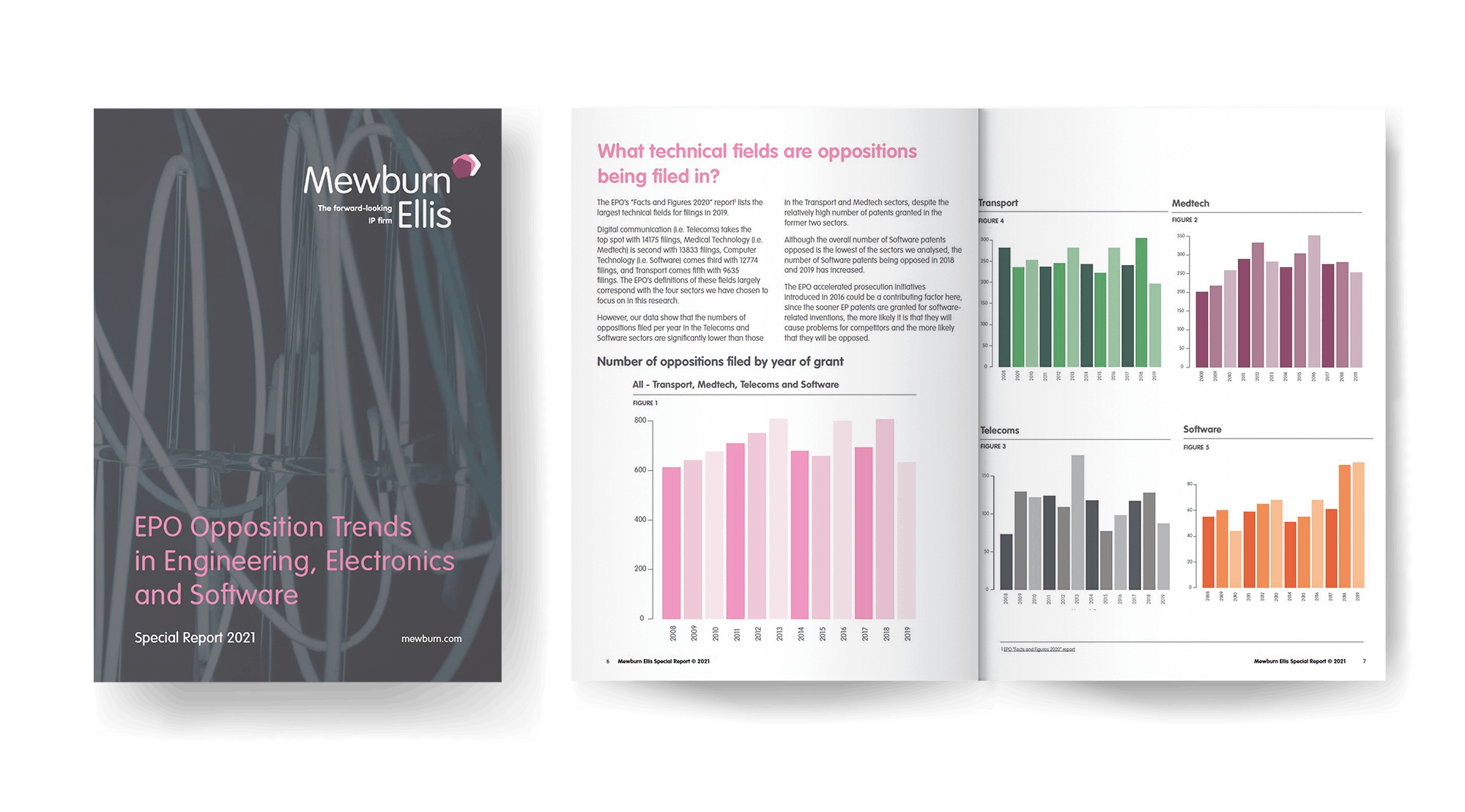
In autumn 2020, we analysed more than 8000 opposition cases filed at the European Patent Office (EPO) over the last 12 years, studying the timelines for hundreds of engineering, electronics and software oppositions.

The research enabled us to see how oppositions have been affected by procedural changes at the European Patent Office and by the Covid-19 pandemic. With a focus on Transport, Medical Devices, Telecommunications and Software, the report also looks at how opposition outcomes vary across the four different technology sectors and which players are the most active.

Download the Report

Read our Blogs

UPC Weekly - Claim interpretation points to direct infringement, leading to all the remedies

UPC Weekly - Claim interpretation points to direct infringement, leading to all the remedies

by Matthew Naylor

2026 Week 7 The supply of consumables for printers and copiers has a lot of baggage in the field of IP, competition law and the space in between. Original equipment manufacturers (OEMs) have a lot to ...

UPC Weekly - Coming around again - UPC revisits confidentiality clubs and long arm jurisdiction

UPC Weekly - Coming around again - UPC revisits confidentiality clubs and long arm jurisdiction

by Matthew Naylor

2026 Week 6 We’re catching up some recent strands at the UPC this week. We have the Court of Appeal giving its view on confidentiality clubs and the Mannheim Local Division proffering an apparent ...

The major players in the SEP landscape in Europe

The major players in the SEP landscape in Europe

by Tom Furnival

Next in our series of blogs, we have investigated the major players in the SEP landscape in Europe.

How does declaring a patent or application as “essential to a standard” affect the pre-grant experience of an application? – Part 3

How does declaring a patent or application as “essential to a standard” affect the pre-grant experience of an application? – Part 3

by Tom Furnival

This article continues our series of blogs investigating whether or not declaring your patent or application as “essential to a standard” influences the outcome of that patent or application in ...

How does declaring a patent or application as “essential to a standard” affect the pre-grant experience of an application? – Part 2

How does declaring a patent or application as “essential to a standard” affect the pre-grant experience of an application? – Part 2

by Tom Furnival

This article is the latest in a series of blogs exploring whether declaring your patent or application as “essential to a standard” influences the outcome of that patent or application in Europe.

How does declaring a patent or application as “essential to a standard” affect the pre-grant experience of an application?

How does declaring a patent or application as “essential to a standard” affect the pre-grant experience of an application?

by Tom Furnival

This article is the latest in a series of blogs exploring whether declaring your patent or application as “essential to a standard” influences the outcome of that patent or application in Europe.

Learn More
Forward Magazines Overlapping 8

Mewburn Ellis

FORWARD MAGAZINE

Mewburn Ellis Forward is a biannual publication that celebrates the best of innovation and exploration. Through its pages we hope to inform and entertain, but also to encourage discussion about the most compelling developments taking place in the scientific and entrepreneurial world. Along the way, we’ll engage with the IP challenges that international organisations face every day.